 Society

Three international exhibitions open in Hà Nội
1.
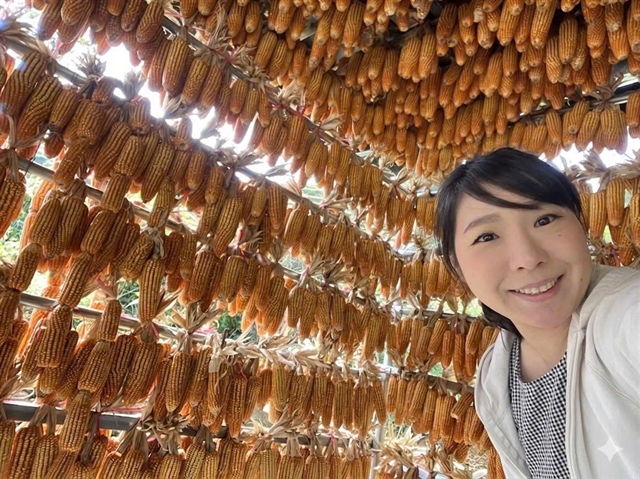 |
| Nakane Saki poses by dried maize in Mù Cang Chải in the former province of Yên Bái, now part of Lào Cai Province. VNS Photos courtesy of Nakane Saki |
Nguyễn Khánh Chi
HÀ NỘI — What began as a flicker of curiosity has grown into a lifelong bond, as a young Japanese woman has woven her love for Việt Nam into every aspect of her world, from her career to the way she raises her Vietnamese-Japanese children, honouring both their dual heritage and their Vietnamese home.
Born and raised in Japan, a country offering every comfort imaginable, Nakane Saki chose a different path by settling in Việt Nam, a rapidly developing lower-middle-income nation.
Her 17-year journey began with a humble curiosity: a love for the Vietnamese language and a desire to explore the country she first discovered during her secondary school years.
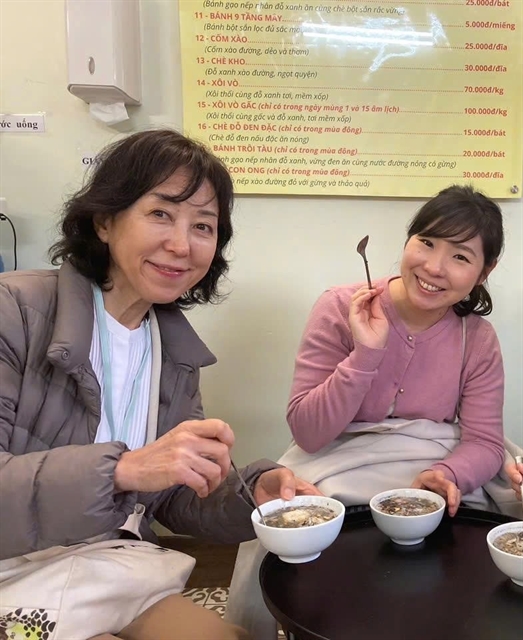 |
| Nakane (pink T-shirt) and a Japanese colleague taste Vietnamese sticky rice ball in ginger-flavoured sweet soup. |
Nakane is a Japanese staff member currently working at the Japan International Cooperation Agency (JICA) Vietnam Office, specialising in general affairs related to expert dispatch management. What surprises many of her colleagues and partners is her fluent and natural Vietnamese, which leaves virtually no linguistic gap between her and native speakers.
Her bond with Việt Nam began during her university years through a short-term Asia Training Programme. From a list of Asian countries, she chose Việt Nam. However, those three weeks were not enough to satisfy her growing curiosity.
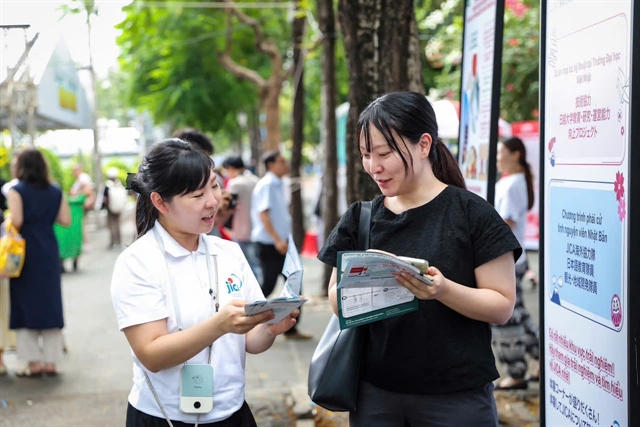 |
| Nakane (left) attends a Việt Nam - Japan festival in Hồ Chí Minh City. |
Driven by a desire to truly experience the country, she decided to defer her university studies for one year and return to Việt Nam to study the language at the Faculty of Vietnamese Studies, University of Social Sciences and Humanities under the Vietnam National University, Hà Nội.
She returned to Việt Nam around 2008 with only a handful of basic phrases like Xin chào (Hello), Tạm biệt (Goodbye) and Hẹn gặp lại (See you again), but she was filled with immense determination.
“I arrived just as everyone was busy preparing for Tết, the Vietnamese Lunar New Year. The streets were filled with people carrying peach blossoms and kumquat trees, the traditional decorations for the holiday. The festive rush made the traffic even more congested, and the dust and pollution were quite noticeable,” Nakane recalled.
“However, none of this left a negative impression on me. On the contrary, it allowed me to feel the vibrant energy and the undeniable strength of a developing country.”
One year quickly passed. Armed with a solid command of the Vietnamese language and a growing fondness for a Vietnamese companion, she returned to Japan to resume her studies in Policy Studies. After completing her university studies in Japan, she sought work with companies doing business in Việt Nam.
She quickly discovered, however, that securing an overseas assignment typically required years of seniority. For her, even a few months felt too long. She returned to Việt Nam to seek out opportunities locally.
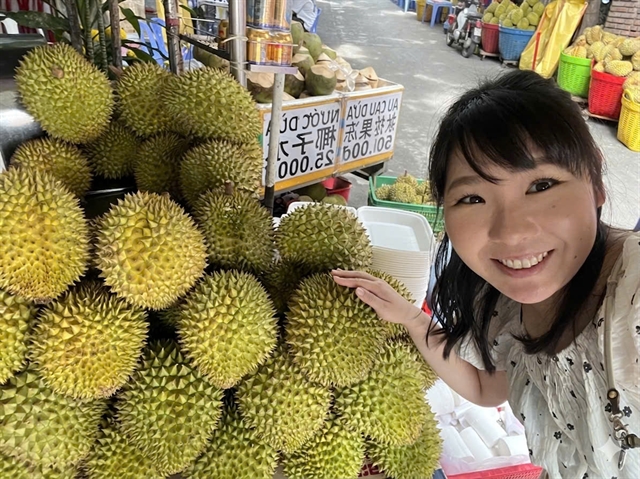 |
| Nakane poses by a street shop selling durian, one of her favourite fruits. |
Learn by heart and from experiences
While many speak highly of Nakane’s decision to live and work abroad, she believes the person she has become is shaped by three things beyond her family: the presence of her mother, the Vietnamese people who supported her and the country that welcomed her with open arms.
"Looking back at the early days, I admit that life wasn't always smooth. I faced many challenges: language barriers, cultural differences and unfamiliar habits. There were times I felt bewildered and even deeply frustrated,” said Nakane.
“However, whenever I struggled, I was always met with support from the local people. It was through being uplifted by them that I matured, gaining a deeper understanding of Việt Nam’s unique charm and the genuine warmth of its people.”
In her view the Vietnamese people possess an open spirit, free from discrimination and a readiness to embrace individuals as they are. This quality originates from Việt Nam's background as a multi-ethnic nation where 54 ethnic groups live together in harmony.
“I have learned from them that being different is entirely natural; one does not need to conform to social pressures or misrepresent oneself. Consequently, I have felt encouraged to live more authentically," she said.
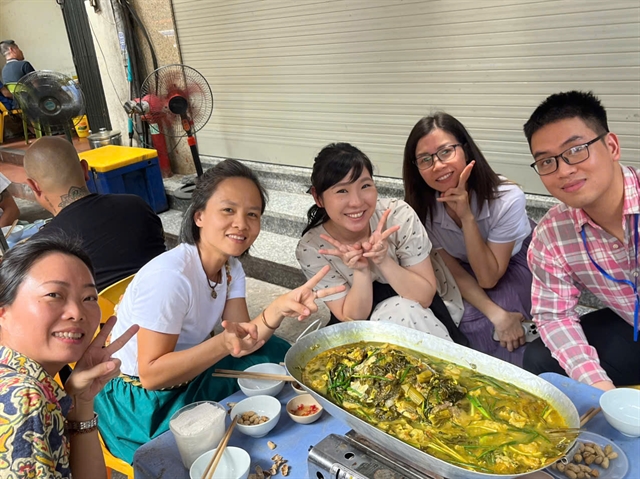 |
| Nakane (middle) enjoys Vietnamese braised fish with pickled mustard greens during lunch time with her Vietnamese colleagues. |
From life to work, she carries that spirit, valuing perspectives, embracing differences and seeking to understand others fully. She said this was also what she learnt from her role in Japan–Việt Nam cooperation, which she believes rests on a foundation of trust.
“Everything is built on a foundation of trust. I constantly strive to be a reliable person and to ensure that the work I do is worthy of the trust placed in me,” said the mother of three.
Asked about the role of JICA, her current employer, Nakane said: “While the bridges, airports and railways built through JICA projects are vital to Việt Nam’s economic growth, they are only part of the story.
“Beyond the concrete and steel are invisible threads of trust, care and deep understanding. To me, these intangible connections are JICA’s real legacy. Our role is to ensure that the relationship between Japan and Việt Nam continues to flourish on a foundation of genuine mutual respect."
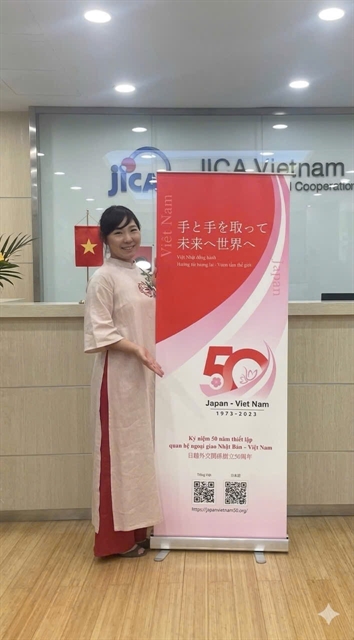 |
| Nakane Saki poses for a photo at the JICA Vietnam office in Hà Nội on the occasion of the 50th anniversary of Việt Nam - Japan bilateral relationship. |
Dual heritage
Looking back on the past 17 years, Nakane feels deeply grateful for the journey and hopes to find a way to give back to Việt Nam in the future.
“Right now, I may not have the time to plan exactly how I will do that, but as a mother, my priority is my children. I want them to always embrace their dual heritage, to be both Vietnamese and Japanese in their hearts, regardless of nationality laws,” she said.
People often ask why she and her husband do not return to Japan, given its excellent environment and education system.
“My decision to stay here is rooted in two things. First, I want my children to be immersed in the local culture, to learn from the virtues of the Vietnamese people and to see the beauty of this country first hand,” said Nakane.
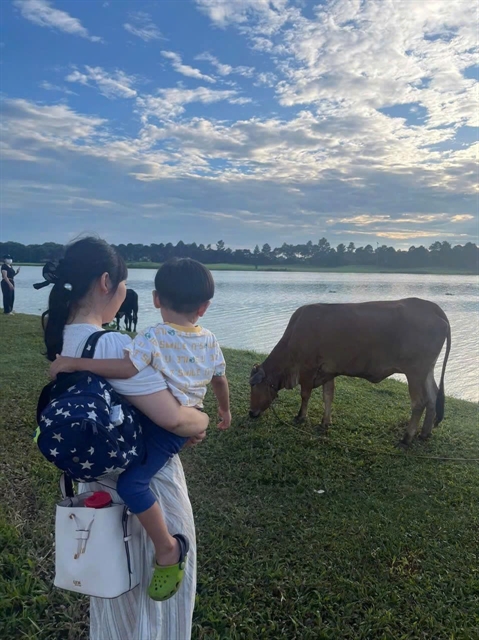 |
| Nakane Saki takes her youngest child out to experience nature in Đông Anh, Hà Nội. |
During holidays, Nakane and her husband travel with their children to different parts of Việt Nam. The children, already fluent in Vietnamese, Japanese and English, are growing up with a deep appreciation for their home, balanced by one or two trips back to Japan each year.
“The strengths of Japan, its developed economy and modern, clean society are easy to see. But the beauty of Việt Nam is subtle; it is something you can only truly understand by living here and experiencing the soul of the people,” she said.
“Furthermore, leaving my mother’s bakery back in Japan was incredibly difficult for me. That shop was more than a business; it was a place where she poured all her heart and passion."
The mother’s legacy
When speaking about her journey and connection with Việt Nam, Nakane emphasised the pivotal role her mother played.
Deciding to study abroad was a monumental step, bringing both determination and anxiety, as her elder sister had already settled in Australia and it was just her and her mother at home.
However, she received her mother’s full support and encouragement.
“She told me, 'I always think about your future and your happiness. You should have your own unique strengths to carry you forward',” said Nakane.
“My mother continued to encourage me even when I announced I was going to marry a Vietnamese man. My grandparents were worried, fearing that Việt Nam was just a developing country still struggling with the aftermath of war and Agent Orange.
“Later, I shared many stories about the country with my mother. Through that exposure, she became captivated by the charm of Việt Nam and eventually chose to move here to live as well."
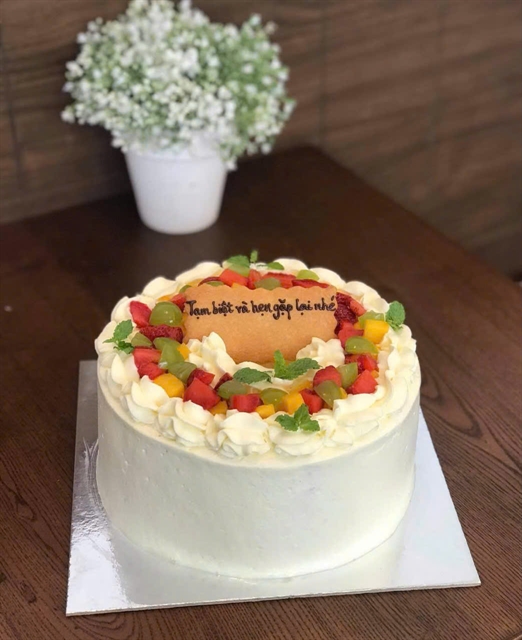 |
| Jamứt cakes gained a reputation not only within the Japanese community but also among Vietnamese locals. |
In Việt Nam, her mother continued the tradition of making fresh handmade cakes, free of additives and borax, sharing her baking with those around her. Gradually, her cakes gained a reputation not only within the Japanese community but also among Vietnamese locals.
Nakane’s mother also developed a fondness for Vietnamese fruits such as dragon fruit, pineapple, passion fruit and mango. She wanted people in Japan to experience these flavours, but due to strict quarantine regulations preventing her from bringing fresh fruit home, she began turning them into jams. By bottling the fruit in this way, she was able to bring a taste of Việt Nam across the border.
“This inspired my mother to open her own cake shop called Jamứt, a combination of jam and its Vietnamese synonym mứt in Hà Nội. Heartbreakingly, just as the business had become stable and was running smoothly, she fell ill and passed away,” Nakane said.
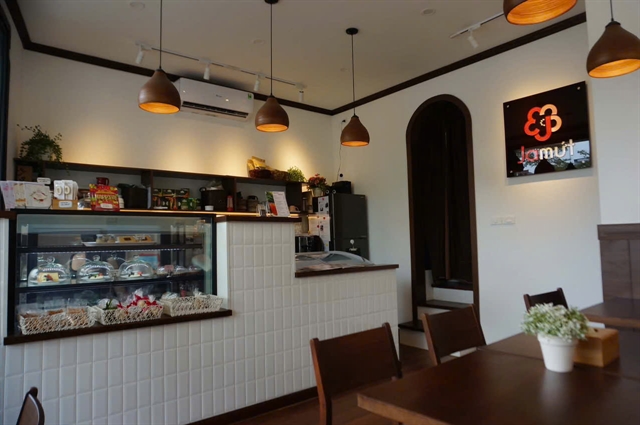 |
| An inside view of the cake shop Jamứt opened by Nakane's mother in Hà Nội. |
Before her death, her mother’s final wish was for her daughter to continue the craft of baking in Việt Nam. Despite the demands of her career and raising three growing children, Nakane and her husband have remained committed to preserving the cake shop as a way to honour her mother’s memory and fulfil her legacy.
Petite in stature but full of positive energy, Nakane embodies a modern Japanese woman, balancing career, family and personal passion in a multicultural environment. VNS
Society
 Society
 Society
 Society
 Society
 Society
 Society
 Society
 Society
 Society
 Society
 Society
 Society
 Society
 Society