 Society
Việt Nam-Cambodia trade gathers pace towards $20 billion target
1.
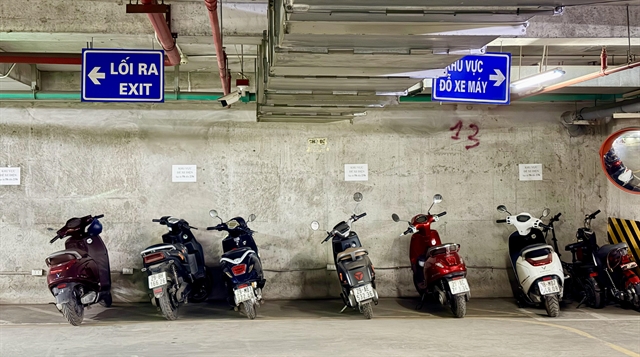 |
| An electric motorbike parking area in the basement of an apartment complex on Tam Trinh Street, Hoàng Mai Ward, Hà Nội. — VNS Photo Nguyễn Hằng |
Nguyễn Hằng
HÀ NỘI — Living within Ring Road 3 but commuting daily into Ring Road 1, Nguyễn Thị Thu Trang, is considering switching from a petrol-powered motorbike to an electric one ahead of the city’s planned restrictions on petrol vehicles in the inner ring from July 1.
Trang is a resident of an apartment block at No 987, on Tam Trinh Street in Hoàng Mai Ward, Hà Nội.
Yet she still remains uneasy.
The apartment complex where she lives, opened in 2018, has stopped accepting additional electric motorbikes for parking and charging since early this year.
Management is concerned that the building’s electrical infrastructure may be inadequate, raising fire risks if multiple vehicles are charging simultaneously.
As a result, residents wanting to switch to electric motorbikes must find charging options elsewhere.
The situation has left residents in a dilemma, while encouraged to adopt environmentally friendly transport by the city, they are effectively turned away by their own buildings due to incompatible infrastructure.
At present, Trang’s complex has around 30 electric bicycles and motorbikes that were registered and allowed to charge prior to the announcement of the petrol motorbike restrictions within Ring Road 1.
A representative of the building management said that, in response to the city’s roadmap, proposals are being prepared for the installation of electric vehicle charging infrastructure.
These will be submitted to the residents’ management board for approval, including plans on technical specifications and associated costs, before any final decision is made.
“Installing charging stations is not the difficult part, the key lies in ensuring fire safety and optimising infrastructure costs,” the representative said.
Residents hoping to switch to electric vehicles may have to wait about two months for charging facilities to be put in place.
In reality, difficulties surrounding the installation and synchronisation of charging infrastructures are not unique to Trang’s building but are common across many apartment complexes in the city.
Roadmap for petrol vehicle restrictions
Under Hà Nội’s newly announced low-emission zone scheme, the rollout of the low-emission zone and petrol vehicle restrictions in Ring Road 1 will be implemented in three phases.
Under the first phase, from July 1 to December 31, 2026, a pilot will be launched in a core area of Hoàn Kiếm Ward, covering 11 surrounding streets including Tràng Tiền, Hàng Khay, Lê Thái Tổ, Hàng Đào, Hàng Ngang, Hàng Buồm, Mã Mây, Hàng Bạc, Hàng Mắm, Nguyễn Hữu Huân and Lý Thái Tổ.
From July 1, all app-based motorbike services using fossil fuels (petrol or diesel) will be banned in this zone. Privately owned motorcycles not used for ride-hailing platforms will be prohibited from operating during peak evening hours on Fridays (6pm-midnight) and throughout weekends (6am-midnight).
The core zone spans 0.5sq.km, with a perimeter of 3.5km and a population of around 20,000.
For petrol-powered cars, trucks under two tonnes that meet Euro 4 emission standards may operate only outside peak hours (peak hours consist of 6am-9am and 4pm–7.30pm daily). Trucks from two to under 3.5 tonnes meeting the same standard may operate only between 9pm and 6am the following day and must obtain written approval from Hà Nội Police Department. Trucks above 3.5 tonnes will be banned entirely.
Vehicles with 16 seats or more (excluding buses and school transport) operating in the Old Quarter and around Hoàn Kiếm Lake, defined as the buffer zone, covering Hoàn Kiếm and Cửa Nam wards, must meet Euro 4 standards and will be banned during peak hours. Smaller petrol cars must also comply with the same emissions standard.
Under the second phase, between January 1 and December 31, 2027, the pilot area will expand to cover Hoàn Kiếm and Cửa Nam wards, spanning 3.6sq.km with a population of approximately 136,950.
The zone will include 14 surrounding streets such as Nguyễn Du, Hàn Thuyên, Trần Hưng Đạo, Trần Khánh Dư, Trần Quang Khải, Trần Nhật Duật, Hàng Đậu, Cửa Đông, Lý Nam Đế, Tôn Thất Thiệp, Điện Biên Phủ, Hàng Bông, Cửa Nam and Lê Duẩn.
Under the third phase, from January, 2028 – December 31, 2029, the low-emission zone will be extended across the entirety of Ring Road 1, covering 26.07sq.km with a population of around 625,000.
The area encompasses nine wards bounded by major roads including Hoàng Cầu, Đê La Thành, Ô Chợ Dừa, Xã Đàn, Đại Cồ Việt, Trần Khát Chân, Nguyễn Khoái, Trần Khánh Dư, Trần Quang Khải, Trần Nhật Duật, Yên Phụ, Nghi Tàm, Âu Cơ, An Dương Vương, Lạc Long Quân, Bưởi and Cầu Giấy.
.jpg) |
| An user swaps the battery for her electric motorbike at an automated battery swapping station in a western urban area of Hà Nội. — VNA/VNS Photo Quỳnh Anh |
Electric vehicle demand surges
With the restrictions on petrol motorbikes approaching, demand for electric vehicles is expected to rise.
Speaking at a Ministry of Industry and Trade press briefing for the first quarter of 2026 on April 9, Nguyễn Thế Hữu, deputy head of the Electricity Authority, said the shift towards electric vehicles is “inevitable”.
Recent geopolitical instability in the Middle East, affecting fuel supply and driving up oil prices, has further incentivised consumers to switch to electric transport, he added.
According to the Việt Nam Association of Motorcycle Manufacturers, by the end of 2025 the country had around 215,000 electric cars and nearly 2.6 million electric motorbikes.
Electricity demand for these vehicles is estimated at 652 million kWh, accounting for just 0.2 per cent of total commercial electricity consumption.
By 2030, the number of electric cars is projected to reach between 1 and 1.6 million, while electric motorbikes could total 8-13 million.
Electricity demand would then rise to between 3.1 and 5.6 billion kWh annually, or roughly 0.68-1.1 per cent of total demand.
While the overall figures remain modest, the challenge lies not in total consumption but in peak load.
Hữu said that if 100,000 electric cars were to fast-charge simultaneously at 60-120kW, the instantaneous load would reach 6,000-12,000MW, equivalent to one-eighth to one-quarter of the current peak capacity, placing significant strain on the grid.
As such, alongside policies encouraging electric vehicle adoption, Việt Nam’s power system faces longer-term challenges in developing medium- and low-voltage grids in tandem with charging infrastructure, particularly in densely populated areas and at public charging stations.
To address this, the ministry plans to review and update power development plans, introduce pricing mechanisms to encourage off-peak charging, and develop smart charging systems to ease peak load pressures.
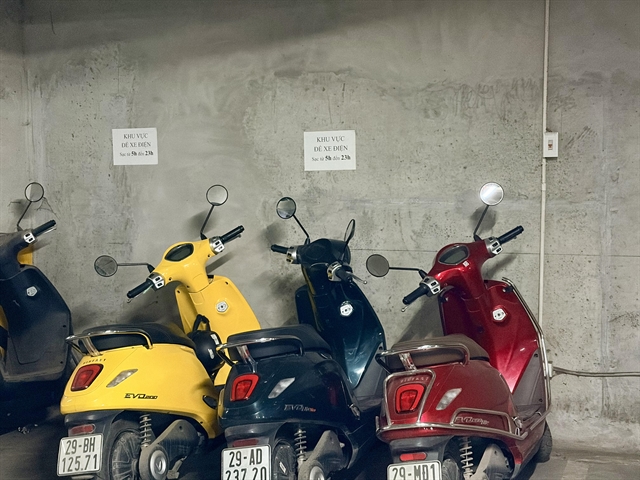 |
| Electric vehicles in the basement of an apartment building on Tam Trinh Street. Electric vehicles can only be charged from 5am to 11pm daily. — VNS Photo Nguyễn Hằng |
Infrastructure lagging behind demand
In Hà Nội, only a small number of apartment buildings have invested in integrated electric vehicle charging infrastructure and designated parking areas.
Most complexes are adopting temporary measures, such as limiting charging hours or allocating separate zones for electric vehicles.
At the basement car park of a building in the Gelexia Riverside urban area on the alley of No. 885, Tam Trinh Street, operators have designated a specific area for electric vehicles.
Nguyễn Thu Hường, a resident living in the building, said residents are allowed to charge vehicles between 5am and 11pm but not overnight.
“Security staff disconnect chargers once batteries are full to reduce risks,” Hường said.
Similarly, at the Thanh Hà urban area, electric vehicle parking zones are separated from other vehicles and located near 24/7 security posts, equipped with surveillance cameras and automatic circuit breakers.
Nguyễn Văn Dương, deputy head of the management board for HH02 ABC building, said the three buildings under his supervision currently host more than 100 electric vehicles but expressed concern over the expected rapid increase.
“We hope authorities will consider establishing above-ground parking areas with roofing to ensure safety,” he said.
Proposed solutions
A Government’s official dispatch No. 27 was announced recently to accelerate the development of electric vehicle charging infrastructure in apartment buildings.
Under the dispatch, an urgent priority is to establish regulatory frameworks, technical standards and planning guidelines for parking, charging and battery-swapping infrastructure to support rapid deployment in line with the roadmap.
Talking about the issue, Hoàng Thu Hằng, deputy head of the Housing and Real Estate Market Management Agency under the Ministry of Construction, said current housing laws and national technical standards for apartment buildings include provisions on management, operation and safety.
However, they do not fully account for the specific technical characteristics of electric vehicles and charging systems.
Electric vehicles have distinct requirements in terms of power supply, charging equipment and safety standards compared with internal combustion engine vehicles, making it necessary to introduce additional regulations.
She emphasised that drafting such regulations requires careful study, given their wide-ranging impact, particularly on building management and fire safety requirements.
The ministry had held consultations with ministries, businesses and experts to gather input on proposed amendments to national standards for apartment buildings.
A draft has been completed and submitted to the Ministry of Science and Technology for appraisal.
The proposed standards focus on requirements for charging areas, electric vehicle parking zones and battery-swapping facilities, including spatial planning, equipment limits, and technical specifications for electrical, lighting and fire safety systems.
As electric vehicles become increasingly widespread, standardising charging infrastructure in residential buildings is seen as an urgent necessity, not only to meet residents’ needs but also to ensure safety, improve management efficiency and accelerate the transition to greener urban transport.
Call for swift action
Hường, said she hopes charging infrastructure and regulations will soon be improved to provide safer and more convenient conditions for daily electric vehicle use.
In the meantime, Trang who’s building previously stopped accepting electric motorbikes since earlier this year 2026, said parking facilities are a basic right of all residents.
“I hope that following the dispatch, ministries, sectors and local authorities will act quickly and require developers to implement solutions so that all complexes' residents have access to safe and convenient parking, charging and battery-swapping facilities when switching from petrol to electric vehicles,” she said.
She added that the need goes beyond simply having charging points.
"It requires a well-planned system with clear technical, electrical safety and fire prevention standards, both to reassure residents and to support the broader transition to green transport," she said. — VNS
Society
 Society
 Society
 Society
 Society
 Society
 Society
 Society
 Society
 Society
 Society
 Society
 Society
 Society
 Society