 Society

Việt Nam tourism gains appeal from safety, diverse experiences
1.
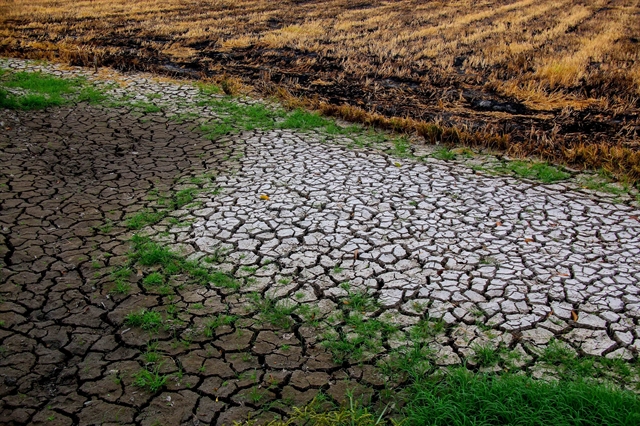 |
| A field in Cần Thơ’s Vị Thủy Commune that cracked due to dry weather. — VNA/VNS Photo |
MEKONG DELTA — Authorities and farmers across the Cửu Long (Mekong) Delta are stepping up response measures and adjusting production as salinity intrusion intensifies at the peak of the dry season.
The National Centre for Hydro-Meteorological Forecasting said salinity up rivers in the 2025–26 dry season is expected to be broadly similar to last year, and higher than the long-term average, meaning the threat of freshwater shortages remains.
The delta, the country’s largest producer of rice, fruit and seafood, has moved early to implement adaptation measures.
Provinces across the region, and Cần Thơ City, have accelerated canal dredging to improve freshwater storage capacity. Public awareness campaigns are also being strengthened to promote efficient water use and protect water sources.
For household water supply, several practical measures have been rolled out.
In Đồng Tháp Province, Tiền Giang Water Supply One Member Company Limited is operating 16 backup wells and installing public water stations in coastal areas not yet connected to pipelines to ensure essential needs are met.
Cần Thơ City has set up 37 free water supply sites equipped with large storage tanks and automatic pumping systems near residential areas to improve access.
In Cà Mau Province, the agricultural sector has also drafted plans to manage water resources throughout the 2025–26 dry season.
Localities are also adjusting planting schedules and restructuring crops in line with water availability.
In Cần Thơ, many farmers have delayed or not yet begun sowing the summer–autumn rice crop after harvesting the 2025–26 winter–spring crop, citing concerns over prolonged heat and water shortages.
Lương Hữu Phước, a farmer in Vĩnh Thuận Đông Commune, said: “The sowing schedule for the summer–autumn crop is now more than 10 days behind previous years. However, my family is leaving the field idle as we are not confident about sowing due to rising input costs and prolonged dry conditions.”
The Cần Thơ Department of Agriculture and Environment said the winter–spring crop performed well, but water shortages are now threatening the next crop. Farmers have been advised to adjust production structures, with water-scarce areas encouraged to shift to short-term, low-water crops or temporarily suspend production.
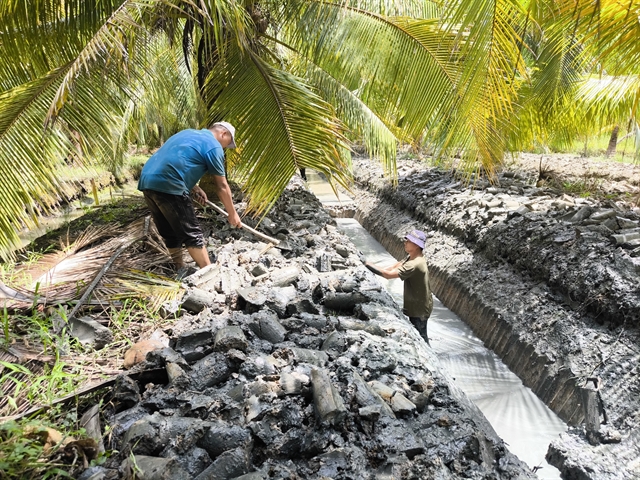 |
| Farmers in Vĩnh Long Province use mud to cover the roots of coconut trees to retain moisture and cope with dryness and salinity. — VNA/VNS Photo |
In Vĩnh Long Province, farmers are combining traditional practices with modern techniques to protect crops from drought and salinity pressure.
Farmers in the country’s largest coconut-producing locality are using mud to cover tree roots to retain soil moisture and reduce damage.
Durian farmers are also shifting towards off-season harvests to avoid peak salinity periods, while water-saving irrigation and freshwater storage measures are being more widely adopted.
The southern region has entered the peak dry season since March, with rising temperatures and declining upstream flows from the Mekong River. As a result, water levels in irrigation canals have dropped sharply, making irrigation increasingly difficult.
Forecasts indicate that this year’s heatwave has arrived earlier and is intensifying across the delta. Under these conditions, many rice-growing areas dependent on natural water sources face a heightened risk of shortages.
The Plant Cultivation and Protection Department under the Ministry of Agriculture and Environment has called on localities to review water availability, particularly in areas without proactive irrigation systems, to determine whether cultivation should be reduced or suspended.
It added that the autumn–winter rice crop, considered the most vulnerable of the year, should only proceed where all cultivation requirements could be met.
Areas at risk of water shortages, especially coastal zones affected by salinity intrusion, are not permitted to expand planting, and provinces have also been urged to avoid unplanned expansion of fruit cultivation, particularly durian and jackfruit. — VNS
Society
 Society
 Society
 Society
 Society
 Society
 Society
 Society
 Society
 Society
 Society
 Society
 Society
 Society
 Society