 Economy



European higher education week opens new opportunities
1.
|
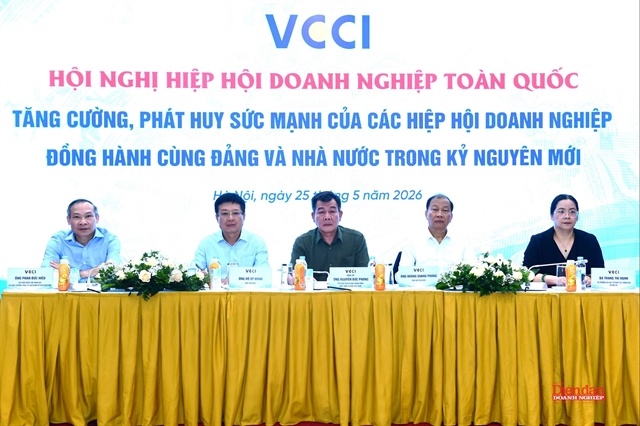
| A national conference for business associations was organised by the Vietnam Chamber of Commerce and Industry (VCCI) on Monday in Hà Nội. Photo diendandoanhnghiep.vn |
HÀ NỘI — Business associations are being urged to move beyond their traditional roles of networking and organising conferences and instead provide more substantive support to enterprises, from voicing concerns and strengthening supply chains to improving competitiveness and policy engagement.
The issue was highlighted at a national conference for business associations organised by the Vietnam Chamber of Commerce and Industry (VCCI) on May 25 in Hà Nội.
Speaking at the event, Vice President of the Vietnam Fatherland Front Central Committee Nguyễn Đức Phong said that during the 2024–2026 period, VCCI and business associations had contributed comments to thousands of legal and regulatory documents related to administrative procedures and the business environment.
Their consultation and policy feedback activities, he said, had helped improve institutions, streamline administrative processes and create a more favorable business climate, particularly in taxation, customs, and investment.
According to Phong, Resolution 68-NQ/TW on private sector development is opening new opportunities for the business community and associations to play a greater role in the country’s economic growth.
However, he stressed that associations must also undergo significant transformation in both mindset and operational capacity in order to effectively represent and advocate for businesses.
“Business associations should not merely serve as membership organisations, they must become effective bridges between enterprises and State management agencies,” he said.
Sharing a similar view, VCCI chairman Hồ Sỹ Hùng emphasised that, amid intensifying competition and deeper international integration, business associations must become more proactive in joining to progress of institutional and investment climate reform, and fostering business linkages.
According to Hùng, associations should not limit themselves to protecting members’ interests. Instead, they must also help businesses enhance competitiveness, expand markets, and contribute to policymaking. In particular, policy advocacy should become one of the core capabilities of business associations in the coming period.
Việt Nam currently has more than 700 business and entrepreneur associations operating at the provincial level and above, with all localities having at least one provincial business association. However, VCCI acknowledged that the quality and effectiveness of these organisations remain uneven.
Hoàng Văn Anh said recent surveys showed that the main reason companies join associations is practical business demand, accounting for 40.9 per cent of respondents.
This is followed by the reputation of the association at 28 per cent, and the need to connect value chains and industry networks at 18.7 per cent.
The findings indicate that businesses increasingly expect associations to provide tangible support rather than merely symbolic activities.
More proactive policy proposals
At the conference, delegates proposed several notable measures to reform the operational model of business associations.
Nguyễn Thị Nga, BRG chairwoman and acting chairwoman of the Vietnam Association of Private Entrepreneurs, said existing associations still lack strong enough coordination to create collective strength for the business community.
She suggested that Việt Nam should study a development model like Keidanren model of Japan’s business federation, to establish a stronger collective voice capable of shaping policy and supporting long-term business development.
Nga also proposed establishing a centre for new economic thinking to enable associations to participate more deeply in policy research, economic forecasting, digital transformation, artificial intelligence, and ESG development, rather than only responding after policies are issued.
Another proposal that attracted attention was the creation of a national digital dialogue mechanism connecting the Government, ministries and business associations.
Under the proposal, the system for receiving and processing business recommendations would be digitised to improve response times and enhance transparency in governance.

|
| Agricultural products at a BRGMart. Photo courtesy of BRG |
Representatives of the Vietnam Logistics Business Association argued that associations should be involved earlier in policymaking processes related to infrastructure, transportation and supply chains.
If businesses are only consulted during the final feedback stage, they said, their perspectives may fail to fully reflect real market conditions.
Meanwhile, representatives from the Hà Nội Supporting Industries Association noted that supporting-industry enterprises currently face not only shortages in capital and production facilities, but also a lack of strong linkage mechanisms to integrate more deeply into domestic supply chains. Without building meaningful cooperation platforms, they warned, it will be difficult to establish a sustainable 'Make in Vietnam' ecosystem.
Speaking at the conference, economist Phan Đức Hiếu observed that many associations still operate in a reactive rather than proactive manner when it comes to policymaking.
He noted that the National Assembly’s legislative agenda is now publicly available for the entire term, creating opportunities for the business community to contribute proposals earlier to institutional reforms.
Hiếu suggested that VCCI develop an annual VCCI White Paper compiling major recommendations from businesses, while also tracking implementation progress and unresolved issues.
Such a document, he said, could become an important tool for promoting continuous institutional reform and stronger accountability.
He also argued that associations should cooperate with professional organisations to provide direct support to enterprises in areas such as financial reporting standards, auditing, governance, and compliance capacity building.
Toward greater professionalism
Another key topic emphasised at the conference was the need for business associations to operate more in line with the true nature of socio-professional organisations - becoming more autonomous, professional, and transparent.
According to VCCI, many associations still rely heavily on State support for office space, funding, or administrative mechanisms, reducing competitive motivation and limiting service quality for members.
As a result, VCCI called for the early completion of a new legal framework to replace Decree 126/2024/NĐ-CP on the organisation, operation, and management of associations.
The proposed framework would clarify operational mechanisms and establish criteria for evaluating the effectiveness of business associations.
At the same time, VCCI recommended developing a competency framework that would allow qualified associations to participate in public service delivery, policy research, and enterprise support programmes.
VCCI Chairman Hùng said the development of business associations has always been closely linked to Việt Nam’s economic reform process, private sector growth, and international integration.
“In the new context, associations must continue reforming their operational models, improving professionalism, and strengthening cooperation to truly become reliable pillars for the business community,” Hùng said. “This is also a critical condition for the stronger development of the private sector in the years ahead.”
Looking ahead, VCCI representatives said improving the quality and effectiveness of business associations will remain essential to supporting economic growth, social development, and international integration.
Hùng added that the Government should accelerate the socialisation of public services by creating legal and policy mechanisms that enable capable business associations to participate in public service provision.
“Doing so would help reduce pressure on the state budget and administrative workforce, while also strengthening the role of business associations in line with the ongoing administrative reform agenda,” he said. VNS
Economy
 Economy
 Economy
 Economy
 Economy
 Economy
 Economy
 Economy
 Economy
 Economy
 Economy
 Economy
 Economy
 Economy
 Economy