 Economy



Cambodian PM Hun Manet chairs welcome ceremony for Vietnamese counterpart Lê Minh Hưng in Phnom Penh
1.
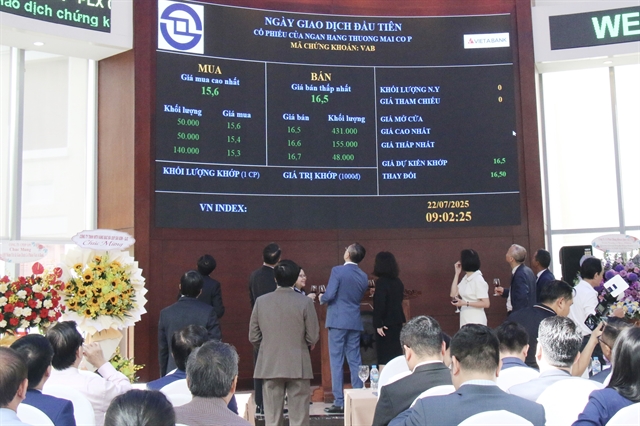 |
| Investors at the first trading session of a stock in the HoSE. — VNA/VNS Photo |
HÀ NỘI — The stock market entered a volatile phase last week after more than eight consecutive weeks of gains, with the VN-Index repeatedly testing the 1,900-point threshold, but failing to establish a decisive breakout amid rising foreign outflows and increasingly fragmented cash flow.
The benchmark index VN-Index on the Hochiminh Stock Exchange (HoSE) closed the week at 1,877.13 points, down 44.47 points from the previous week. In the final trading session alone, the VN-Index dropped 19.76 points as selling pressure spread broadly across the market.
In contrast, the HNX-Index on the Hanoi Stock Exchange (HNX) gained 10.09 points to close at 267.51 points.
Although the VN-Index had previously climbed above the 1,900-point mark to set a new historic peak, market participants noted that the rally since the beginning of the year has been largely driven by a limited number of large-cap stocks, while the broader market has remained relatively flat.
Many stocks surged sharply for only one or two sessions before reversing lower, making it increasingly difficult for investors to secure stable returns.
Liquidity improved during the week, but capital flows continued to diverge significantly among sectors and stock groups.
According to data from Vietnam Construction Securities JSC (CSI), average liquidity on the HoSE reached around 913 million shares per session, up 11.33 per cent from the previous week, while trading value rose by 8.72 per cent to nearly VNĐ27.1 trillion (US$1 billion).
Another notable development was the acceleration of foreign net selling activity. Foreign investors recorded net sales of nearly VNĐ6.25 trillion during the week.
According to Vietcombank Fund Management (VCBF), foreign investors have withdrawn a cumulative net amount of more than $13 billion from the Vietnamese stock market since 2020, reducing foreign ownership in the VN-Index basket to around 14.5 per cent.
Speaking at a recent annual general meeting, Phạm Minh Hương, chairwoman of the Board of Directors at VNDIRECT, said that despite rapid growth in market size, Việt Nam's stock market still lacked sufficient depth and had yet to establish a truly sustainable capital base.
According to Hương, the current capital structure is increasingly polarised between short-term speculative money and long-term investment flows linked to economic growth.
Stable capital from institutional investors, such as insurance companies and fund management firms, is playing a key role in mitigating short-term market volatility.
LPBank Securities CEO Hoàng Việt Anh said the bigger challenge following a potential market upgrade lay in the market's ability to retain and absorb foreign capital inflows.
He noted that one of the market's major bottlenecks remained the shortage of investment products and the limited scale of listed assets, adding that the market would need more high-quality enterprises to participate in listings.
Nevertheless, Việt Anh said the market could be entering a third IPO wave thanks to a convergence of favourable conditions.
Newly issued resolutions by the Politburo on private-sector and State-sector economic development were expected to create momentum for large enterprises to raise capital through the stock market.
According to market estimates, the new IPO wave could mobilise between VNĐ500 trillion and VNĐ600 trillion in equity capital, equivalent to roughly 3-5 per cent of GDP, helping the stock market strengthen its role as a medium- and long-term capital channel for the economy.
Domestic retail investors were also emerging as a key support pillar for the market.
The number of securities trading accounts had surged from around two million before 2020 to more than 12 million currently, equivalent to roughly 10 per cent of Việt Nam's population.
Analysts said the sharp increase had helped reduce the market's dependence on foreign capital while strengthening domestic resilience during periods of heightened volatility.
Regarding short-term market developments, Pinetree Securities analyst Nguyễn Tấn Phong, said correction pressure was being driven by multiple factors simultaneously.
Domestically, leading stocks such as those linked to Vingroup had shown signs of cooling after a prolonged rally.
Globally, escalating tensions between the US and Iran and continued disruptions around the Strait of Hormuz had kept oil prices elevated, adding pressure on inflation and global monetary policy. — BIZHUB/VNS
Economy
 Economy
 Economy
 Economy
 Economy
 Economy
 Economy
 Economy
 Economy
 Economy
 Economy
 Economy
 Economy
 Economy
 Economy