 Society

LANDMARK Launches ‘Destination CENTRAL’: A District-Wide Invitation to Explore the Dynamism, Luxury, and Soul of Central
1.
.jpg) |
| A workshop in HCM City highlights cooperation between Việt Nam and the Netherlands in aquaculture and provides an overview of the sector’s development orientation. — VNS Photo Hồng Linh |
HCM CITY — A workshop held in HCM City on Wednesday showcased partnership models and promoted cooperation between the Kingdom of the Netherlands and Việt Nam in sustainable and resilient aquaculture.
The event is part of Việt Nam's first international exhibition on fisheries science and technology from April 28 to 30, organised by the Việt Nam Fisheries Society (Vinafish).
Raïssa Marteaux, Consul General of the Netherlands in HCM City, said the Netherlands and Việt Nam share a long-standing and trusted relationship. The two countries' Strategic Partnership Arrangement on Sustainable Agriculture and Food Security, now in its 12th year, builds on more than 50 years of diplomatic relations and 400 years of trade.
She also emphasised that the two countries share similarities in opportunities and challenges as both nations are delta countries.
"The Netherlands is proud to support Việt Nam through two strategic partnerships: one on sustainable agriculture and food security, and another on water management and climate change. Together, these frameworks enable us to contribute to protecting, nurturing, and unlocking the full potential of the Mekong Delta," she added.
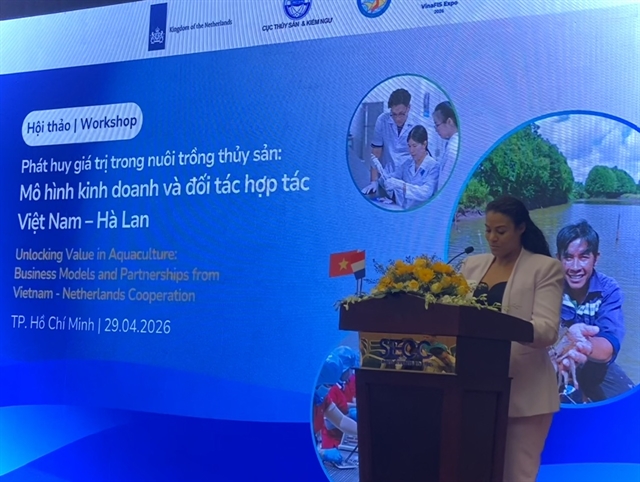 |
| Raïssa Marteaux, Consul General of the Netherlands in HCM City, speaks at a workshop on partnership models to promote sustainable and resilient aquaculture cooperation between the Netherlands and Việt Nam. — VNS Photo Hồng Linh |
Nguyễn Quang Hùng, deputy director general of the Directorate of Fisheries and Fisheries Surveillance, said Việt Nam's aquaculture sector has developed rapidly and become a key driver of economic growth and exports.
During the 2020-25 period, the country's aquaculture cultivation area reached around 1.3 million hectares, with production increasing from 4.7 million to 6.1 metric tonnes by 2025.
Currently, the country ranks among the top 10 nations by aquaculture production volume and is among the top three global aquaculture exporters, with products including species such as shrimp, fish, mollusks, as well as seaweed and cold-water fish.
However, the industry also faces significant challenges, including the impacts of climate change, environmental issues and disease outbreaks that directly affect production efficiency.
Export markets have stricter requirements regarding traceability criteria, sustainability certification, emissions and social responsibility standards.
Furthermore, the industry faces challenges with productions remaining fragmented and small-scale, alongside weak supply chain integration. The application of science and technology remains uneven and insufficiently developed across the sector.
This has made it necessary for the industry to transition from production-driven growth to a focus on efficiency and quality to meet international standards.
He proposed several solutions, such as fostering technology adoption, reorganising production along value chains, strengthening production links and deepening international cooperation.
He also highlighted the cooperation between Việt Nam and the Netherlands, stating that the partnership has entered a new phase, moving from technical cooperation to value chain-based collaboration and enhancing the competitiveness of the entire industry.
This includes the Combi-Track programme, a sustainable aquaculture partnership between the Vietnamese and Dutch governments, which has mobilised the participation of relevant stakeholders, promoting the application of technology, innovation and the development of sustainable aquaculture models resilient to climate change.
The programme was launched in 2022, designed to turn shared ambitions into practical, scalable solutions – focusing on sustainable pangasius and shrimp farming. It is in line with Vietnamese government commitments to turn towards a greener and lower carbon growth path, reaching net-zero carbon emissions by 2050.
The event also featured a panel discussion which introduced flagship sustainable aquaculture projects in the Mekong Delta under the Combi-Track program, such as ShrimpTech Vietnam project, The DeltaVax project and AquaGene Vietnam.
In addition, the panel discussed how innovation is changing farming practices and highlighted genetics, animal health and disease prevention as the foundation for productivity and resilience. — VNS
Society
 Society
 Society
 Society
 Society
 Society
 Society
 Society
 Society
 Society
 Society
 Society
 Society
 Society
 Society