 Economy



Vietnamese Prime Minister meets Cambodian National Assembly President
1.
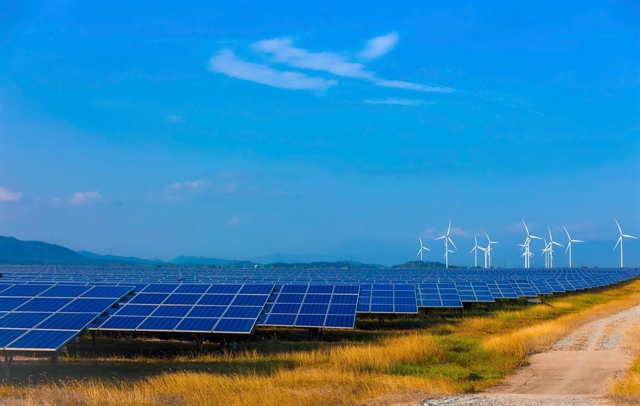 |
| A solar and wind farm of Trung Nam Group in Khánh Hoà. — VNA/VNS Photo Đặng Tuấn |
HÀ NỘI — Việt Nam must accelerate its energy transition and remove longstanding bottlenecks in infrastructure and institutional frameworks to sustain double-digit economic growth and strengthen its position in global value chains, experts said at a conference on Monday.
Đào Duy Anh, deputy director of the Department of Innovation, Green Transition and Industrial Promotion under the Ministry of Industry and Trade, said that energy is no longer merely an input, but an increasingly important determinant of national competitiveness and resilience.
In the past, energy security was largely about ensuring sufficient supply, he said. Today, it also means cleaner, greener and more diversified energy systems that can withstand geopolitical disruptions, as countries face growing pressure to meet environmental standards such as the European Union's Carbon Border Adjustment Mechanism, environmental, social and governance requirements and net-zero commitments.
If Việt Nam does not move quickly enough in its energy transition, it will face difficulties maintaining export competitiveness, attracting high-quality investment and integrating more deeply into global value chains, Anh noted.
Expanding new energy sources and strengthening energy self-sufficiency will also be critical to achieving the Government's goal of double-digit economic growth, he added.
Anh said broadening energy transition efforts beyond the power sector to transportation is also necessary.
He described the nationwide rollout of E10 biofuel on June 1 as a practical step towards greener energy use.
More importantly, he said, the E10 rollout creates opportunities to develop a new fuel value chain, from raw materials and production to distribution and consumption, while generating higher value-added economic activity.
Nguyễn Xuân Quang from the Institute of Energy Technology said Việt Nam's total installed power capacity had reached nearly 90,000MW, with renewable energy accounting for about 27 per cent.
However, grid infrastructure has not expanded at the same pace, forcing some provinces to cut solar and wind power generation as clean electricity is unable to be transmitted to the system, resulting in wasted resources and affecting investor confidence.
Nguyễn Quốc Việt, a lecturer at the University of Economics under Việt Nam National University Hà Nội, said investors are often more concerned about regulatory predictability than electricity prices alone.
For renewable energy developers, the key issue is policy certainty, he said.
However, deputy director of the Electricity Authority of Việt Nam Trịnh Quốc Vũ said that significant challenges remain.
With expected annual economic growth of around 10 per cent during the 2026-30 period, the energy sector would need to expand at a much faster pace than at present.
In recent years, Việt Nam has largely maintained adequate electricity supply. But energy imports continue to rise and several major power generation and transmission projects have fallen behind schedule, he said.
Vũ said the ministry is working to improve the legal framework for energy development, including proposed amendments to the Law on Electricity and related regulations, while coordinating with other ministries to review regulations in investment, construction, land use and planning.
Focus will be placed on accelerating regulatory reforms, promoting cooperation with local authorities to speed up project implementation and raising private investment in energy transition, he said. — VNS
Economy
 Economy
 Economy
 Economy
 Economy
 Economy
 Economy
 Economy
 Economy
 Economy
 Economy
 Economy
 Economy
 Economy
 Economy