 Society
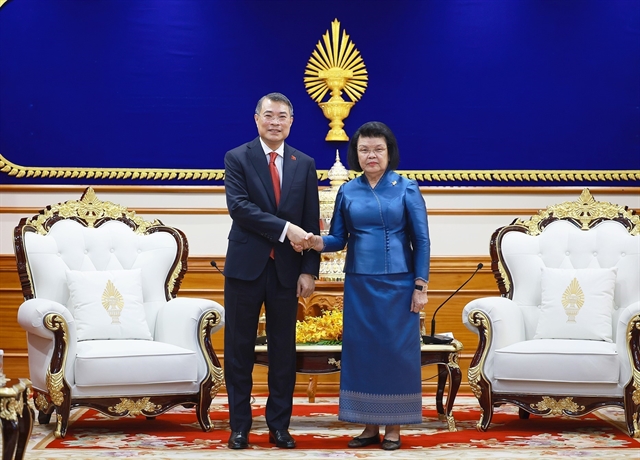
Vietnamese Prime Minister meets Cambodian National Assembly President
1.
|
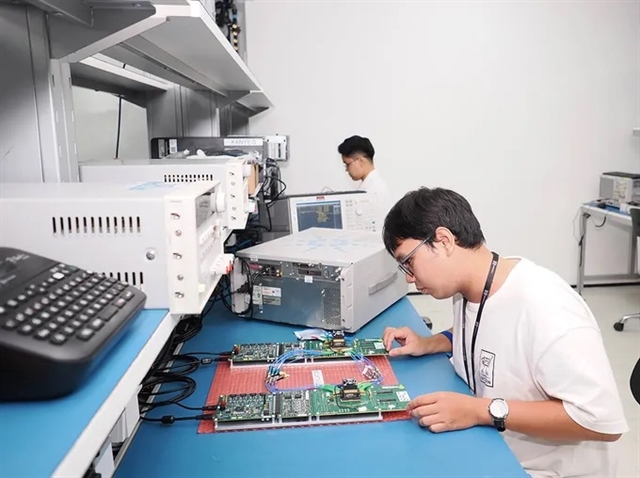
| Engineers of Marvell Technology in HCM City work at a laboratory specialising in the design, testing, and development of semiconductor chips. — Photo www.sggp.org.vn |
HCM CITY — HCM City is restructuring its urban landscape into specialised hubs for research, production, and logistics, positioning itself as the primary gateway for Việt Nam to integrate into the global semiconductor value chain.
The city is shifting away from fragmented growth to focus on functional division and regional synergy.
Under this model, the central city serves as the nation's R&D and training nucleus, while the former Bình Dương Province handles large-scale industrial production, and the former Bà Rịa-Vũng Tàu Province acts as the vital international logistics gateway.
Nguyễn Hữu Yên, deputy director of the city’s Department of Science and Technology, said the city is creating "sandboxes" for policy testing.
“This approach ensures regulations remain flexible and aligned with practical industry needs.”
Under Plan 98/KH-UBND for 2026, the city aims to build a comprehensive semiconductor ecosystem.
Key targets include attracting at least four major FDI projects in the sector; collaborating with global giants such as AMD, NVIDIA, and Qualcomm for technology transfer; investing in an international-standard research centre and upgrading the computing facility at Quang Trung Software City for AI and chip design; and expanding Sài Gòn Hi-Tech Park (SHTP) into a large-scale industrial complex to support long-term growth.
The city's efforts align with a strengthening national strategy.
Speaking at a recent workshop, Deputy Minister of Science and Technology Bùi Hoàng Phương said the legal framework for the industry is nearing completion.
This includes the Law on Digital Technology Industry and the national semiconductor strategy through 2030, with a vision to 2050.
Việt Nam aims to capitalise on global supply chain shifts by focusing on specialised chips and high-tech human resources.
The country currently hosts over 170 foreign investment projects in this sector.
More than 50 foreign enterprises and 10 domestic firms are active in chip design, employing approximately 7,000 engineers.
Major domestic players are also moving from orientation to action.
Viettel is constructing the country's first semiconductor manufacturing plant on a 27-hectare site at Hòa Lạc Hi-Tech Park. Meanwhile, FPT Group has launched an advanced chip testing and packaging factory to foster an interconnected domestic value chain.
Despite the momentum, experts warn of significant hurdles.
Associate Professor Nguyễn Văn Hiếu, chairman of the HCM City Semiconductor Industry Association, said building chip factories requires massive capital and precise market calculations.
“Domestic businesses have not yet identified their core production strengths. Competitive export products also remain a major concern. The Government must act as a ‘fulcrum’ while state-owned enterprises should lead in mastering technology.”
As global competition shifts toward high-tech supply chains, Việt Nam’s long-term economic resilience will depend on its ability to master the full production cycle, from R&D and design to packaging and testing. — VNS
Society
 Society
 Society
 Society
 Society
 Society
 Society
 Society
 Society
 Society
 Society
 Society
 Society
 Society
 Society