 Society

LANDMARK Launches ‘Destination CENTRAL’: A District-Wide Invitation to Explore the Dynamism, Luxury, and Soul of Central
1.
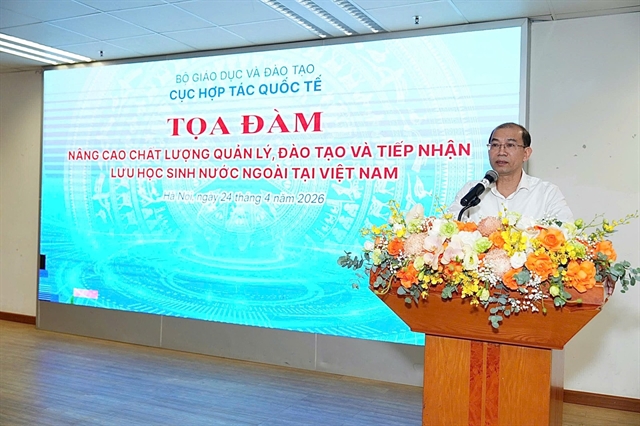 |
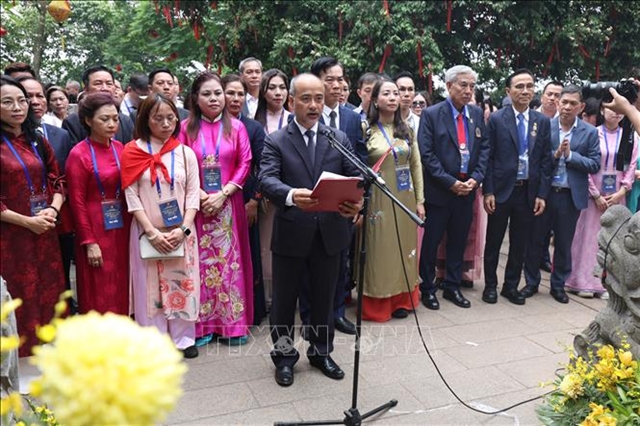
| Nguyễn Tiến Dũng, deputy director of the International Cooperation Department under the Ministry of Education and Training, speaks at the event. — Photo courtesy of the International Cooperation Department |
HÀ NỘI — Training for foreign students has been identified as a priority task, serving to promote integration and elevate the standing of Vietnamese higher education.
Nguyễn Tiến Dũng, deputy director of the International Cooperation Department under the Ministry of Education and Training (MoET), stated in an educational event, which was organised in Friday in Hà Nội.
Attending the symposium titled “Enhancing the quality of management and training for foreign students studying in Việt Nam”, with participation of representatives from numerous universities and colleges across the country, Dũng emphasised that Việt Nam's international integration in education was progressing deeply, playing a crucial role in modernising education and training quality.
He confirmed that attracting and training international students not only enhanced the reputation and rankings of higher education institutions but also fostered an international academic environment, thereby promoting cultural, academic exchange and educational cooperation.
“This is also a consistent policy of the Party and the State, reflected in numerous resolutions and major strategies on educational renewal and integration,” said Dũng.
In recent times, higher education institutions have actively implemented various measures such as developing high-quality programmes, expanding international training partnerships, increasing English-language instruction, and investing in facilities to attract foreign students.
In the context of increasingly deep integration, the management and training of foreign students present new requirements regarding quality, professionalism and coordination mechanisms.
Educational institutions must not only carry out training tasks but also address numerous issues related to recruitment, Vietnamese language training, academic support, student life management, as well as security and safety assurance.
The work should be viewed as an important component of the education system.
During the symposium, representatives exchanged views and shared difficulties, while proposing recommendations to improve the effectiveness of foreign student management and training.
Educational institutions recommended that the MoET should enhance further training and specialist support for staff involved in international cooperation; develop a comprehensive strategy for attracting international students; consider excluding foreign students from enrolment quotas and training scales; and introduce more flexible mechanisms regarding Vietnamese language proficiency requirements for English-taught programmes.
The reception, training and management of foreign students in Việt Nam are entering a phase that requires elevation to a new level, in terms of state management quality, systemic support quality and service quality for learners.
Many current challenges cannot be resolved individually by each institution but require unified coordination mechanisms, common orientations and effective connectivity tools.
A key consensus was the urgent need to develop a shared electronic information portal to connect, share data and support unified management across the entire system.
On that basis, the International Education Development Centre under the International Cooperation Department will research, propose and gradually implement solutions; while continuing to refine management processes in a synchronous and effective manner.
Educational institutions will strengthen coordination and participate in conducting the agreed contents, ensuring substantive and seamless connectivity.
From 2019 to 2024, Việt Nam recorded over 22,000 long-term international students and 13,401 short-term ones in 169 higher education institutions, according to statistics of the International Cooperation Department. — VNS
Society
 Society
 Society
 Society
 Society
 Society
 Society
 Society
 Society
 Society
 Society
 Society
 Society
 Society
 Society