 Society

Vietnamese Prime Minister meets Cambodian National Assembly President
1.
|
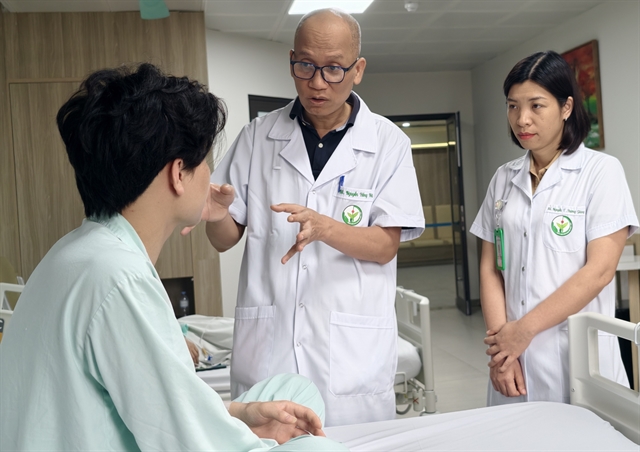
| Associate Professor Dr Nguyễn Hồng Hà and Dr Nguyễn Thị Hương Giang consulting with the patient during his recovery. — Photos from Việt Đức University Hospital |
HÀ NỘI — A 25-year-old man has been given emergency care after he was hospitalised with two chopsticks deeply embedded in both eyes, in what doctors described as an exceptionally rare case in world medical literature, the Hà Nội-based Việt Đức University Hospital said on Monday.
The patient, B.T.D, from the northern province of Phú Thọ, was admitted to the hospital with only a short tip of a chopstick visible in one eye while in the other eye socket the object was fully embedded and its trajectory initially unclear. The chopsticks reportedly measured between 7 and 10cm.
Associate Professor Dr Nguyễn Hồng Hà, head of the Maxillofacial, Plastic and Aesthetic Surgery Department, said the case was exceptionally rare. The hospital deployed its emergency multi-slice CT system along with three-dimensional vascular and nerve reconstruction techniques to determine the exact position and trajectory of the foreign objects.
Dr Nguyễn Thị Hương Giang, a surgeon in the department, said the object was lodged beneath the orbital floor, passing close to the left eyeball and coming to rest beside the major carotid arteries. A deviation of just one more millimetre could have been life-threatening.
"After reviewing world medical literature, we were unable to find a single report describing a case in which a patient had a chopstick deeply embedded more than halfway into each eye socket on both sides," Giang said.
|
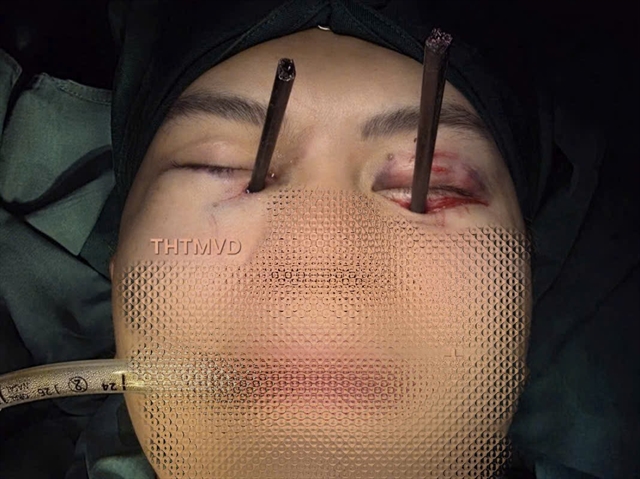
| The chopsticks being carefully removed during operation. |
Given the complexity of the case, the emergency team mobilised multiple specialties for a joint consultation, including maxillofacial, plastic and aesthetic surgery, neurosurgery, cardiovascular and thoracic surgery, diagnostic imaging and anaesthesiology and resuscitation, before agreeing on a plan for emergency surgery.
Throughout the two-hour operation, the foreign objects on both sides were withdrawn millimetre by millimetre as any deviation could have ruptured a major blood vessel or damaged the patient's eyeball. Surgeons not only ensured the safe removal of the objects but also preserved anatomical structure and visual function, giving the patient a chance of near-complete recovery.
The patient is currently alert, with dry wounds and positive progress, and is being treated at the Maxillofacial, Plastic and Aesthetic Surgery Department.
Hà advised that in cases of head, face and neck trauma with a suspected foreign object, particularly involving the eyes, brain or major blood vessels, patients must be transferred to a specialised medical facility as quickly as possible, with modern diagnostic equipment and multidisciplinary consultation playing a decisive role in saving lives and preserving the functions of the organs. — VNS
Society
 Society
 Society
 Society
 Society
 Society
 Society
 Society
 Society
 Society
 Society
 Society
 Society
 Society
 Society