 Society

Vietnamese Prime Minister meets Cambodian National Assembly President
1.
 |
| A community consultation session with groups vulnerable to HIV within the Digital Health and Rights Project gathers input on the challenges in seeking health information and services. — Photo courtesy of the project |
Nhật Hồng
HÀ NỘI — Digital transformation is reshaping health care, but connectivity comes with hidden costs.
Personalised care, telemedicine and multi-platform health information have increased health care quality. Yet the same digital environment amplifies cyberbullying, data breaches and misinformation, posing risk to people’s health and well-being.
In the case of key population groups most vulnerable to HIV, the impacts of stigma and discrimination enabled by the internet's anonymity reach far beyond the screen.
“Cyberspace, positively speaking, is a space where people get to live as they wish and have access to a multitude of information,” Mai Châu, a transgender woman living in Hà Nội, told Việt Nam News. “But it also requires us to equip ourselves with skills to stay safe online.”
Châu witnessed that psychological impact firsthand, when she opened up about falling victim to an elaborate online scam and was met with negative and conflicting comments.
She has worked with key populations, including transgender people, for nearly a decade. Châu explained that for those on HIV treatment, the psychological weight of cyberbullying sits on top of the physical toll of daily medication, which can leave people feeling jittery or exhausted as the side effects.
“When their physical condition is already strained, and their mental state is fragile, encountering negative narratives about the disease can further destabilise them,” she said. “It can lead to frustration, discouragement, and in some cases, a reluctance to continue treatment.”
Nguyễn Tấn Thủ, a physician and health communicator who has nearly two decades of experience in HIV consultation and treatment, said: “When we live in a digital environment, our virtual identity feeds back into our real-life experiences and well-being.”
For people living with HIV, online harassment and digital violence are the risks that come with bringing personal experience into public digital spaces, many of which could affect their right to privacy and data protection.
The damage is not limited to those directly targeted.
“If a person reads about a stranger they have never met but share the same condition, such as living with HIV, and they see hundreds of attacking comments, it can still feel deeply hurtful,” said Thủ.
Manager for the Digital Health and Rights Project (DHRP) in Việt Nam Phạm Huyền Trang said that online abuse compounds an already difficult reality for people living with HIV, leading to self-blaming and reluctance to be seen in public – especially at health stations, clinics and hospitals, where they would receive care, counselling or support.
Technology-facilitated abuse is one of the key findings of the project, which has been gathering evidence on how digital transformation affects young people living with HIV and other key populations across several low- and middle-income countries, including Việt Nam.
Thủ also noted that online safety is an issue that has been raised within vulnerable communities for the past several years as digital spaces expanded, with discussions focusing on safe practices online.
Stressing digital literacy and resilience, he said that recommendations should raise awareness so individuals can make informed choices about their behaviour.
“It’s not about withdrawing from the internet out of fear of stigma. Instead, it’s about recognising that stigma may exist online and being prepared with the knowledge and skills to respond to it,” said Thủ.
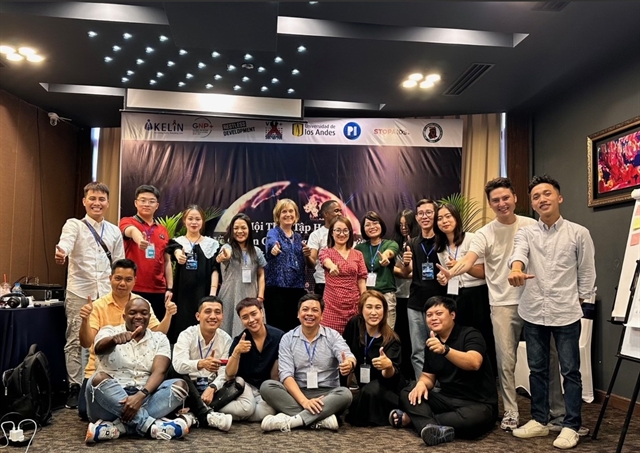 |
| DHRP's Việt Nam Community Advisory Team comprises representatives from key populations at risk of HIV in Việt Nam. — Photo courtesy of the project |
Community at the core
Within the broader activities of DHRP, a core group of representatives from key populations at risk of HIV in Việt Nam has been formed for focused training on health-related digital literacy, Trang said. They would then be empowered to share information with their respective communities.
Through these training sessions, the group has strengthened its ability to critically assess and verify health-related content on social media and digital platforms.
“Beyond building digital skills, they are guided on where to seek help, who to contact and how to handle situations like personal data exposure or cyberbullying,” she said.
Research findings are also used for policy advocacy, with key population members engaging local authorities on digital literacy. DHRP-supported dialogues in Hưng Yên Province held in November 2025 brought together young members of these key populations, provincial health officials, hospital workers and university students, initiating a collaborative network.
The dialogues emphasised digital safety education, reporting channels for online stigma and capacity building on gender diversity, alongside stronger collaboration to protect sensitive health data and improved communication to combat stigma.
In the face of both online and offline stigma, which can discourage people living with HIV from seeking support, solidarity remains central to the community's resilience.
For Châu, that solidarity is something she actively builds. While the comments on her personal story can feel discouraging, she has not stopped her outreach activities.
Her team’s regular HIV information sessions have become something more – they are safe spaces where people can open up and find others who understand.
“Those moments are when we feel we can meaningfully pass on what we know, helping equip others with the knowledge and skills they need to use the digital space more safely,” said Châu. — VNS
Society
 Society
 Society
 Society
 Society
 Society
 Society
 Society
 Society
 Society
 Society
 Society
 Society
 Society
 Society