 Society
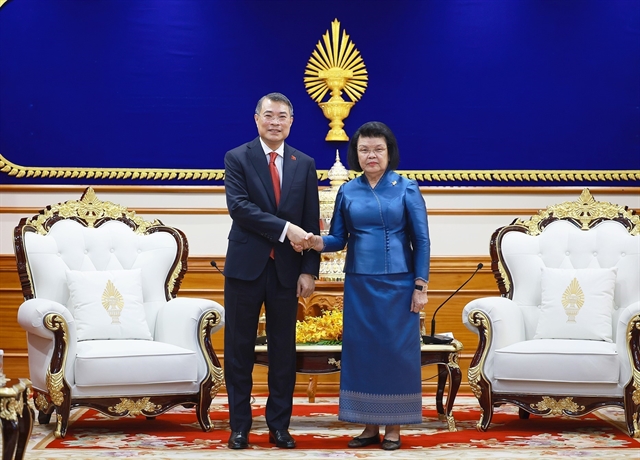
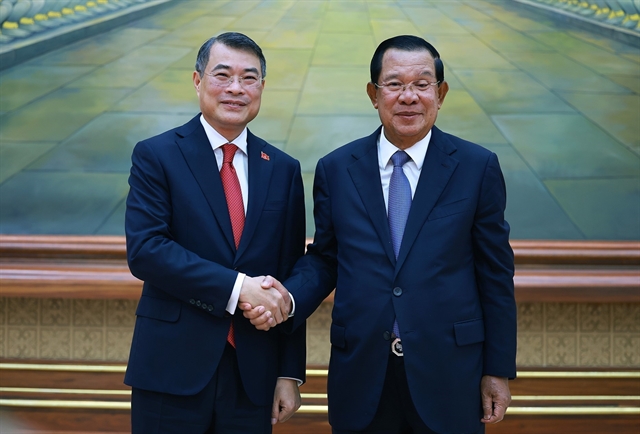
Vietnamese Prime Minister meets Cambodian National Assembly President
1.
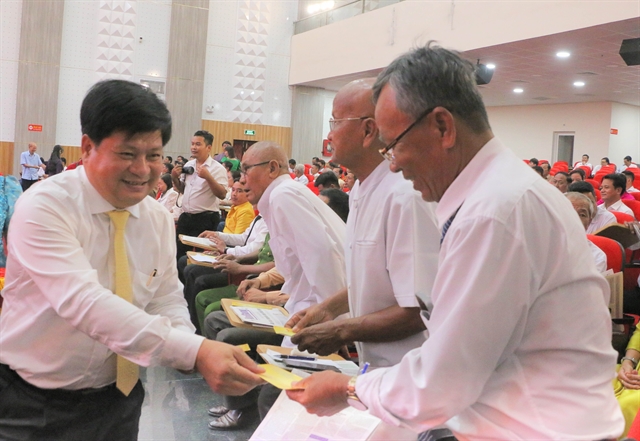 |
| Tống Phước Trường, head of the An Giang Province Party Committee’s Commission for Propaganda and Mass Mobilisation, presents gifts and lucky money to reputable Khmer people and religious dignitaries on April 10 on the occasion of the 2026 Chol Chnam Thmay, the traditional Khmer New Year Festival. — VNA/VNS Photo |
AN GIANG — Khmer communities in An Giang Province are seeing steady improvements in living standards, supported by synchronised policies and targeted national programmes.
The Cửu Long (Mekong) Delta province has effectively implemented national target programmes and local support policies, especially to help Khmer people escape poverty and improve their livelihoods.
The province has more than 109,000 Khmer households with over 364,000 people, accounting for more than 8 per cent of the population.
Thanks to effective support policies in past years, the poverty rate among Khmer households has fallen to 2.38 per cent, while the near-poor rate stands at 3.09 per cent.
Danh Be, a resident of Định Hòa Commune, is one example. From difficult beginnings, his family now owns nearly 5ha of rice fields, cultivating two to three crops each year and raising buffalo.
His family harvests around 80 tonnes of rice annually and sells four to five buffalo, earning a profit of more than VNĐ400 million (US$15,200).
Be said that his family’s current stable and comfortable life was the result of both their own efforts and practical support from policies for Khmer communities, including loans for production, investment in the national power grid and transport infrastructure, as well as health insurance and tuition fee exemptions for students.
With a clear understanding of this support, once their income stabilised, his family actively contributed to social welfare funds, donated land for road construction, and joined efforts to build a cultural lifestyle, he said.
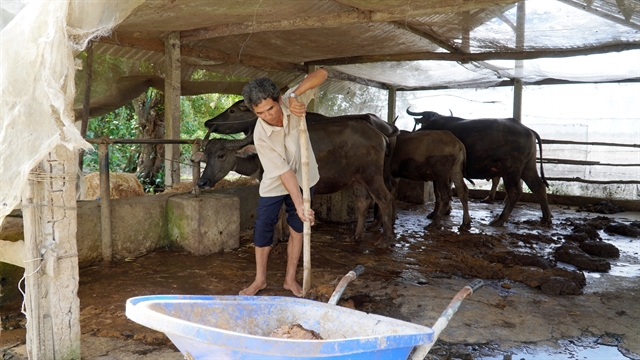 |
| The family of Danh Be is among exemplary Khmer households in Định Hòa Commune that overcame difficulties to achieve prosperity. — VNA/VNS Photo |
Other Khmer families have also stabilised their livelihoods by making good use of support policies.
Danh Mích’s family in Ngọc Chúc Commune has improved their living conditions, building a new concrete house worth about VNĐ400 million ($15,700) and securing stable work for their daughter.
With only 1ha of rice field, they supplement income by growing straw mushrooms, making brooms and selling vegetables.
Previously facing hardship, his family benefited from preferential loans, health insurance, tuition exemptions and support for electricity and clean water, easing financial pressure and enabling production.
“In recent years, local infrastructure, such as transport, schools and Khmer pagodas, has been increasingly upgraded, improving both material and spiritual life for residents,” he said.
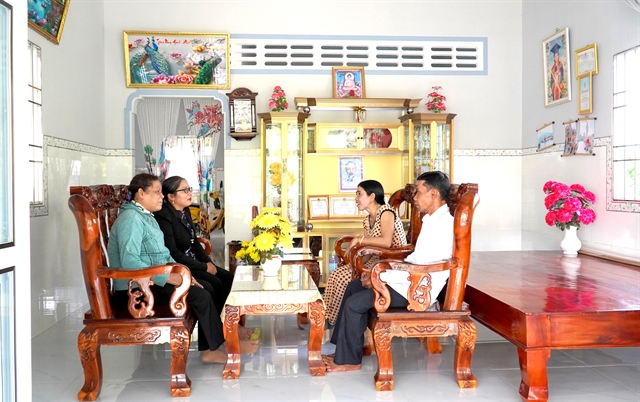 |
| The family of Danh Mích in Ngọc Chúc Commune has improved their living standards thanks to preferential loans for production development. — VNA/VNS Photo |
Upgrading infrastructure
Alongside livelihood development, infrastructure in Khmer communities in An Giang has been upgraded, creating momentum for socio-economic growth.
Over the past five years, the province has supported building houses for 1,034 households and housing land for 51 households, according to its Department of Ethnic and Religious Affairs.
It has also invested nearly VNĐ90 billion ($3.4 million) in 367 essential projects, including bridges, roads, schools and health stations.
Nearly 20,000 Khmer households have gained access to clean water with total funding of VNĐ54 billion ($2 million).
All communes now have roads connecting to their centres, and nearly 95 per cent of disadvantaged hamlets have rural transport routes.
Thị Manh of Giang Thành Commune, said: “In the past, travelling was difficult and mainly by boat. Now with roads and bridges, travel is easier, trade is more convenient, and living conditions have improved.”
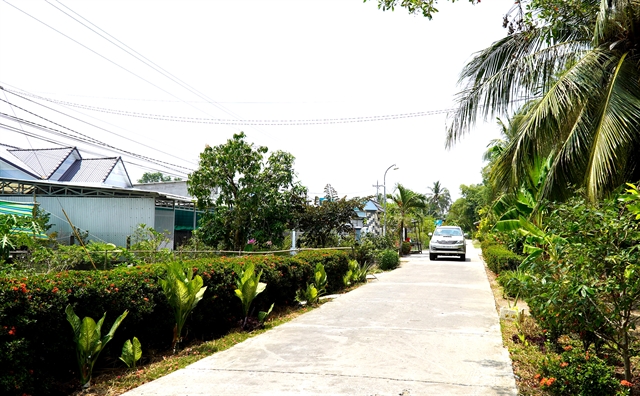 |
| Transport infrastructure in Khmer communities in Định Hòa Commune has been upgraded to better meet local needs. — VNA/VNS Photo |
Education infrastructure has also been strengthened. Every commune has schools and healthcare stations.
The province has nine ethnic minority boarding schools and one vocational secondary school, serving nearly 4,500 students.
Three new boarding schools are being built in border communes to improve ethnic minority children’s access to education.
Health insurance policies have also proved effective.
The rate of Khmer people with health insurance cards reached 98.6 per cent last year.
Thị Thu, a resident of Hà Tiên Ward, said: “In the past, I hesitated to go to hospital because of the cost. Now with health insurance, I go for check-ups whenever I am ill.”
Practical policies
Livelihood support programmes and soft loans have played an important role in raising incomes for Khmer households.
The province has granted soft loans worth a total of VNĐ85 billion ($3.3 million) for nearly 16,980 Khmer households for agricultural production.
Chau Siêng, a Khmer in Ô Lâm Commune, said: “Before, my family relied on casual work to make ends meet. Since receiving support for housing and breeding cattle, our life has become more stable.”
Cultural preservation has also been promoted through support for building traditional Ngo boats, providing musical instruments and costumes, and helping to maintain Khmer cultural identity.
Danh Phúc, Director of the province Department of Ethnic and Religious Affairs, said: “The most important thing is that policies must be implemented effectively and bring practical benefits. They improve infrastructure, support economic development, and build trust and motivation for Khmer people to stabilise their lives.”
Danh Hùng, a respected member of the Khmer community in Giang Thành Commune, said that compared with previous years, living standards and the local economy had improved steadily.
“Poverty and near-poverty rates have dropped significantly, unemployment has decreased, and awareness of community responsibility and national unity has increased,” he said.
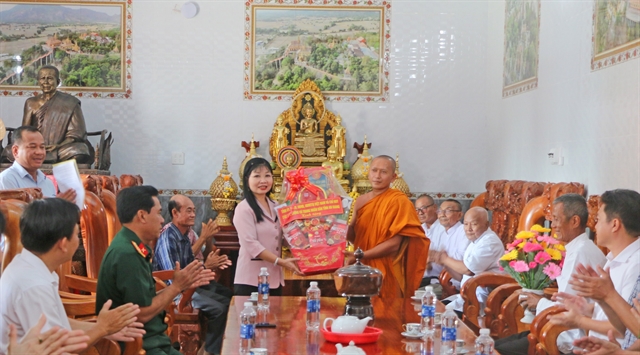 |
| Trần Thị Thanh Hương, Deputy Secretary of the An Giang Province Party Committee and Chairwoman of the province Fatherland Front Committee, presents gifts and extends greetings at the 2026 Chol Chnam Thmay festival, the traditional Khmer New Year, at Tà Pạ Pagoda in Tri Tôn Commune on April 6. — VNA/VNS Photo |
Before and during the 2026 Chôl Chnăm Thmây festival, the traditional Khmer New Year, falling between April 14 and 16, An Giang organised various activities to support Khmer residents.
They included distributing gifts, building houses and providing free medical care, helping people celebrate the festival in a warm and meaningful way.
Ngô Công Thức, Deputy Chairman of the province People’s Committee, has called on Khmer religious dignitaries and reputable individuals to work closely with local authorities to promote Party and State policies, encourage production, support social welfare activities, and maintain political security and social order.
The province would continue investing in infrastructure, education and healthcare, while promoting sustainable livelihoods and preserving Khmer cultural values, aiming for inclusive and long-term development, he said. — VNS
Society
 Society
 Society
 Society
 Society
 Society
 Society
 Society
 Society
 Society
 Society
 Society
 Society
 Society
 Society