 Society

Vietnamese, Danish FMs discuss ways to deepen bilateral ties
1.
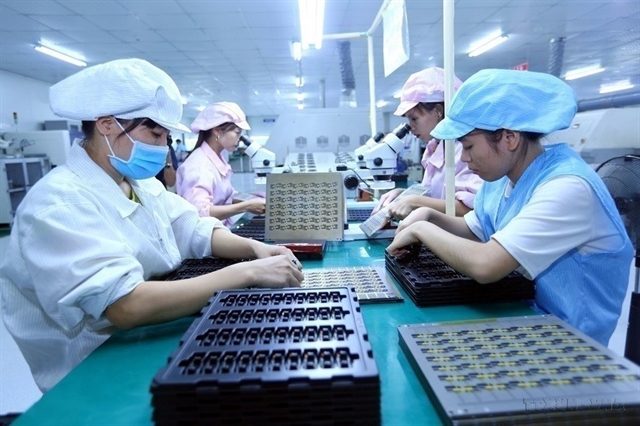 |
| Female workers work in a company in Bắc Giang Province. Women are more likely than men to be in jobs exposed to generative artificial intelligence, according to the ILO’s new brief. — VNA/VNS Photo Danh Lam |
HÀ NỘI — Around 11.5 million workers in Việt Nam, roughly one in five, are in jobs potentially exposed to generative artificial intelligence (GenAI), though most are likely to see tasks reshaped rather than replaced, according to a new report.
The brief, Generative AI and Jobs in Việt Nam: Labour Market Exposure and Policy Considerations, released on Thurday by the International Labour Organisation (ILO) Country Office for Việt Nam, finds that GenAI-related changes are likely to be widespread, but large-scale job displacement remains unlikely in the near term.
Instead, the report highlights task transformation within existing roles. Only about one million workers are in occupations where tasks are both highly susceptible to AI and sufficiently standardised to be automated, accounting for less than 2 per cent of the workforce, a lower share than in Indonesia, the Philippines and Thailand.
Exposure varies across the labour market. Clerical support workers face the highest risk, with nearly two-thirds employed in roles most susceptible to GenAI-driven automation.
Financial and insurance services, wholesale and retail trade, and information and communication are among the sectors with the highest exposure rates.
Geographically, Hà Nội, HCM City and Đà Nẵng account for more than one-third of all potentially affected jobs nationwide.
The report also points to a notable gender gap. Women are more likely than men to be in jobs exposed to GenAI, with an exposure rate of 24.1 per cent compared to 17.8 per cent for men.
This gap persists even after accounting for differences in education, occupation and other factors, reflecting the concentration of women in clerical, administrative and service roles where tasks are more easily automated due to their standardised and documentation-intensive nature.
The implications are mixed. In sales occupations, where women make up around two-thirds of the workforce, GenAI could enhance productivity and improve job quality. In routine clerical roles, however, the risk of task displacement is more acute, potentially affecting a segment that has traditionally provided stable and formal employment for many women.
Despite global concern about AI-related job losses, the report finds no clear evidence of declining employment opportunities for young, highly educated workers in high-exposure sectors in Việt Nam during 2022–2024.
Employment in these service sectors has continued to expand, suggesting labour demand remains resilient as AI adoption is still at an early stage.
The brief calls for coordinated action by the Government, employers, workers and other stakeholders.
Priority areas include reinforcing AI governance and institutional capacity, with attention to gender equality and non-discrimination; strengthening labour market information systems to track AI’s evolving impacts; promoting responsible AI adoption through social dialogue at the workplace level; supporting small and medium-sized enterprises in combining productivity gains with decent work; and investing in gender-responsive skills development and active labour market programmes for the most exposed groups.
ILO Country Director for Việt Nam, Sinwon Park, said: “Việt Nam has a significant opportunity to harness generative AI as a driver of productivity and decent work. However, the benefits and risks will not be evenly distributed, with women facing higher levels of exposure than men.
“Getting this transition right requires deliberate action now: reinforcing AI governance in line with labour standards, investing in people's skills, ensuring workers have a voice in how AI is introduced in their workplaces, supporting SMEs in responsible AI adoption, and putting in place the protections needed to ensure technological change is fair and inclusive."
As Việt Nam advances its digital transformation agenda, proactive and inclusive policies will be essential to ensure that the benefits of generative AI are widely shared and that no workers are left behind. — VNS
Society
 Society
 Society
 Society
 Society
 Society
 Society
 Society
 Society
 Society
 Society
 Society
 Society
 Society
 Society