 Society

Việt Nam steps up fight against counterfeits, IP violations
1.
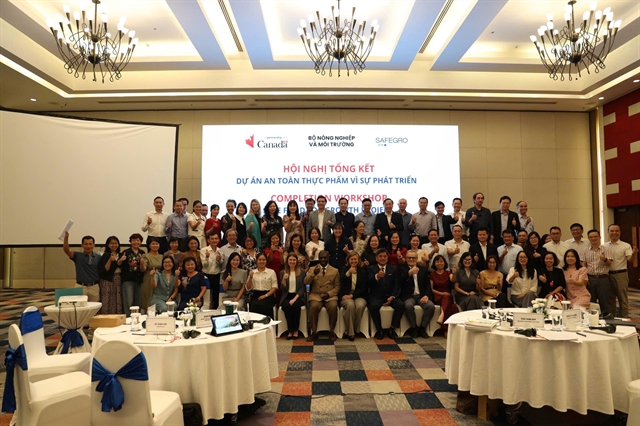 |
| Officials and experts at the completion workshop of the Safe Food for Growth (SAFEGRO) project, organised by the Ministry of Agriculture and Environment and the Canadian embassy in Việt Nam, in Hà Nội on Thursday. — VNS Photo Trần Như |
HÀ NỘI — By strengthening the food safety system in line with international standards, the Safe Food for Growth (SAFEGRO) project has helped lay a foundation for sustainable trade and increase export opportunities for Vietnamese agricultural products, officials and experts heard at the completion workshop of the project in Hà Nội on Thursday.
Running from 2020 to 2026, SAFEGRO is a non-refundable technical assistance project worth CAD$15.3 million (US$11.2 million), funded by the Canadian Government. Canada is a long-standing supplier of safe, high-quality food to Việt Nam, while Việt Nam is Canada’s second-largest agricultural export market in ASEAN.
One of the project’s notable achievements has been promoting food-safe market models in wholesale and traditional markets in Hà Nội and HCM City, including Bình Điền, Minh Khai, Thượng Thanh, Kim Quan, and Mía markets.
Ensuring food safety at wholesale markets, which are considered key links in the agricultural supply chain, has been identified as a critical point of the project.
Beyond improving sanitation infrastructure and reorganising market stalls, the project focused on behavioural change through communication and training.
More than 1,000 people, a majority of them women, received training, helping foster compliance with food safety standards in both business practices and consumption.
SAFEGRO also supported the development and upgrading of food safety models along agricultural value chains.
At the Cần Giờ–Tương Lai Cooperative in HCM City, the project helped upgrade processes to meet HACCP standards, with a view toward FSSC 22000 certification, in addition to improving packaging and adopting solar energy solutions.
The cooperative’s products have entered modern retail chains, with revenue increasing by around 30 per cent.
Meanwhile in Hà Nội, the Hoàng Long pork-selling cooperative received support to improve slaughtering and processing conditions, enhance food safety control capacity and expand distribution channels to schools and retail systems. Phong Thúy company also achieved GlobalGAP Smart V6 certification, advanced digital transformation and is moving toward export markets.
Notably, a digital traceability system was piloted for vegetables, pork and seafood, meeting international GS1 standards and integrated with the national traceability portal.
The shift from manual to digital management has strengthened risk control capacity and enabled faster decision-making across the supply chain.
After more than five years of implementation, the key lessons from SAFEGRO have highlighted that effective implementation depends on strong inter-agency coordination and clear governance mechanisms.
The project also underscored that risk-based inspections help optimise resource allocation and improve oversight. The selection of value chains and intervention design must be closely aligned with market demand, prioritising high-risk sectors with spillover potential.
In addition to supporting digital traceability and developing a food safety culture to drive behavioural change, SAFEGRO also integrates gender-sensitive approaches, promoting the role of women in food value chains, and investing in capacity building and training for sustainable systems.
Speaking at the completion workshop, Francesca Bellone, head of cooperation at the Canadian embassy in Hà Nội, said that SAFEGRO’s impact extends beyond regulatory agencies to markets, farms, businesses and communities, bringing direct benefits to hundreds of traders and thousands of consumers.
Bellone, who also serves as co-chair of the project committee, added that the project’s conclusion marks not an endpoint but a milestone.
Its lessons, technical reports and recommendations will continue to support Việt Nam’s shift toward a modern, risk-based food safety management approach, she said, affirming Canada’s commitment to supporting Việt Nam in transitioning to greener, safer and more sustainable agri-food production.
Addressing the workshop, Deputy Minister of Agriculture and Environment Trần Thanh Nam said SAFEGRO has delivered important results, contributing to the development of a modern, practical and internationally aligned food safety framework in Việt Nam, particularly through a stronger shift toward risk-based management.
He highlighted the project’s comprehensive impact across regulatory bodies, businesses, cooperatives, consumers and training systems. Practical, well-structured guidelines on food safety have been developed, serving as effective tools to enhance capacity and gradually establish self-regulatory mechanisms.
“From practical implementation, the project has clarified a ‘logic’ in food safety management, which is starting with institutional development, then moving to practical implementation and self-regulation, and ultimately fostering a food safety culture in society,” Nam said.
The deputy minister highlighted that SAFEGRO’s outcomes go beyond technical support, laying the groundwork for a modern, transparent and market-oriented food safety system that enhances the competitiveness of Vietnamese agricultural products in the context of international integration. — VNS
Society
 Society
 Society
 Society
 Society
 Society
 Society
 Society
 Society
 Society
 Society
 Society
 Society
 Society
 Society