 Society
Việt Nam has five Halal certification bodies recognised by Malaysia
1.
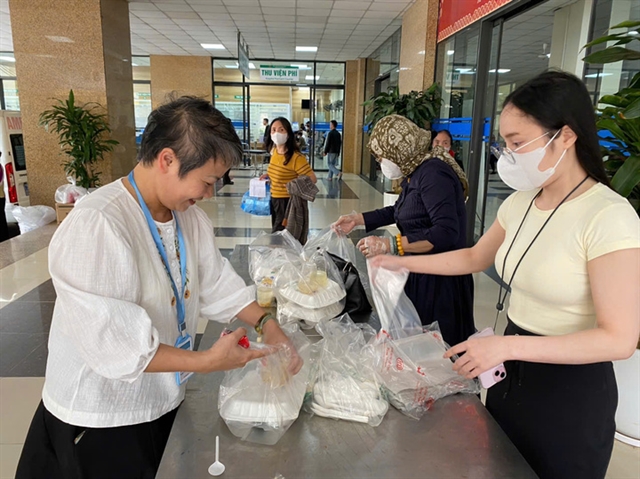 |
| Phạm Thị Thành Chung (left) prepares meals for poor patients. Photo vtcnews.vn |
HÀ NỘI — Amid the morning rush at the Central Lung Hospital, where anxious faces and hurried footsteps fill the corridors, one quiet figure has spent a decade guiding patients through fear and uncertainty, even as she faces her own illness.
At 7.30am each day, the hospital lobby is crowded with patients. Loudspeakers calling out names mingle with hurried footsteps, while many faces show the weariness and anxiety of sleepless nights.
At the information counter, a small woman is almost lost in a crowd of patients’ relatives asking about examination procedures, hospital admission and bill payments.
Even when overwhelmed with questions, she answers gently, clearly and patiently.
That is the familiar image of Phạm Thị Thành Chung, a staff member of the hospital’s social work department, for the past 10 years.
Five years ago, Chung was diagnosed with lung cancer, deepening her empathy for patients.
“Those seemingly simple questions are actually essential needs for patients. It is not just a lack of information, but also a very common anxiety when entering an unfamiliar environment like a hospital for the first time,” Chung told vtcnews.vn
“Some questions are naive, some are harsh due to impatience and some gazes are simply silent, like an unspoken plea for help,” she said.
Her work does not stop at the information counter.
At 10am, she is busy again among boxes of rice and porridge from various charitable groups.
Each box of hot rice is opened, counted and arranged. She never forgets to say “thank you,” her eyes bright with joy, knowing that more patients will receive a free meal that day.
“For many people, it is just a meal. But for poor patients, it is valuable support helping them continue the really burdensome treatment journey,” Chung said.
Amid her daily routine, there are days when her work becomes a race against time.
The phone rings from the Emergency Department: "A male patient, nearly 40 years old, from Tuyên Quang Province, has severe pneumonia and septic shock. He needs ECMO, a state-of-the-art resuscitation technique costing hundreds of millions of đồng, but he's in extremely difficult circumstances and doesn't have health insurance."
Without hesitation, Chung goes to the department to verify the information and assess the situation.
Appeals are quickly posted on the hospital’s fan page, while she directly contacts potential donors.
Within a short time, VNĐ120 million (US$4,300) is raised, offering not just financial support but a chance at life.
In another case, a patient with pneumonia also required ECMO. The young wife burst into tears: "I did not know where to find such a large sum of money..."
Chung reassured the family while continuing to seek support and VNĐ80 million ($3,000) was soon raised, allowing the patient to continue treatment.
There are also homeless patients admitted without identification or relatives. Chung and her colleagues handle everything, from meals and necessities to care and coordination.
“In these cases, the boundary between task and responsibility seems to be wiped out. We just thought that no one is left behind,” Chung said.
After more than 10 years, Chung cannot recall how many meals she and her colleagues have arranged, nor the total amount of donations mobilised to support patients at the Central Lung Hospital.
But she clearly remembers the messages: "Sister, I am feeling better," "Do you still remember me? Thanks to you all, I am alive..."
"These are extraordinary, immeasurable 'numbers,' but they bring boundless happiness, letting us know that we are on the right track," she said.
Journey starts from empathy
Few people know that her path into social work did not begin with a grand ambition.
In 2003, she worked in the paediatrics department, where sick children and struggling families first inspired her to help others.
Thirteen years later, when the social work department was established, she became one of its first members, at a time when procedures and models were still being developed.
What drives her commitment is not only professional responsibility but also personal experience.
She spent years caring for her mother in hospital.
“Ten years, walking along the hospital’s corridors, I deeply understood the feeling of agonising waiting, the heavy burden of financial worries and the helplessness of standing on the fragile boundary between life and death,” she said.
Then, in 2021, when she herself became a lung cancer patient, that understanding deepened further.
"As a patient, I understood their suffering more deeply," she said.
Illness has not stopped her. Instead, it has strengthened her commitment, turning dedication into instinct.
There are nights when she cannot sleep because of her illness. There are days when her body is exhausted, yet she returns to work the next morning.
“Helping patients at the information counter or handing over free meals and asking for hospital fees for poor patients and seeing them get better day by day, is motivating me. So I am grateful for the work,” she said.
According to Chung, the most difficult part of voluntary work in hospitals is not raising funds but maintaining trust.
She and her colleagues ensure transparency in every detail. Meals are recorded and monitored. Financial support can be given directly or transferred to the hospital’s billing system with full documentation.
This clarity helps build lasting trust between donors and recipients, ensuring continued support.
Chung’s efforts have been recognised with certificates from the Ministry of Health and the hospital.
But for her, the greatest reward is seeing patients recover.
Some jobs do not attract attention but keep things running smoothly. Social work in hospitals is one of them.
And Chung quietly continues her work, drawing on her experience from both sides of the hospital bed to support patients navigating the fragile line between illness and hope. — VNS
Society
 Society
 Society
 Society
 Society
 Society
 Society
 Society
 Society
 Society
 Society
 Society
 Society
 Society
 Society