 Society
Commune-level digital transformation app launched
1.
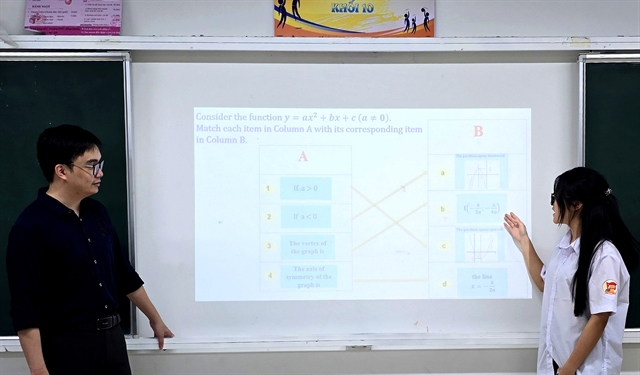 |
| Hồng Quang High School in Hải Phòng City pilots teaching Mathematics in English in the 2025–2026 academic year. VNA/VNS Photo Minh Thu |
HẢI PHÒNG — The northern port city of Hải Phòng is steadily moving to make English a second language in schools and is adopting a range of innovative approaches, including teaching core subjects in English.
At Hồng Quang High School in Lê Thanh Nghị Ward, one of the city’s early adopters, mathematics and chemistry are being piloted in English. The shift has brought a new sense of excitement and creativity to both teachers and students.
Class 10C stands out as a model, where mathematics lessons are delivered in English. Classes have become more dynamic as teachers integrate technology, including artificial intelligence (AI) generated characters that pose questions in English alongside visual graphics that make concepts easier to grasp.
Student Đinh Nguyễn Phương Linh said studying mathematics in English helped expand her vocabulary, improve access to international academic materials and develop logical thinking in both languages.
Phạm Quang Minh, the teacher leading the pilot maths programme, said students looked forward to the lessons thanks to their solid language foundation and strong learning spirit. To enhance effectiveness, teachers invested significant time in designing lessons and applying technology to increase interactivity while helping students master subject-specific terminology.
According to Principal Trịnh Ngọc Tùng, the school launched pilot English-medium instruction for mathematics and chemistry in the 2025–2026 academic year, receiving positive feedback from both teachers and students. To ensure quality, science teachers guide students in familiarising themselves with technical vocabulary, question structures and exercises in English.
During lessons, students are encouraged to ask questions, respond and discuss in English. Initial results show strong engagement, laying the groundwork for expanding English-medium teaching to other subjects.
Implementation has been facilitated by students’ strong English proficiency. Most Grade 12 students hold IELTS certificates with more than 50 per cent scoring 6.0 or higher.
The school has mapped out a clear roadmap to expand English-medium teaching in mathematics, chemistry and eventually other subjects while addressing disparities in teachers’ language proficiency. Core teachers capable of fully teaching in English deliver model lessons that are livestreamed to other classes, allowing both teachers and students to observe and learn. These sessions help teachers acquire key phrases and structures for classroom use. Students are also required to prepare and present content in English.
Looking ahead, the school will pursue three key solutions. First, it will continue its phased approach while gradually increasing the frequency of English-medium lessons. Under this plan, natural science subjects such as mathematics, physics, chemistry and biology will have at least two fully English-taught periods per semester.
Second, the school will foster an English-rich environment by promoting language clubs, debate forums and public speaking competitions.
Third, it will accelerate digitalisation by adopting international learning platforms, enabling both teachers and students to access standardised academic language.
According to Hải Phòng’s Department of Education and Training, alongside Hồng Quang High School several institutions across the city have introduced mathematics teaching in English. Some integrated schools, including Vinschool Imperia, Dewey, Alpha and Hà Nội Star-Hải Phòng Campus, have already implemented international programmes, teaching multiple subjects in English from primary to upper secondary levels.
To strengthen English proficiency among both teachers and students, since the 2018–2019 academic year the department has organised city-level competitions in mathematics and natural sciences in English for lower and upper secondary students. These contests provide opportunities for teachers to exchange experience and improve their subject-specific English, enabling better access to international resources.
In the 2025–2026 academic year alone, the competitions attracted more than 3,700 participants. The education sector also encourages teachers to register for English-medium teaching in annual city-level excellent teacher contests, particularly in mathematics and science subjects.
Đỗ Duy Hưng, Deputy Director of the municipal Department of Education and Training, said the sector would continue advising the city on implementing two major schemes on making English a second language in schools for 2025–2035, with a vision to 2045, and enhancing foreign language teaching and learning for 2025–2035, with orientation to 2045. These initiatives would focus on expanding English-medium instruction, especially in mathematics and science, while diversifying foreign language education to meet learners’ needs.
The sector was also proposing mechanisms to promote socialisation in foreign language education, particularly teaching subjects in English, while attracting qualified language and subject teachers. Policies would be developed to allow foreign teachers and volunteers to participate in teaching alongside support for teachers to obtain international English certifications.
Another key priority would be improving the quality of the teaching workforce through regular assessment and targeted training, enhancing both language proficiency and pedagogical skills for English-medium instruction. The city also planned to send core English and subject teachers abroad for training while ensuring sufficient recruitment of language teachers each year to meet implementation needs, he said. — VNS
Society
 Society
 Society
 Society
 Society
 Society
 Society
 Society
 Society
 Society
 Society
.jpg) Society
Society
 Society
 Society
 Society