 Society
Commune-level digital transformation app launched
1.
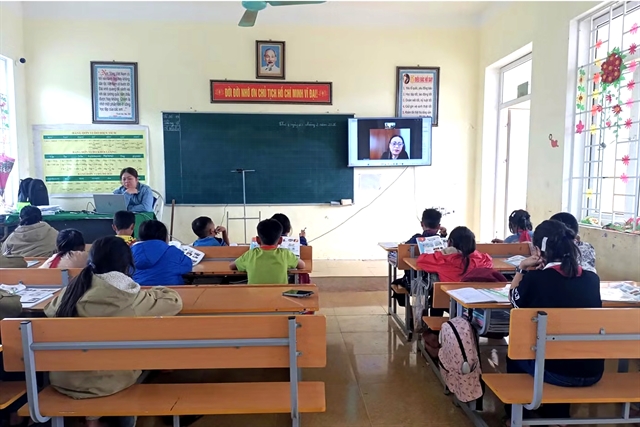 |
| An online English class at Nậm Cắn 2 Primary School. Photo tienphong.vn |
NGHỆ AN — In many schools in the mountainous areas of central Nghệ An Province, a shortage of teachers has led to an improvised but determined approach to English lessons, with teachers in the lowlands and students in border communes connecting via television screens.
Despite never having met in person, these online classes are maintained to ensure students’ learning is not interrupted.
In a small classroom at Nậm Cắn 2 Primary School in Nậm Cắn Commune, a television is placed in the middle of the room. On the screen, a teacher delivers a lesson from a location hundreds of kilometres away.
At the other end, Nguyễn Thị Thuý Hằng, a teacher at Hưng Bình Primary School, teaches via computer. Meanwhile, in the border classroom, 17 students watch attentively, listening to every English sentence.
This is a special class that Hằng began at the age of 50, teaching English to students she has never met in person.
"I was quite surprised during the first lesson. When I tested them, they were 5th graders, but many of them had to start almost from scratch, learning very basic concepts," Hằng tells tienphong.vn.
In the early days, online teaching faced many challenges. The internet connection was unstable and the audio was sometimes interrupted.
There were times when the teacher called out a student’s name but they could not hear, and other times the whole class sat in silence, staring at the screen because the signal had dropped.
But after a while, the class gradually settled into a routine.
With 17 students, Hằng can call on each one individually to read, correct pronunciation and practise conversation.
Whenever a student correctly pronounces an English word, the whole class applauds.
"Even through the screen, I can feel the students' enthusiasm. That motivates me to teach better," Hằng says.
Online English classes are also being held in other schools across the province’s mountainous areas.
At Lưu Kiền Ethnic Semi-Boarding Primary School, they have become increasingly common.
Cao Thị Hồng Na, a third-grade teacher, says online teaching is not as effective as in-person classes. However, with strong support from homeroom teachers, lessons can still run steadily.
In each session, on-site teachers help students maintain connection and interaction with the remote instructor.
To engage pupils, lessons are designed more vividly, often incorporating mini games.
Simple English words are repeated many times so that children gradually become familiar with pronunciation.
"We only hope that one day the children will be able to learn directly from teachers. When teachers are in the classroom, learning will definitely be more effective," Na says.
The reliance on online classes reflects a deeper issue, as many schools in mountainous areas face a serious shortage of English teachers.
Trần Xuân Hùng, principal of Lưu Kiền Ethnic Semi-Boarding Primary School, says the school has 10 classes with 300 students, 200 of whom board at the school.
“Most of the students are children from ethnic groups, and their learning conditions are still very limited," Hùng says.
"Without teachers, the students are at a disadvantage. English is a compulsory subject, but in remote schools like ours, finding teachers is very difficult."
The situation is not unique to one school, with many across Nghệ An Province facing similar challenges.
At Nậm Cắn 2 Primary School, there are seven classes with 163 students. Merging them with another school was considered, but the distance of nearly 30km made travel impractical.
For years, the school has also lacked IT and English teachers.
Đặng Xuân Quế, the school’s vice principal, says that in the first semester of this school year, an English teacher was hired but teaching stopped after a few weeks.
To ensure students do not miss out entirely, the school has adopted alternative measures. For IT lessons, an art teacher with technological skills teaches pupils from grades three to five, Quế says.
According to the Nghệ An education sector, about 20 primary schools in the province lack English teachers, mainly in mountainous districts such as Tương Dương, Kỳ Sơn and Quế Phong.
This leaves thousands of students at risk of missing a compulsory subject.
While online teaching helps prevent learning gaps during teacher shortages, it remains a temporary solution.
Recent recruitment drives have allocated more English teaching positions to mountainous communes in an effort to address the shortage.
However, the challenge lies not only in recruitment but also in retaining teachers in disadvantaged areas, he says. — VNS
Society
 Society
 Society
 Society
 Society
 Society
 Society
 Society
.jpg) Society
Society
 Society
 Society
 Society
 Society
 Society
 Society