 Society
Việt Nam has five Halal certification bodies recognised by Malaysia
1.
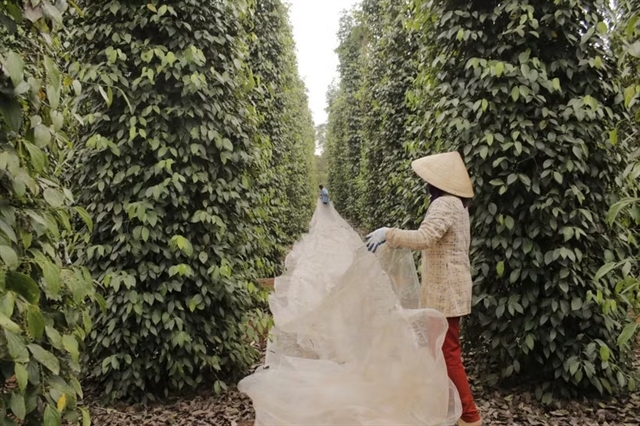 |
| Amid a shortage of seasonal labour, farmers in HCM City’s main pepper-growing areas are laying nets to collect ripe pepper as it falls. — VNA/VNS Photo Hoàng Nhị |
HCM CITY — Since the beginning of the year, rural areas of HCM City have once again been confronted with a familiar yet growing problem, with a shortage of seasonal labour affecting both agricultural harvesting and offshore fishing activities.
In early April, Nguyễn Bình Tuys' one-hectare pepper farm in Hiệp Thành hamlet, Bình Giã Commune, remained only partially harvested, despite the peak season having started nearly two months earlier.
In previous years, with sufficient labour, the harvest would have been completed in just over two weeks. Now, it stretches close to two months.
Daily wages have climbed to VNĐ300,000 (US$11.4), yet workers remain scarce. Younger labourers have largely migrated to factory jobs, drawn by stable incomes and less physically demanding work. Those who remain in rural areas are mainly middle-aged or elderly.
This situation is not uncommon. Across pepper-growing households, farmers are resorting to unusual measures, paying deposits to secure workers before the Lunar New Year, covering meals and accommodation during harvest, and in some cases relying on support from local authorities, including soldiers and youth volunteers.
The consequences are already noticeable and severe, with harvests pushed back, a growing likelihood of crop losses, and a continued drop in incomes.
If farmers on land are struggling, fishermen face an even harsher reality.
Vũ Văn Lạng, a veteran fisherman with nearly 50 years at sea, said he has never seen such difficulty in recruiting crew members. Of his family’s 19 fishing boats, 10 now sit idle due to a lack of labour.
Even a 50–50 profit-sharing arrangement has failed to attract workers.
The challenges go beyond recruitment. Boat owners often must advance money to secure crew, only to face cases where workers disappear, or even abandon voyages mid-trip, causing significant financial losses.
For many young workers, the fishing profession has simply lost its appeal. Long, hazardous days at sea, combined with uncertain income dependent entirely on the catch, make it far less attractive than land-based jobs.
“If the catch is good, you earn. If not, you come back empty-handed,” Đồng Thanh Điền, a fisherman in Phước Hải Commune said.
As a result, the fishing workforce is aging rapidly, raising concerns about long-term sustainability.
Adapting to a new reality
Faced with persistent labour shortages, many rural producers are no longer waiting for solutions, they are creating their own.
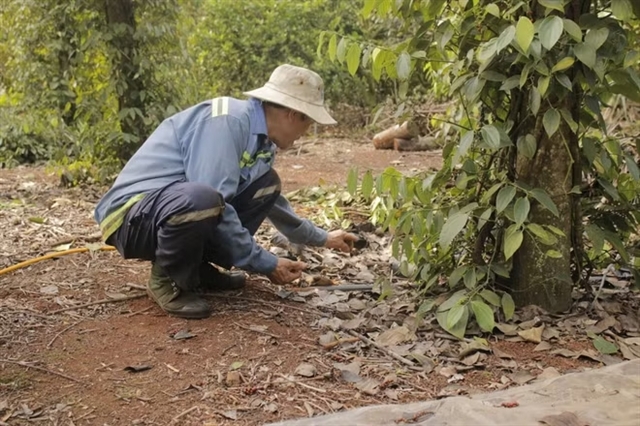 |
| A farmer in Bình Giã Commune gathers fallen peppercorns from the ground. |
On his pepper farm, Tuy has begun laying nets across the ground during peak season, allowing ripe peppers to fall and be collected more easily, reducing the need for manual picking.
Elsewhere, some farmers are shifting crops entirely.
Võ Ngọc Thanh, 75, a farmer from Kim Long Commune, has transitioned from labour-intensive pepper and durian cultivation to coffee, which requires less effort to maintain and harvest.
In the fisheries sector, technological adoption is gaining ground.
The situation is already stark, as harvests are delayed, the risk of crop losses grows, and incomes keep declining. Mechanisation, once considered optional, is now becoming essential.
Vũ Ngọc Đăng, head of the HCM City's Rural Development Sub-Department, said the labour shortage reflected deeper changes. Rapid urbanisation and the shift toward industrial and service-sector employment have steadily drawn workers away from agriculture and fishing.
"Mechanisation is increasingly viewed as a key solution, not only to reduce dependence on manual labour, but also to improve productivity and product quality," he said.
However, limited access to capital continues to be a major obstacle, highlighting the importance of supportive credit policies.
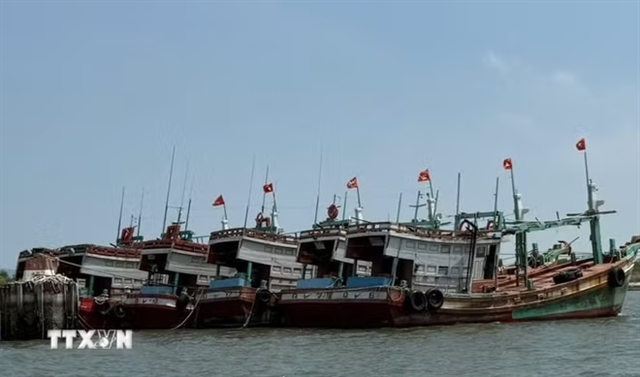 |
| Fishing boats have been idle for days due to a shortage of workers. |
In fisheries, improving the profitability of each voyage is equally critical. Without better income and working conditions, the industry is unlikely to regain its appeal to younger workers, Đăng said.
At the same time, investment in vocational training and rural social welfare will be essential to building a more sustainable workforce.
The shortage of rural labour is no longer a localised concern. It is a widespread trend accompanying Việt Nam’s rapid urban transformation.
In HCM City, where industrial and service sectors continue to expand at pace, retaining workers in agriculture is especially difficult. Yet within this challenge lies an opportunity.
The shift away from manual labour is prompting a gradual restructuring of the agricultural sector, toward modernisation, higher efficiency, and greater value creation.
From nets spread across pepper fields to fishing boats equipped with modern machinery, these adaptations are more than temporary fixes. They signal the early stages of a broader transformation in how rural economies function.
For now, farmers and fishermen continue to navigate an uncertain landscape, hoping that stronger policies and practical, innovative solutions from local authorities will arrive in time to support their transition. — VNS
Society
 Society
 Society
 Society
 Society
 Society
 Society
 Society
 Society
 Society
 Society
 Society
 Society
 Society
 Society