 Society
Cambodian PM Hun Manet chairs welcome ceremony for Vietnamese counterpart Lê Minh Hưng in Phnom Penh
1.
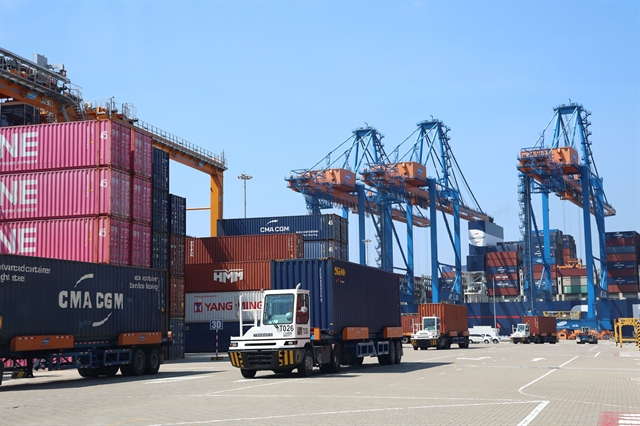 |
| Container trucks at the Gemalink Port at the Cái Mép port system. — VNA/VNS Photo |
HCM CITY — HCM City authorities are accelerating preparations for breaking ground on three major seaports, which is expected to be done on April 30, Reunification Day.
But they have admitted that not all are ready in terms of legal status to proceed on schedule, underscoring persistent procedural bottlenecks in large-scale infrastructure development.
Nevertheless, according to a recent report submitted by the city Department of Construction to the People’s Committee, the three are being lined up for either groundbreaking or ceremonial launch.
They include the second phase of the Cái Mép Gemadept Terminal Link Port and the Cái Mép Hạ General and Container Port (phase one) in Vũng Tàu Ward and the Cần Giờ International Transshipment Port in Cần Giờ Ward.
Legal formalities are complete only for Cái Mép Gemadept.
But their developers insist on going ahead during the holidays though the department has raised concerns over feasibility.
The Cái Mép Hạ General and Container Port stands out as one of the most ambitious projects in the city pipeline.
To spread over 351.2ha, it will cost around VNĐ50.2 trillion (US$2 billion).
Once complete, it will have a capacity of 11 million twenty foot equivalent unit (TEU) per year and accommodate ultra-large container vessels of up to 24,000 TEU, equivalent to roughly 250,000 tonnes.
Its initial phase will cost VNĐ14.87 trillion ($590 million).
It will include two main berths with a combined length of 900 metres and capable of receiving the ultra-large container vessels and nine barge berths stretching 1,027 metres for vessels of up to 5,000 tonnes.
Its designed capacity is expected to be two million TEU annually.
The project has received approval for its investment form last January, with a consortium comprising Geleximco Group, International Transport and Trading Joint Stock Company and the State Capital Investment Corporation recognised as the developer.
But the Department of Construction, saying that a substantial volume of administrative and legal procedures remains incomplete, warned that commencing construction during the April 30 milestone would not be legally secure or practically feasible.
Outstanding issues include land clearance, boundary demarcation and completion of relevant permits.
Officials pointed out that even preliminary works such as site preparation could only proceed once all the required land is handed over.
The department has urged the city administration to instruct the investor consortium to coordinate closely with relevant agencies and local authorities to finalise boundaries and complete all procedures before April 25.
The Cần Giờ International Transshipment Port is a mega project of strategic significance not only for HCM City but also for Việt Nam’s position in global maritime logistics.
It is proposed to be built on 571ha at a cost of approximately VNĐ128.87 trillion ($4.99 billion).
Once completed, it is expected to have a capacity of 21 million TEU per year and to handle container vessels exceeding 250,000 DWT.
The main berth alone will extend to about 7,465m, among the largest in the region.
The project has attracted a consortium comprising Vietnam Maritime Corporation, Saigon Port Joint Stock Company and Terminal Investment Limited Holding S.A.
The consortium submitted its application in early March 2026 and is now awaiting appraisal by the Department of Finance.
However, the Department of Construction noted that the project has yet to receive formal approval, and any launch ceremony or announcement of strategic partners could only take place after it is granted.
The department has recommended that the city government conditionally approve a launch event, provided the approval comes in time.
It has also urged the Department of Finance to expedite the appraisal process and submit its evaluation for approval of investor selection results.
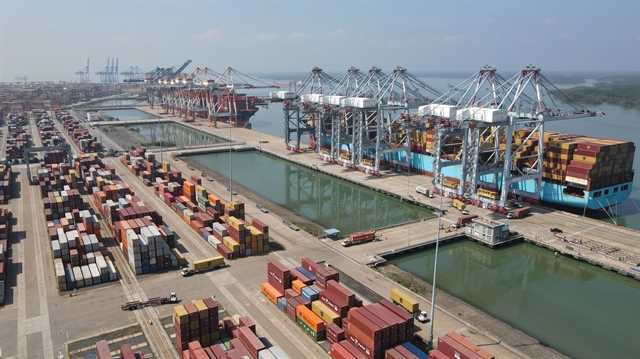 |
| The Cái Mép International Port has become a key hub in the Gemini Cooperation with an important role to play in enhancing connectivity between the Cái Mép–Thị Vãi port cluster and international shipping routes. — VNA/VNS Photo |
Gemadept cleared for launch
On the other hand, the second phase of the Cái Mép Gemadept Terminal Link Port is in an advanced position in legal terms.
The project, spanning 93ha, has completed its first phase with an 800-metre main berth and 190m of auxiliary berths.
It can handle vessels of up to 232,000 tonnes.
The second phase will significantly expand capacity with a 285-metre main berth for vessels of up to 250,000 DWT, a 359-metre upstream berth for vessels of up to 150,000 DWT and a 390-metre barge berth for vessels of around 5,600 DWT.
Its cost is estimated at VNĐ8.361 trillion ($330 million).
Importantly, the entire land required has already been allocated and leased for the project.
So the Department of Construction has greenlit the developer’s request to hold the groundbreaking ceremony on April 17.
The mixed status of the three projects highlights a broader tension between ambitious timelines and regulatory realities.
While aligning milestones with national celebrations carries symbolic value, experts note that legal certainty and procedural completeness are essential for long-term viability.
The Cái Mép – Thị Vải port cluster, where two of the projects are located, has already established itself as one of Southeast Asia’s most important deep-water ports.
Its ability to handle some of the world’s largest container vessels has reduced reliance on foreign transshipment hubs and strengthened Việt Nam’s export competitiveness.
The addition of the Cái Mép Hạ port and expansion of the Gemadept Terminal Link are expected to further consolidate this position, boosting capacity and connectivity with global shipping routes.
Meanwhile, the Cần Giờ International Transshipment Port is envisioned as a transformative project that could elevate HCM City into a major international logistics hub.
Located near key maritime routes and supported by improving inland transport links, it could attract significant transshipment flows currently handled by regional competitors.
Nevertheless, analysts cautioned that such mega projects require close coordination between multiple agencies and strict adherence to legal frameworks.
Delays in land clearance, environmental approvals and identification of developers remain common challenges.
City authorities have repeatedly stressed their commitment to speeding up infrastructure development to support economic growth and regional connectivity.
In recent years the city has prioritised investment in transport, logistics and industrial infrastructure to reinforce its role as the country’s leading economic centre.
The current push reflects this direction, particularly amid growing global trade and shifting supply chains.
By expanding port capacity and improving efficiency, the city aims to enhance its appeal to international investors and logistics operators.
Yet the Department of Construction’s report underscores that administrative readiness is as critical as financial and technical capacity.
Without a solid legal foundation, even well-funded projects could suffer delays or complications that affect long-term outcomes.
As the April 30 milestone approaches, attention will focus on whether key procedures can be completed in time to allow at least part of the planned activities to proceed.
The Gemadept project will move ahead as scheduled, but the other two depend heavily on the pace of approvals in the coming weeks.
In the longer term successful implementation could reshape the maritime landscape of southern Việt Nam, reinforcing HCM City’s role as a gateway for international trade and a central node in regional logistics networks. — VNS
Society
 Society
 Society
 Society
 Society
 Society
 Society
 Society
 Society
 Society
 Society
 Society
 Society
 Society
 Society