 Society

Tuyên Quang festival offers a hands-on experience of Tày culture
1.
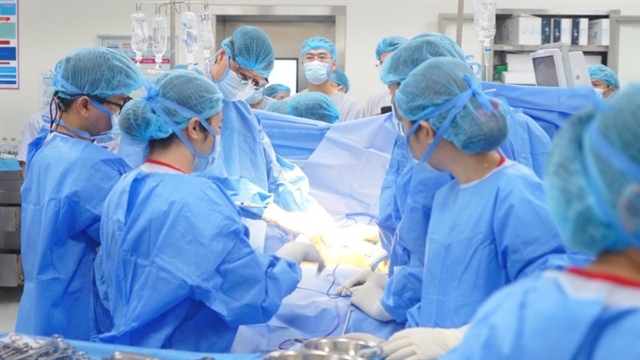 |
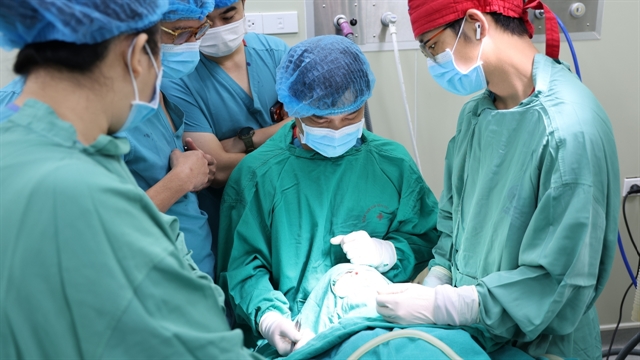
| The team proceeds to take multiple organs from the donor. — Photo nhandan.vn |
HÀ NỘI — Doctors in Hà Nội carried out a complex multi-organ retrieval and transplant operation on Saturday using organs donated by a 31-year-old man declared brain-dead, a decision by his family that ultimately saved six lives.
The young man had been admitted to E Hospital at 11.30pm on Thursday following a serious road traffic accident.
He suffered a severe traumatic brain injury, including a subdural haematoma, subarachnoid haemorrhage and widespread cerebral oedema.
By Saturday morning, he was declared brain-dead.
In the midst of overwhelming grief, his family made an extraordinary decision to donate his organs, offering hope and a second chance at life to patients in critical need.
Shortly after consent was given, a multidisciplinary consultation was convened at 9am, bringing together leading specialists from hospitals across Hà Nội.
The meeting was chaired by Associate Professor Nguyễn Hoàng Ngọc, Deputy Director of the 108 Central Military Hospital.
After nearly two hours of careful assessment, a coordinated allocation plan was agreed.
The heart, right lobe of the liver and one kidney were transported to the 108 Central Military Hospital; a second kidney was transplanted at E Hospital; the left lobe of the liver was sent to Vinmec International Hospital for a paediatric recipient; the lungs were delivered to the National Lung Hospital; and two corneas were transferred to the tissue bank at the 103 Military Hospital.
By 1pm on Saturday, multiple specialist teams from the 108 Central Military Hospital, including cardiac, hepatic and renal surgeons, alongside anaesthesia and intensive care teams, had arrived at E Hospital to assist with organ retrieval and transplantation.
Lê Trung Hiếu, Acting Director of the 108 Central Military Hospital’s Organ Transplant Centre, said the operation highlighted the strength of a coordinated medical system.
“In this procedure, we undertook three critical roles simultaneously, receiving organs and performing heart, liver and kidney transplants at our hospital; splitting the donor liver to save two patients; and dispatching a team to carry out a kidney transplant at a partner hospital,” he said.
“It demonstrates that in organ transplantation, a strong system can save more lives than any single outstanding individual.”
Throughout the procedure, key data, including aortic cross-clamp time, organ retrieval and transport, were continuously relayed in real time to the 108 Central Military Hospital, where transplant teams stood ready to operate the moment the organs arrived.
At 4pm, the donor heart was retrieved at E Hospital. Just 28 minutes later, it reached the operating theatre at the 108 Central Military Hospital, where it began beating again in its recipient.
At 4.25pm, the liver was removed at E Hospital and transported to two hospitals.
The donation saved two patients, a child at Vinmec International Hospital and a 53-year-old woman suffering from decompensated cirrhosis at the 108 Central Military Hospital.
At 4.45pm, the kidneys were retrieved and transferred to the 108 Central Military Hospital for transplantation.
Ambulances carrying the organs departed in quick succession, racing against time to deliver life-saving grafts to waiting patients, each journey carrying the hopes of hundreds of medical staff working against the odds.
Most complex procedures
Vũ Văn Quang, Deputy Head of the Hepato-Biliary-Pancreatic Surgery Department, described liver transplantation as one of the most technically demanding procedures in modern medicine.
“We now perform this procedure routinely,” he said.
“It allows us to maximise the use of precious donor organs and expand survival opportunities, particularly at a time when organ donation remains limited.”
One of the liver recipients, a woman diagnosed four years ago with cirrhosis, likely linked to autoimmune hepatitis, had seen her condition deteriorate, with symptoms including fatigue, jaundice, poor appetite and insomnia.
She was later diagnosed with decompensated cirrhosis at the 108 Central Military Hospital.
Following the transplant, her condition has stabilised and she remains under close monitoring.
The heart transplant recipient is also under intensive care, with doctors closely tracking recovery.
For the kidney procedures, two surgical teams were deployed, one operating at E Hospital and the other at the 108 Central Military Hospital.
Nguyễn Việt Hải, Director of the hospital’s Centre for Urology and Andrology, confirmed both transplants had been successful.
“From recipient evaluation to each surgical step, we ensured safety and precision. Both transplanted kidneys are functioning well, with stable patient conditions,” he said.
Beyond the immediate life-saving impact, the operation also marked a step forward in expanding Việt Nam’s transplant capacity.
By directly performing and transferring kidney transplant techniques to E Hospital, doctors from the 108 Central Military Hospital are helping to strengthen a nationwide transplant network.
A lasting legacy
The donor’s mother, struggling to hold back tears, spoke of the family’s decision.
“Everything happened so quickly. When we heard our son had been in a very serious accident and was rushed to hospital, we were devastated,” she said.
“It was unbearably painful when doctors told us his condition was critical, with no hope of recovery despite their best efforts.”
“They said he could save six or seven people. So we tried to overcome our grief, to give others a chance to live. I only hope that the transplants succeed, so that in some way, my son can continue to live on, doing something meaningful for others.” — VNS
Society
 Society
 Society
 Society
 Society
 Society
 Society
 Society
 Society
 Society
 Society
 Society
 Society
 Society
 Society