 Society

Japan’s centenarian population tops 100,000 for first time
1.
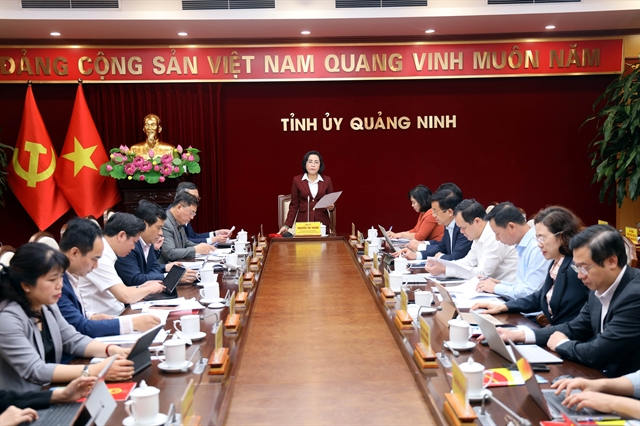 |
| Nguyễn Thị Thanh, Deputy Chairwoman of the National Assembly, chairs a working session with the Quảng Ninh Province's Election Committee on Tuesday. — VNA/VNS Photo Đức Hiếu |
QUẢNG NINH — Senior officials have urged Quảng Ninh Province to strictly follow central directives and fully implement the Party Central Committee’s conclusions to ensure the election of the correct and full number of deputies to the 16th National Assembly and People’s Councils at all levels for the 2026-2031 term.
The instruction was delivered by Nguyễn Thị Thanh, Member of the Party Central Committee, Deputy Chairwoman of the National Assembly and member of the National Election Council, as she led an inspection and supervision delegation on electoral preparations in the north-eastern province on Tuesday.
Thanh called on provincial authorities to maintain close and comprehensive leadership over the remaining stages of the electoral process, including post-election work, ensuring strict compliance with the timetable and the law, with no room for error.
She urged the province to organise election campaigning effectively, creating equal conditions for candidates to exercise their lawful rights.
Action programmes, she said, should be practical and aligned with the province’s profile as a border, industrial, service, tourism and maritime economy.
Electoral teams were instructed to review and update voter lists accurately and comprehensively, particularly in areas experiencing significant population fluctuations such as industrial parks, economic zones and tourist hubs.
Special attention should be paid to temporary residents, shift workers, voters in border and island communes, the elderly and people with disabilities, ensuring all eligible citizens can exercise their right to vote.
Election committees at all levels were told to strengthen professional training and guidance, particularly in newly merged localities and among newly appointed officials who lack experience.
Contingency plans and response scenarios should be developed, with key areas clearly identified to prevent passivity or unexpected disruptions.
The province must also safeguard political security and social order, especially in border areas, border gates, seaports and other sensitive locations.
Authorities were urged to proactively prevent and address malicious information and any attempts to exploit the election to sow division or destabilise society.
Thanh emphasised the need to deploy digital transformation applications effectively in the electoral process, ensuring systems operate smoothly, securely and accurately.
Thorough checks must be conducted before, during and after polling day, particularly when aggregating and reporting results, to avoid technical incidents.
Local authorities have been asked to ensure adequate facilities, funding and personnel and to comprehensively review all polling stations.
Travel conditions and communications infrastructure in mountainous and island areas must be secured, while voters should be promptly informed of polling times and locations.
Decoration and ceremonial arrangements must be conducted solemnly and in line with regulations.
She underlined that the election is taking place amid ongoing restructuring and streamlining of the administrative apparatus.
The newly implemented two-tier local government model remains in its early stages, and many officials in various localities are newly appointed and not yet fully familiar with their areas or local populations.
These factors, she said, require even more decisive, attentive and responsible leadership at the local level.
At the working session, Lê Văn Ánh, Deputy Chairman of the provincial People’s Committee, said the province has established one provincial election committee and 54 commune-level election committees.
Three National Assembly Election Boards have been formed to elect nine deputies to the National Assembly, including three centrally nominated and six local candidates.
In addition, 15 provincial-level People’s Council Election Boards will oversee the election of 56 deputies, while 363 commune-level Election Boards will supervise the election of 1,115 deputies.
A total of 1,243 electoral teams have been established, corresponding to 1,243 polling stations.
The establishment of these bodies has been carried out in accordance with proper authority, procedures and timelines, laying an important foundation for subsequent stages.
Consultative conferences have been organised in a democratic, transparent and open manner, ensuring compliance with regulations on structure, composition and candidate surplus.
Notably, the proportion of female candidates is relatively high, reflecting a strong commitment to gender equality and representative quality.
Women account for 40 per cent of National Assembly candidates, 48.38 per cent of provincial People’s Council candidates and 44.43 per cent at commune level.
The reception of candidate dossiers, professional training, communications work and security arrangements for the election have all been implemented proactively, synchronously and in line with regulations.
Nguyễn Hữu Quý, Secretary of the Party Committee of Bãi Cháy Ward, said the ward’s election committee has thoroughly briefed members of electoral teams and used Zalo groups to communicate with voters, ensuring compliance with required structures and composition.
The ward has publicly posted voter lists and updated changes in a timely manner.
Decoration and ceremonial preparations have been completed ahead of schedule, with contingency measures in place for unforeseen circumstances.
No complaints or denunciations have been lodged against any candidates, and residents are said to be eagerly awaiting polling day, he said. — VNS
Society
 Society
 Society
 Society
 Society
 Society
 Society
 Society
 Society
 Society
 Society
 Society
 Society
 Society
 Society