 Society

Tech sector growth opens up opportunities for Việt Nam to go global
1.
|
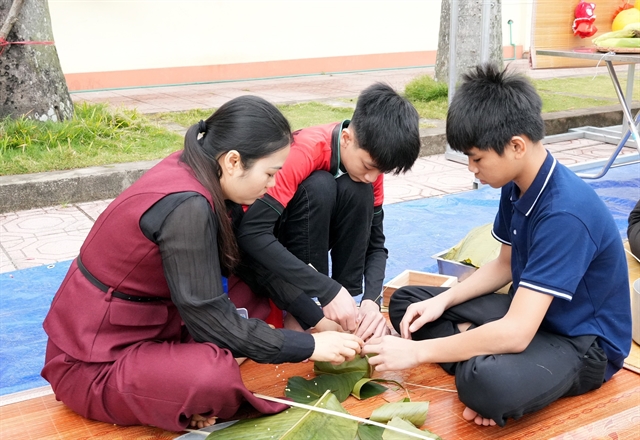
| A teacher guides students with disabilities to make bánh chưng (Vietnamese square sticky rice cake) to welcome Tết holiday in Bắc Ninh Province. — VNA/VNS Photo Đồng Thúy |
Thu Trang
HÀ NỘI — Fresh high-level policy direction on disability inclusion is giving new momentum to efforts to expand inclusive education for students with disabilities in Việt Nam, as government agencies, educators, organisations of persons with disabilities and development partners move to scale up practical solutions nationwide.
The renewed push reflects both long-standing national policy and growing recognition that implementation must accelerate to match ambition.
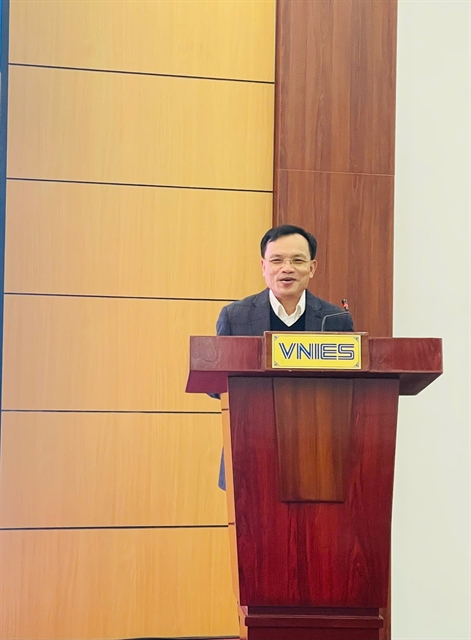
“Inclusive education for children with disabilities is one of the major, consistent orientations of our Party and State, clearly manifested in the Education Law, the Law on Persons with Disabilities, as well as the current strategies, programmes and projects for education development,” said Associate Professor Mai Văn Trinh, deputy director of the Việt Nam Institute of Educational Sciences.
Beyond domestic law, inclusive education is also central to Việt Nam’s international commitments, including the Sustainable Development Goals, particularly SDG 4, which aims to ensure quality, equitable and inclusive education for all.
Despite progress, significant obstacles remain at the local level.
“The implementation of inclusive education in localities still faces many difficulties and challenges, from inter-sectoral coordination mechanisms, the capacity of the workforce, conditions, to effectively connecting management levels, schools, families and communities,” Trinh said.
Against that backdrop, closer, more substantive and sustainable coordination between domestic agencies and international organisations has become increasingly important. That need for cooperation was the focus of a national multi-sectoral workshop titled 'Collaboration to Promote Inclusive Education Models for Students with disabilities in Việt Nam,' held early this week.
The workshop was jointly organised by the Việt Nam Institute of Educational Sciences and the United Nations Development Programme with funding from the Global Disability Fund.
It took place at a pivotal moment following the issuance of Conclusion Notice No.444-TB/VPTW by the Office of the Central Party Committee. The conclusion sets out strategic directions for disability affairs in Việt Nam and signals an important shift toward a more rights-based and inclusive approach to development, reinforcing the policy momentum behind expanding inclusive education nationwide.
|
| Associate Professor Mai Văn Trinh, deputy director of the Việt Nam Institute of Educational Sciences, speaks at the workshop. — VNS Photo Thu Trang |
Integral part
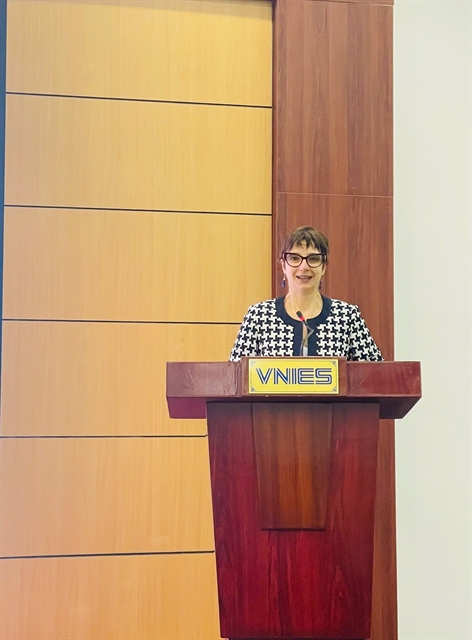
Speaking at the workshop, Federica Dispenza, Assistant Resident Representative of UNDP in Việt Nam, said Conclusion 444 strongly affirmed two critical principles.
“First, that persons with disabilities are an integral part of the national community. And second, that persons with disabilities are not merely beneficiaries of charity, but rights-holders and contributors to national development,” she said.
She noted that the conclusion firmly embraces the social model of disability and calls on the entire political system to remove barriers and ensure accessibility is embedded in the design of public buildings, products and services.
Despite that policy direction, gaps in educational inclusion persist. According to the Việt Nam Disability Survey 2023, the proportion of children with disabilities attending school at the appropriate age alongside their peers declined at all three levels of general education compared with 2016. The sharpest drops were recorded at the primary and lower secondary levels, falling by 13.6 and 14.4 percentage points respectively.
“We know that an inclusive education system is not only about placing children with disabilities into mainstream classrooms. It is about ensuring that every learner can participate meaningfully, learn effectively and thrive with dignity,” she said.
|
| Federica Dispenza, Assistant Resident Representative, UNDP in Việt Nam, confirms that persons with disabilities are an integral part of the national community. — VNS Photo Thu Trang |
By adopting an inclusive, multisectoral and systematic approach through the joint programme 'Collaborating for an Inclusive Future,' early tangible results have begun to emerge.
“We have built Việt Nam’s first-ever system for producing and distributing accessible electronic textbooks,” said Federica.
A total of 147 accessible e-textbooks meeting international standards are now available to secondary students with print disabilities through a new digital library and mobile application. More than 100 students, teachers and parents in Hà Nội, HCM City, Hải Phòng and Đà Nẵng have been trained and have used the materials.
“In strengthening inclusive education practice, more than 100 educators and managers across Việt Nam have been trained in practical skills, such as lesson planning based on universal design for learning and positive behaviour support. These are essential daily tools that help teachers respond to the diversity in their classrooms,” she said.
She added that comprehensive sexuality education has also been successfully integrated into everyday learning and activities in three schools in Đà Nẵng City.
Looking ahead, Federica underscored the need to embed inclusive education in policy, invest in teacher capacity and accessible learning materials and ensure that the voices of persons with disabilities remain central to solutions.
Đinh Việt Anh, deputy chairwoman of the Việt Nam Blind Association, emphasised the need for concrete systemic reforms.
She called for the formal recognition of accessible digital textbooks as an official format, with clear technical standards, publishing and accessibility appraisal processes and a born accessible approach to ensure that all students can read books at the same time. She also highlighted the urgency of accelerating the development of inclusive education resource centres in line with national planning and of building a strong ecosystem of specialised support personnel within schools.
Looking to the next phase, authorities said further steps are planned to advance inclusive education for students with disabilities nationwide.
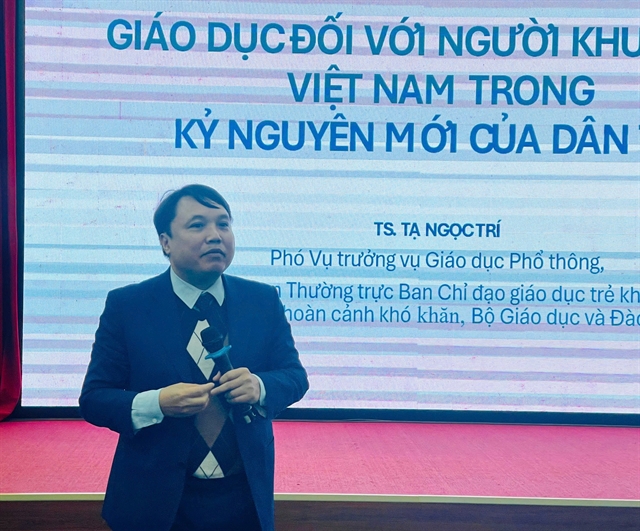
Tạ Ngọc Trí, deputy director of the General Education Department under the Ministry of Education and Training, said: “To effectively implement the policy on inclusive education for persons with disabilities, Việt Nam's priority in the coming years is to develop a system of specialised educational institutions for persons with disabilities and a system of public centres for supporting inclusive education development across all localities, alongside encouraging the development of private educational institutions.”
A clear roadmap for localities to establish this system was approved by the Prime Minister in Decision No. 403/QĐ-TTg, issued on February 25 last year.
Localities are currently developing implementation plans based on approved projects under the Master Plan set out in Decision No. 2056/KHG-BGDĐT, issued on July 16 last year by the Minister of Education and Training.
Conclusion No. 444 by the Party General Secretary also calls for a review of centres supporting inclusive education development in localities and for the development of learning materials for students with hearing and visual impairments.
“The MoET clearly recognises the importance of these centres for supporting inclusive education development and accessible learning materials in advancing inclusive education and is actively reviewing as directed. From there, the MoET will promptly issue guidance to enable localities to effectively implement the General Secretary's directives on these matters,” Trí said.
|
| Tạ Ngọc Trí, deputy director of the General Education Department under the Ministry of Education and Training, affirms that many work should be done to expand inclusive education for students with disabilities. — VNS Photo Thu Trang |
The Ministry of Education and Training will also step up inspection and monitoring of localities in implementing the Master Plan, while continuing to refine its system of guiding documents to ensure the framework operates effectively once in place.
The ministry has clearly identified education development for persons with disabilities as a priority in recent Party and State directives, including Resolution No. 71 and the amended Law on Education 2019. These documents address compulsory education at the primary and lower secondary levels, progress toward universal upper secondary education and equivalent pathways, and the organisation of upper secondary education suited to persons with disabilities and local conditions.
“The MoET is urgently developing regulations on electronic versions of textbooks. In essence, the regulations already include electronic textbook formats,” said Trí.
He stressed that students with disabilities need convenient and simultaneous access to learning materials alongside their classmates. That requirement is increasingly achievable as technology advances, with electronic publishing applications such as InDesign now incorporating accessibility features.
“In the coming period, the MoET will research and direct the Việt Nam Education Publishing House to develop processes for publishing accessible electronic textbooks for all students,” he added.
|
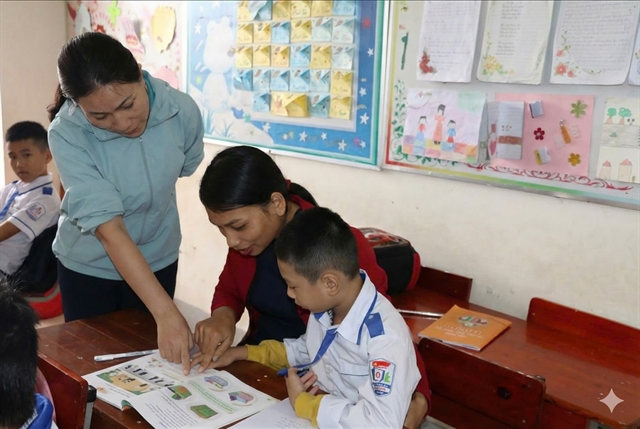
| Teachers instruct a student with disabilities at the Nam Lĩnh Primary School in Nghệ An Province. — VNA/VNS Photo Bích Huệ |
As a result, students with disabilities will be able to use the same textbook versions as their peers without waiting for converted materials. This will help eliminate situations in which they attend classes without books, relying solely on lectures and struggling to complete homework.
Concurring with the ministry’s efforts, Associate Professor Trinh said: “We work together to implement inclusive education models, aiming for the goal that every child, whether with or without disabilities, learns in a safe educational environment that respects differences and maximises their potential.” — VNS
Society
 Society
 Society
 Society
 Society
 Society
 Society
 Society
 Society
 Society
 Society
 Society
 Society
 Society
 Society