 Society

Sovico and Hamburg Forge Partnership to Expand Vietnam-Germany Economic Ties
1.
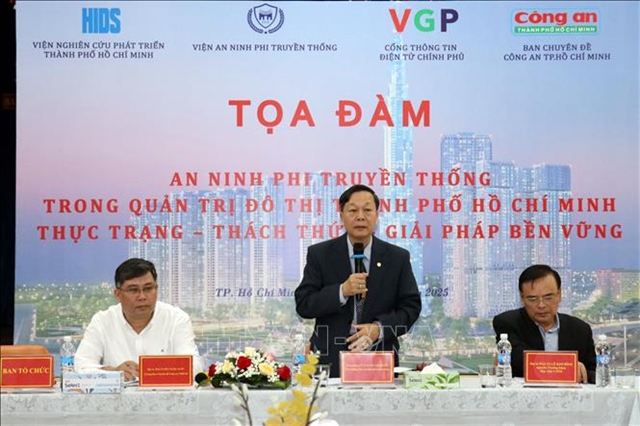 |
| Associate Professor Dr Lê Kim Bình, former head of a faculty at the People’s Police Academy, delivers the opening remarks at the workshop. — VNA/VNS Photo Tiến Lực |
HCM CITY — Rapid urban growth is exposing HCM City to rising non-traditional security risks, including traffic congestion, flooding, environmental pollution and drug-related crime, that require comprehensive, coordinated solutions beyond law enforcement alone, experts said at a workshop on Friday (December 26).
The workshop, titled “Non-traditional security in HCM City’s urban governance: Reality – challenges – sustainable solutions”, was co-organised by the Institute for Non-Traditional Security under the Vietnam National University–Hà Nội’s School of Governance and Business, the Government Portal, the HCM City Police’s Special Topics Board, and the HCM City Institute for Development Studies.
Associate Professor Dr Lê Kim Bình, former head of a faculty at the People’s Police Academy, said the city’s fast-paced growth has exposed it to increasing non-traditional security risks.
“These issues include traffic congestion, flooding and tidal inundation, environmental pollution, and drug-related crime, all of which are already priority tasks in the city’s action programme implementing the Party Congress resolution.”
He said the workshop aimed to provide scientific and practical evidence to support policymaking and improve the effectiveness of urban governance, contributing to the goal of building a safe, smart and sustainable city with high adaptive capacity.
“The city needs a comprehensive approach, not one that relies solely on law enforcement, on the goal of building a drug-free HCM City,” he said.
He called for coordinated solutions ranging from early prevention in schools and families, community-based communication and education, early intervention and treatment that view drug addiction as a public health and social issue, to support for livelihoods and reintegration to reduce relapse.
He underscored the importance of combating organised and transnational drug crime, including online-related offences.
Architect Phạm Văn Phước, deputy director of the city's Institute for Urban Planning and Construction, said HCM City's expanding population, economy and infrastructure have made non-traditional security challenges more visible and interconnected.
“Prolonged traffic congestion, climate change-induced flooding, environmental pollution, water and energy security, epidemics, crime and social evils, if not addressed holistically, could become major obstacles to sustainable development.”
 |
| Delegates chair the workshop on non-traditional security in HCM City’s urban governance. — VNA/VNS Photo Tiến Lực |
Non-traditional security issues often cut across sectors and administrative boundaries, spread rapidly and are difficult to control without effective coordination and data-sharing mechanisms.
He called for integrating non-traditional security considerations into urban master plans, regional planning and specialised sectoral plans, while promoting a multi-centre urban governance model with unified coordination between the city and surrounding localities to tackle inter-regional challenges in transport, environment, water resources, waste management and social welfare.
During the workshop, participants discussed post-merger urban restructuring towards a “multi-polar, integrated and connected” model, urban traffic bottlenecks, public order and sidewalk management, environmental and water pollution, air quality, climate change impacts, flooding and tidal inundation in urban and riverside areas, as well as efforts to build a drug-free city. — VNS
Society
 Society
 Society
 Society
 Society
 Society
 Society
 Society
 Society
 Society
 Society
 Society
 Society
 Society
 Society




