 Environment

Vietnamese, Panamanian first ladies bond over ethnic textiles at Hà Nội cultural event
1.
 |
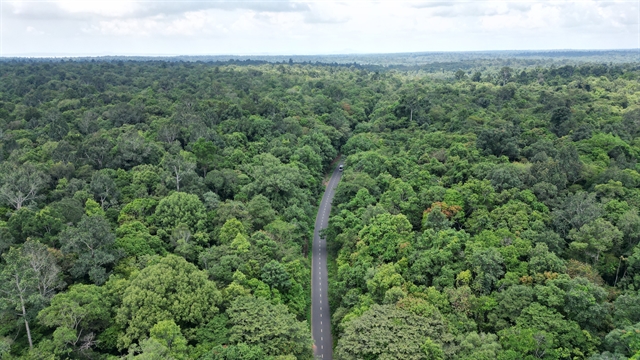
| An aerial view of Pù Huống Nature Reserve which makes up a green corridor in Nghệ An Province together with Pù Mát National Park and the Pù Hoạt Nature Reserve. — VNA/VNS Photo |
NGHỆ AN — Việt Nam is accelerating its move toward modern and sustainable forest management, aiming for 70 per cent of special-use and protection forests to adopt smart technologies for data storage, patrolling, monitoring and biodiversity conservation, VNFOREST said at its annual review conference on Monday at Pù Mát National Park in Nghệ An Province.
Việt Nam currently manages 14.87 million hectares of forests, including 10.13 million hectares of natural forest and 4.74 million hectares of planted forests, with a national coverage rate of 42.03 per cent.
The 2024 national forest status report records 14.874 million hectares of forested land, equivalent to 44.89 per cent of the national territory, underscoring the sector’s pivotal role in the ecosystem and sustainable development.
Speaking at the event, VNFOREST director general Trần Quang Bảo said these areas encompass most of the country’s key forest ecosystems and are essential for biodiversity conservation, disaster prevention, soil and water protection, climate change response, eco-tourism and national defence.
“As the agency responsible for advising on state management of forestry, we are committed to sustainable forest management, biodiversity conservation, and the enhancement of forest ecosystem services,” he said.
Việt Nam’s special-use forest system includes 35 national parks, 56 nature reserves, 18 species and habitat conservation areas, 63 landscape and cultural-historical protection sites, and various research forests.
The largest special-use forest areas are found in Đắk Lắk Province with 224,300ha, Quảng Trị Province with 176,400ha, Nghệ An Province with 167,500ha, Đà Nẵng City with 158,800ha, and Lâm Đồng Province with 149,400ha.
Protection forests are concentrated in the northern midlands and mountains, with Nghệ An, Lâm Đồng, Tuyên Quang, Sơn La and Gia Lai holding the largest areas.
Anja Barth, chief technical advisor of GIZ Việt Nam, noted that viewing special-use and protection forests as part of a connected landscape-wide network strengthens long-term and effective conservation.
She said Việt Nam’s forestry development strategy, biodiversity plans and the strong commitment of forest managers position the country on the right track toward a more resilient, better-connected and more effective forest network.
Through international cooperation, knowledge exchange and improved national coordination, the 2025 annual review conference aims to further Việt Nam’s efforts in biodiversity conservation, policy reform, carbon stock enhancement, technology adoption, digital transformation and climate mitigation.
From January to November this year, Việt Nam detected 2,814 cases of illegal logging and forest fires, a decrease of 426 cases or 17.5 per cent from the same period in 2024. The damaged forest area dropped to 1,059ha, down 527ha or nearly 33 per cent.
A notable advance in forestry strategy has been the roll-out of sustainable financing mechanisms through Payment for Forest Environmental Services (PFES).
Since 2011, PFES has generated more than VNĐ29 trillion (US$1.1 billion), or about VNĐ1.7 trillion per year, supporting forest owners and providing livelihoods for around 500,000 households, mostly ethnic minority communities, directly involved in forest protection.
Delegates agreed to maintain forest and biodiversity protection aligned with the Law on Forestry, the Việt Nam Forestry Development Strategy 2021–2030 with a vision to 2050, and the National Forestry Plan.
Key goals for 2030 include expanding the special-use forest area from 2.2 million hectares to 2.455 million hectares and increasing the number of special-use and protection forests from 176 to 225 sites.
Việt Nam also aims for every forest area managed by organisational forest owners to be sustainably managed by 2030, bolstering biodiversity, strengthening forest protection functions, and reducing violations of forestry law. — VNS
Environment
 Environment
 Environment
 Environment
 Environment
 Environment
 Environment
 Environment
 Environment
 Environment
 Environment
 Environment
 Environment
 Environment
 Environment