 Society

AIMCONNECT 2026 Held in Singapore, Bringing Global Automotive Leaders Together to Explore the Future of AI, Trust and Connected Mobility
1.
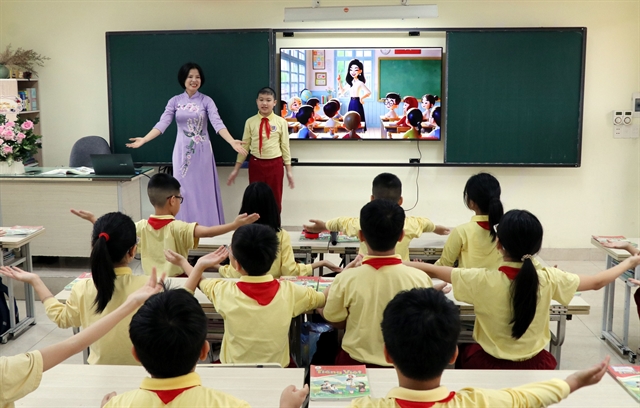 |
| A digital-learning-themed 'Nam Định – The Essence of Craft Villages' lesson, taught by Phạm Thị Hoa, a teacher at Phạm Hồng Thái Primary School in Nam Định Ward, Ninh Bình Province. — VNA/VNS Photo Nguyễn Lành |
As schools in the northern province of Ninh Bình push to improve learning quality, a quiet but powerful transformation is taking place inside classrooms.
Teachers are driving this shift, experimenting with digital teaching tools and artificial intelligence to create more engaging, student-centred lessons. Their innovations are reshaping how children absorb knowledge, explore their local culture and develop essential skills for a digital world.
At Phạm Hồng Thái Primary School in Nam Định Ward, a group of teachers began rethinking how to teach local heritage long before "digital transformation" became a familiar phrase.
Since the 2020–2021 school year, teachers Phạm Thị Hoa and Đinh Thị Thu Hương have developed a digital learning kit called "Nam Định – The Essence of Craft Villages".
The tool helps bring local studies lessons, part of the 2018 national curriculum, alive for pupils in Grades 3, 4 and 5. Their initiative was officially recognised by the provincial Department of Education and Training in 2024 for its broad and effective impact.
Hoa explains that although local education is practical and meaningful, topics such as social welfare policies or traditional craft villages can feel abstract to primary students.
“We wanted a way to make the lessons vivid and accessible,” she says.
Using PowerPoint 365 and iSpring Suite, the teachers designed digital modules filled with licensed images, videos and audio. Uploaded onto LMS platforms, the materials can be accessed anywhere, allowing teachers to customise lessons and students to explore content on their own.
Instead of reading short paragraphs in a textbook, pupils now watch videos of craft artisans at work, complete interactive exercises and virtually "visit" traditional villages. This is an invaluable substitute when real-life field trips aren't possible. The result is stronger comprehension, deeper cultural awareness and a more joyful learning experience.
 |
| Students create fairy-tale storyboards using STEM products during a literature lesson taught by Trần Thị Thùy Dương, a teacher at Trần Đăng Ninh Secondary School in Nam Định. VNA/VNS Photo Nguyễn Lành |
Bring complex lessons to life
At Nguyễn Viết Xuân Primary School, the goal was similar - help young learners grasp concepts too complex for static textbook images.
In the 2023–2024 school year, teacher Mai Mạnh Hà created a digital teaching tool for the Grade 3 lesson "The Digestive System" in Natural and Social Sciences.
Realising that printed diagrams offered little insight into how digestion actually works, Hà built a 3D animated model showing how food moves and changes inside the body. He edited videos, designed visuals and added narration, along with a system of interactive questions.
The impact was immediate. Students understood the lessons faster, retained knowledge longer and eagerly volunteered to explain what they had learned. The dynamic format also gave teachers more flexibility in assessing learning outcomes. Hà’s innovation earned First Prize in Ninh Bình’s 2024 digital teaching tools competition and is now widely used across the school.
Principal Đinh Việt Hà says the project reflects a broader movement.
“Teachers are experimenting with new methods, and useful innovations like this are helping energise the school and helping us implement the 2018 curriculum more effectively,” she says.
AI sparks creativity
While primary teachers are reinventing digital materials, secondary teachers are embracing the next frontier - artificial intelligence (AI).
At Trần Đăng Ninh Secondary School in Nam Định, literature lessons in class 6A3 have taken on an exciting new rhythm since the start of the 2025–2026 school year. Teacher Trần Thị Thùy Dương uses AI to support student projects, turning traditional storytelling assignments into creative showcases.
During a "Show and Tell" session on legends and folk tales, students presented stories like King An Dương Vương or Cây khế (The Starfruit Tree) through AI-generated videos, musical adaptations, rhyming verses, STEM-made miniature film sets and even dramatised scenes. The classroom buzzed with excitement as students became creators, not just listeners.
“Her lessons are so lively and varied,” says student Ngô Ngọc Lâm Anh of Class 6A3. “We learn through many formats, so it’s easier to remember and enjoy the material.”
Teacher Dương emphasises that while AI tools like Canva, Quizizz, ChatGPT, and Gemini enhance teaching, they must be used responsibly.
“AI is just a tool. Teachers still need to guide students on how to verify information, think critically and use technology safely,” she says.
According to Principal Trần Thị Hương, the biggest challenge when implementing the 2018 curriculum has been the lack of teaching equipment. Encouraging teachers to create digital tools and embrace AI has become an essential solution.
“Teachers here are proactive and willing to try new approaches,” she says. “That spirit helps make our school’s digital transformation successful.” VNS
Society
 Society
 Society
 Society
 Society
 Society
 Society
 Society
 Society
 Society
 Society
 Society
 Society
 Society
 Society