 Society
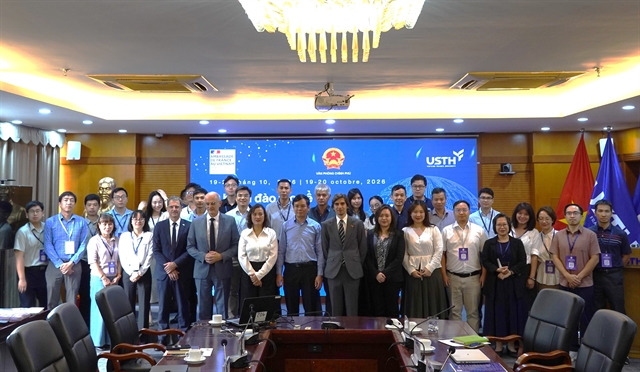
France-supported training course on semiconductor development held for State officials
1.
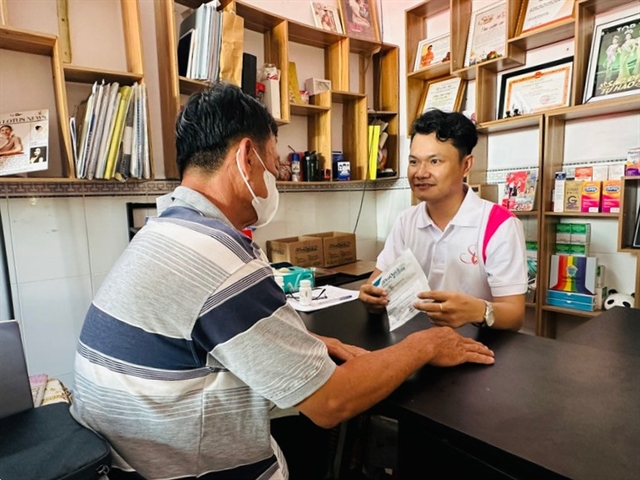 |
| A member of a community HIV response organisation in the southern province of Đồng Tháp consults with a client. — VNA/VNS Photo |
HÀ NỘI — Việt Nam’s efforts in HIV response have cushioned the impact of funding cuts on HIV treatment, but preventive programmes are seeing disruptions, according to a 2025 World AIDS Day report.
The report released by the Joint United Nations Programme on HIV/AIDS (UNAIDS) shows that the number of people using pre-exposure prophylaxis (PrEP) in Việt Nam fell by 21 per cent between late 2024 and mid-2025.
PrEP, considered a critical prevention option against HIV, used to be provided for free at local clinics under donor-supported programmes before the funding disruptions.
A similar situation was also reported in other countries, with Burundi and Uganda recording 64 per cent and 38 per cent drops in PrEP users, respectively.
Community-led organisations from Việt Nam to Kenya and Mozambique have also been impacted by funding cuts, with many forced to reduce staffing. Layoffs range from a third of organisational staff to nearly all clinical staff, per the report.
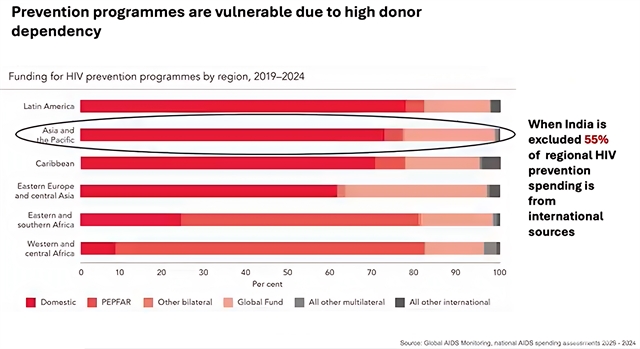 |
| On average, Asia-Pacific countries rely on donors for about 27 per cent of HIV prevention spending. But excluding India, the region’s dependence on international funding for prevention rises to 55 per cent. — Illustration courtesy of UNAIDS |
At the UNAIDS Asia Pacific’s report and advocacy campaign launch on Friday, Director of the Regional Support Team Eamonn Murphy said: “After decades of struggle, the world is within reach today of ending AIDS as a public health threat by 2030. Yet, a severe funding crisis has thrown that response into turmoil, disrupting HIV prevention and community-led services.
“If these cuts persist, almost four million people could contract HIV over the next five years, from 2025 to 2030. Instead of finishing the job, we will have given the epidemic fresh momentum to spread and grow.”
Việt Nam has been recognised for its commitment to prioritising domestic resources, including its national health insurance scheme, to reduce disruptions caused by declining external funding.
Evidence demonstrates that cuts in donor support have had a less severe impact on access to HIV services in countries where antiretroviral therapy (ART) is already integrated into national health insurance systems, such as the Philippines, Thailand and Việt Nam, according to a UNAIDS report.
However, the UN joint programme underscored the need for sustainability, stressing that governments must move beyond simply covering treatment costs and begin making substantial investments in prevention and community-led services.
The Việt Nam Administration of Disease Prevention has also formed an informal task team to receive feedback from people living with HIV and key populations, according to a UNAIDS update in March focused on the impact of US funding cuts on HIV response programmes in Việt Nam.
Meanwhile, the key population-led Hải Đăng (Lighthouse) Social Enterprise has piloted tiered co-payment models for PrEP to mitigate the effects of donor cuts, while also providing financial assistance to community members negatively affected by service cutbacks.
HIV response efforts in the Asia Pacific reported positive news recently, after the Australian government on Thursday announced an AUD48 million (US$31.3 million) programme to provide the region with technical assistance and co-investment.
This year, UNAIDS also launched the French-supported L’Initiative/Expertise France on Equitable, Sustainable and Efficient Financing for HIV and Health in Southeast Asia. This effort aims to increase sustainable and equitable financing for national HIV responses and health in several countries in the Southeast Asia region, including Việt Nam, Cambodia, Laos and Thailand. — VNS
Society
 Society
 Society
 Society
 Society
 Society
 Society
 Society
 Society
 Society
 Society
 Society
 Society
 Society
.jpg) Society
Society