 Society

Tech sector growth opens up opportunities for Việt Nam to go global
1.
|
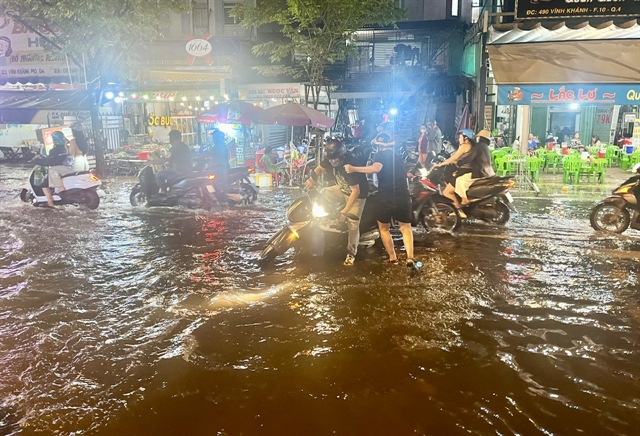
| A flooded street in Khánh Hội Ward, HCM City, following a recent heavy downpour. — VNS Photo Bồ Xuân Hiệp |
HCM CITY — The Dầu Tiếng Reservoir, one of southern Việt Nam’s largest water sources, began releasing water into the Sài Gòn River at 7am on Tuesday, with controlled discharge levels ranging from 28 to 200 cubic metres per second, authorities said.
The release, scheduled to run until December 2, comes as southern and southeastern provinces brace for increasingly severe weather linked to approaching Storm No. 15.
The Southern Irrigation Management Company said the operation follows updated hydrological forecasts. The reservoir’s water level is currently 23.9 metres (about 0.5 metres below its pre-flood safety limit) and discharge volumes may be adjusted depending on rainfall, inflow, and downstream tides.
Officials have warned communities along the Sài Gòn River to take precautions. Under normal conditions, a discharge rate of up to 200 cubic metres per second does not cause flooding, but heavy rain combined with the release could inundate low-lying areas.
Straddling Tây Ninh, HCM City, and Đồng Nai, the Dầu Tiếng Reservoir has a catchment area of more than 270 sq.km and a capacity of 1.58 billion cubic metres. It is a key source of water supply and plays a critical role in controlling flood and preventing saltwater intrusion in the downstream Sài Gòn and Vàm Cỏ Đông rivers.
In late October, simultaneous releases from Dầu Tiếng and the Trị An Hydropower Plant, coinciding with peak tides of 1.77 metres, triggered widespread flooding across HCM City, inundating residential areas including Thanh Đa and Bình Quới, and submerging major roads.
Several major hydropower and irrigation reservoirs in the South Central and Southeast regions, including Sông Ba Hạ, Sông Hinh, Sông Cái Nha Trang and Đồng Nai, are also releasing water following historic floods earlier this month.
The city’s Department of Agriculture and Environment has ordered reservoir operators to coordinate closely based on updated rainfall, inflow and tide levels to minimise flood risks while ensuring dam safety.
Infrastructure agencies have been instructed to prepare quick response teams and repair units.
As a tropical depression threatens to strengthen into Storm No. 15, provincial and city authorities have been told to intensify preparedness, monitor forecasts continuously, and mobilise rescue resources.
Coastal localities, including Côn Đảo, have been instructed to safeguard vessels, fishermen, and maritime activities, while urban drainage units prepare pumps and flood control systems for potential heavy rainfall. — VNS
Society
 Society
 Society
 Society
 Society
 Society
 Society
 Society
 Society
 Society
 Society
 Society
 Society
 Society
 Society