 Society

Việt Nam–Belgium partnership entering new phase of strategic significance: diplomat
1.
|
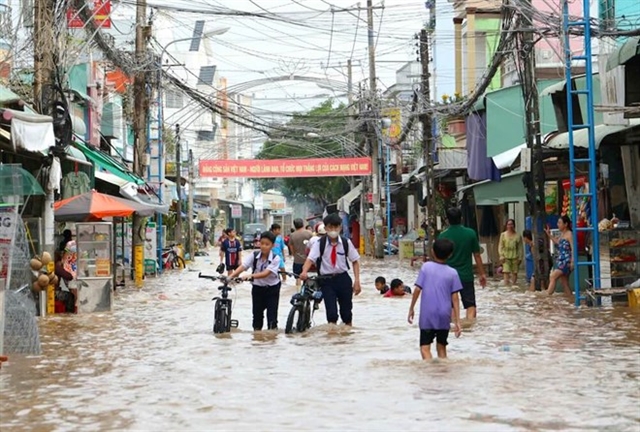
| Floodwater submerges several areas in Cần Thơ City during high tides or heavy rainfall. Photo laodong.vn |
CẦN THƠ — The People’s Committee of Cần Thơ City has approved a non-refundable grant worth over VNĐ9.1 billion (US$384,683) from the Japan International Cooperation Agency (JICA) to strengthen the city’s drainage and climate resilience capacity.
The project, titled “Technical Cooperation in Drainage to Enhance Climate Resilience in the city,” will run from October 2025 to September 2028.
According to Decision No. 2046/QD-UBND signed by chairman Trường Cảnh Tuyên, the project will be managed by the People’s Committee, with the Department of Construction as the project owner.
It will be jointly implemented with the Bureau of Roads and Drainage of Fukuoka City, Japan.
The grant will be fully financed and managed by JICA, with no counterpart funding required from the Vietnamese side.
The project aims to strengthen Cần Thơ’s capacity to sustainably manage its drainage and wastewater treatment systems amid growing climate challenges.
In recent years, heavy rains and rising river levels have increasingly caused flooding across the city, disrupting daily life and affecting public health.
By transferring Japanese technology and expertise, the cooperation seeks to improve both the technical and managerial aspects of urban drainage.
Key goals include improving the city’s planning and operation of wastewater collection and treatment systems, enhancing staff capacity in maintenance and management, and promoting public awareness on proper drainage practices.
The project will train at least five key officials from the Department of Construction and related agencies, equipping them with skills to independently manage maintenance plans and implement inspection routines.
Technical manuals and periodic checklists will be developed, followed by at least two workshops for knowledge sharing and two public awareness campaigns.
This grant approval follows the signing of a Memorandum of Understanding in March 2025 between the city’s Department of Construction and Fukuoka’s Bureau of Roads and Drainage.
The project is part of JICA’s Partnership Programme, which encourages cooperation between local Japanese governments and developing cities facing similar environmental challenges.
Takeshita Kazuhiro, director of the Bureau of Roads and Drainage of Fukuoka City, said the project will draw from Fukuoka’s decades of experience in drainage and wastewater management.
“Through JICA’s cooperation framework, Fukuoka will share advanced technology and practical know-how to help Cần Thơ address three major challenges,” he said.
“These include flood damage and untreated wastewater discharge, inefficient operation of existing facilities, and limited public participation in connecting private drainage to the city’s network.”
He noted that the ultimate goal is to improve flood control and water quality management, helping Cần Thơ achieve more sustainable growth.
Fukuoka, one of Japan’s leading eco-cities, currently treats wastewater for 99.9 per cent of its population through advanced recycling technologies and comprehensive flood prevention systems.
Its model of water-saving and environmental management is expected to serve as a valuable reference for Cần Thơ.
A JICA representative told the Vietnam News Agency on October 28 that this project represents a “grassroots-level partnership” between Cần Thơ and Fukuoka that is focused on practical knowledge exchange and capacity building. Following the city’s approval, both sides are expected to sign a detailed implementation agreement within three months.
The city has made ongoing efforts to improve its drainage system, investing in modern facilities and maintenance plans.
However, progress has been limited by funding shortages and a lack of skilled personnel. Several wastewater treatment plants are not fully operational, while some districts, including Ninh Kiều and Bình Thủy, continue to face flooding after heavy rain.
The city has therefore sought support from international partners such as JICA, the World Bank, and the Asian Development Bank to mobilise both technical and financial resources.
Chairman Trường Cảnh Tuyên said the cooperation reflects Cần Thơ’s determination to build a cleaner and more resilient city.
“With JICA’s support and Fukuoka’s experience, we expect to learn new methods and technologies that can make our drainage system more effective and sustainable,” he said.
For Fukuoka, the partnership is also an opportunity to share lessons learned from its own transformation.
Decades ago, the city faced similar flooding and wastewater problems.
Today, its integrated approach combining advanced treatment technology, public awareness, and efficient maintenance has turned it into a model of urban water management in Asia.
Scheduled to begin in late 2025, the JICA-funded project marks a new chapter in the city’s cooperation with Japan.
As climate change continues to threaten the Mekong Delta with more frequent floods and unpredictable weather, the project is expected to help Cần Thơ enhance its environmental resilience and improve the quality of life for its residents. – VNS
Society
 Society
 Society
 Society
 Society
 Society
 Society
 Society
 Society
 Society
 Society
 Society
 Society
 Society
 Society