 Society
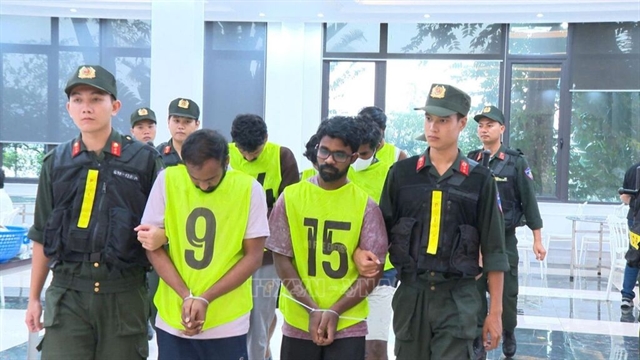
84 individuals investigated for transnational online frauds
1.

|
| Vice President of the Vietnam Academy of Science and Technology Trần Hồng Thái speaks at the conference on Monday. — Photo nhandan.vn |
HÀ NỘI — A new generation of Vietnamese students is setting its sights far beyond Earth, onto the skies and space itself, as the country pushes to turn aerospace technology into one of its next strategic industries.
On Monday, more than 1,000 students, scientists and engineers joined the Student Scientific Conference on Aerospace Technology in Hà Nội as part of a national series highlighting fields tied to Việt Nam’s high-tech ambitions.
"The aviation and space sector is no longer some distant dream. It’s becoming a pillar of national security, sustainable development and Việt Nam’s global standing," said Vice President of the Vietnam Academy of Science and Technology Trần Hồng Thái.
He recalled how even during years of hardship, Việt Nam sent its first cosmonaut, Phạm Tuân, into orbit and began training young engineers abroad.
Today, Thái said, aerospace technology ranked among the country’s 11 designated strategic technology groups –from low-orbit satellites and ground-control systems to unmanned aircraft.
"To build these fields, we need people who love science and dare to take on the toughest intellectual challenges," he said.
The demand is immense. By 2030, Việt Nam will need up to 1.5 million high-tech workers, according to Lâm Tùng, vice president of the Vietnam Students’ Association.
"We’ve met less than half that number," Tùng said.
"That gap may sound daunting, but it’s also an opportunity for young people today – a generation capable, confident and ambitious enough to master science and technology, conquer space and invent the future."
Every satellite prototype, every aerodynamic model, he added, "is a small brick in building Việt Nam’s dream to own its skies and space."
Tùng also said the association aimed to use the conference to link young researchers in Việt Nam and abroad into a global network of Vietnamese talent, connecting master’s and PhD students, engineers and innovators to strengthen collaboration across borders.
Thái said students with strong academic foundations could find opportunities at the Vietnam National Space Centre, from internships and R&D projects to graduation theses tied to real-world engineering problems.
The conference underscored a growing push to bring universities, research institutes, businesses and international partners together to build a highly skilled workforce for the country’s aviation and space industry, part of a long-term strategy stretching to 2045.
For many of the students in attendance, that horizon feels closer than ever. What once sounded like a distant dream, they said, was fast becoming a national mission. — VNS
Society
 Society
 Society
 Society
 Society
 Society
 Society
 Society
 Society
 Society
 Society
 Society
 Society
 Society
 Society