 Society
New chapter in Việt Nam–Switzerland comprehensive partnership
1.
|
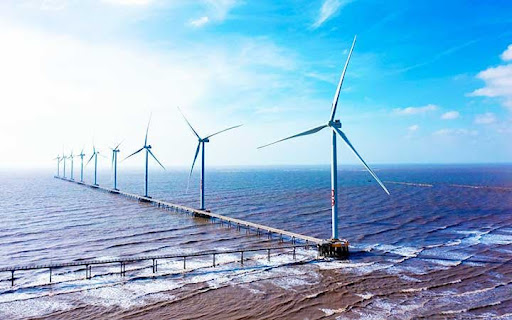
| Offshore wind turbines in Vĩnh Long Province generate green energy to support Việt Nam’s transition toward renewable energy and net-zero emission by 2050 - Photo nhandan.vn |
HCM CITY - Experts at the Việt Nam Energy Transition Seminar in HCM City on November 5 asserted that realising the country’s renewable energy development plan requires stronger multi-sectoral cooperation and collaboration with other countries.
Nguyễn Thị Phương Yến, deputy director of the Centre for Energy Information and Electricity Market Development (EAVCED), shared that the implementation of the Direct Power Purchase Agreement (DPPA) mechanism and the Vietnam Wholesale Electricity Market (VWEM) is attracting more investors to participate in renewable energy development, as the country moves towards its Net Zero goal.
Regularly updating policies and sharing practical experiences, as well as enhancing the understanding of stakeholders such as experts, investors and customers, will help build a transparent and fair energy transition process, she added.
Việt Nam has set a target to achieve net-zero emissions by 2050, but it remains one of Southeast Asia’s top carbon emitters and depends largely on coal-fired power.
According to experts, despite major challenges, Việt Nam has great renewable energy potential, which is 15 times higher than its current installed capacity.
Việt Nam has also issued several resolutions to ensure national energy security, develop a competitive energy market, diversify energy supply sources and promote the use of green energy and the reduction of carbon emissions.
Việt Nam’s National Energy Development Strategy has set a goal for renewable energy to account for 20 per cent of the energy mix by 2030 and 70 per cent by 2045.
With the right policies, technologies and strong partnerships, Việt Nam can unlock its potential for green energy development and lead the region in sustainable growth.
According to Peter Lundberg, executive director of the Asia Pacific Urban Energy Association (APUEA), energy transition requires multi-sectoral cooperation and collaboration with other countries.
In the context of increasingly complex climate change and rising geopolitical instability, pursuing sustainable and renewable energy transition has become an urgent task for all nations.
Jeremy Colson, Energy Efficiency Business Director at GreenYellow Vietnam, said that the biggest barrier for businesses in the energy transition process is the lack of financial resources.
Energy service companies can help businesses implement efficient energy solutions, allowing them to reduce business expenses in the long run.
Huỳnh Phước Cường, deputy general director of GREE Vietnam, shared that electricity production and consumption are currently among the largest sources of greenhouse gas emissions.
Businesses need to frequently inspect and identify areas where electricity is being wasted in order to improve energy efficiency and avoid electricity waste. – VNS
Society
 Society
 Society
 Society
 Society
 Society
 Society
 Society
 Society
 Society
 Society
 Society
 Society
 Society
 Society