 Society
Vietnamese scientist wins ASEAN-US Science Prize for Women
1.
|
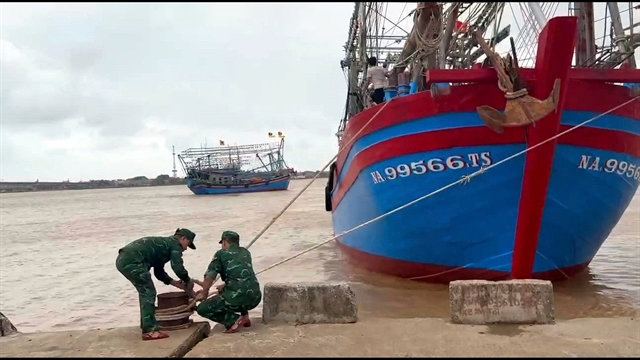
| The Quảng Trị Border Guards support fishermen in securing and anchoring boats to respond to Storm Fengshen. — VNA/VNS Photo Tá Chuyên |
HÀ NỘI — Deputy Prime Minister Trần Hồng Hà on Wednesday urged organisations, local authorities and citizens to prepare thoroughly for Storm Fengshen, the 12th tropical storm to enter the East Sea this year.
Chairing an online meeting with people’s committees of localities in the central region – Huế and Đà Nẵng cities, and Quảng Ngãi, Quảng Trị and Hà Tĩnh provinces – Deputy PM Hà praised the responsibility and efforts shown so far.
Highlighting the work of the meteorological sector in recent typhoon forecasts, he called on stations to continue improving capabilities, especially in issuing early warnings.
“Central and local stations must operate cohesively, issuing forecasts accurate to specific areas, detailing sea dikes, river dikes, reservoirs and zones at risk of flash floods and landslides. Forecasts should cover pre-storm, during-storm and post-storm periods, serving as a basis for directive decisions,” he said.
With predictions of two extended periods of heavy rainfall, the Deputy PM warned affected regions would face multiple natural hazards due to rising river and reservoir water levels, saturated soils and increased risks of floods, landslides and urban inundation.
Households should prepare a 'survival bag' with water, food, medicine and dry clothes sufficient for three days if isolated. Localities must ensure suitable rescue equipment, including motorboats and rubber boats, is ready for timely interventions.
Regarding reservoir and dam management, he instructed the Ministry of Agriculture and Environment (MAE) and local authorities to inspect and supervise operations and spillway releases according to regulations.
Small hydropower reservoirs without flood control functions should release water early to reduce downstream risks, while large reservoirs must calculate appropriate release timing to limit downstream flooding and its impact on residents.
He commended border army forces and relevant agencies for providing information, guidance and inspections of sea vessels, calling for enhanced public communication to raise awareness and encourage proactive measures.
He also tasked the MAE, in collaboration with the National Civil Defence Steering Committee, to prepare a nationwide conference next month on civil defence, disaster prevention and response evaluation.
The conference will review forecasting capabilities, dike systems and response infrastructure, and discuss solutions to improve coordination and operational methods, ensuring timely and effective responses to increasingly complex natural disasters.
Early deployment
|
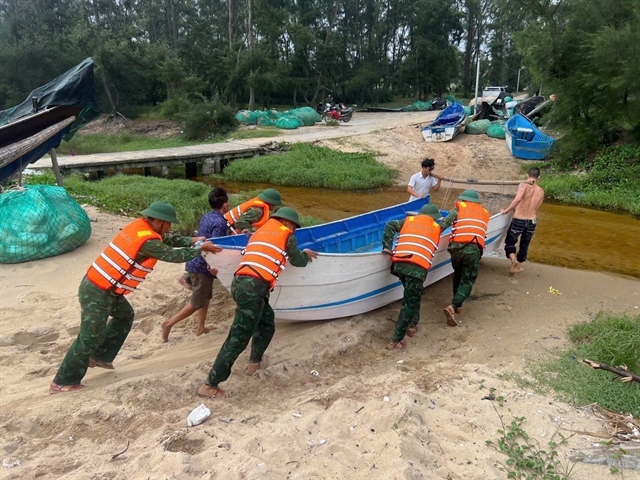
| People bring boats ashore to shelter from the storm in Huế City. — VNA/VNS Photo Mai Trang |
At the meeting, Chairman of the Huế City People’s Committee Phan Thiên Định reported that water levels in the Hương and Bồ rivers were at alert level one, while high tides had caused flooding in lakes and coastal areas.
The city prepared four rainfall scenarios from 600 to 1,000mm, suspended schools, and assigned 450 personnel to help residents reinforce embankments, secure houses and prune trees.
Over 10,000 households, comprising 32,000 people, are ready for evacuation, with more than 5,000 officials and soldiers available for rescue operations.
In Quảng Trị Province, leaders reported extended heavy rain impacts and saturated terrain from previous storms.
There are 152 landslide-prone mountain sites, 128 riverbank erosion points, 10 coastal erosion areas and 46 flood-prone crossings.
Reservoir capacities stand at 85–87 per cent of design volume.
From now until next Monday, heavy to very heavy rain of 300–550mm, reaching up to 700mm in some areas, is forecast, with flood risk reaching alert level three, similar to 2020.
The province has requested over 5,000 soldiers and 17,000 militia for round-the-clock duty at five key areas, warned and guided 8,700 boats to move to safety, and ensured 18 vessels with 128 workers returned ashore.
Evacuation plans for 12,470 households comprising 44,500 people are in progress, ensuring reservoir safety and readiness for isolated areas.
Đà Nẵng City Deputy Chairman Trần Nam Hưng stated that the city has 91 landslide-prone sites in mountainous areas, with urban zones largely at risk of flooding.
At 2pm on Monday, Đà Nẵng held online meetings with ward and commune authorities, activating full flood and storm prevention plans tailored for different scenarios.
Three forward command centres were established at key locations: the western mountainous region, the southern urban area near Tam Kỳ – Quảng Nam, and the city administrative centre, each led directly by a deputy chairman of the people’s committee.
From Monday morning, 121 reservoirs were regulated to their lowest water levels according to the prepared scenarios, ready for flood mitigation and flow control.
All students were dismissed at noon on Tuesday. The city deployed rescue equipment including over 50 small boats for flood-hit neighbourhoods and distributed more than 1,000 life jackets in critical areas.
Evacuations were completed before 5pm on Tuesday. Authorities urged residents to stock food and supplies sufficient for at least three days. — VNS
Society
 Society
 Society
 Society
 Society
 Society
 Society
 Society
 Society
 Society
 Society
 Society
 Society
 Society
 Society