 Politics & Law
HCM City aims to eliminate 28 traffic congestion hotspots by 2030
1.
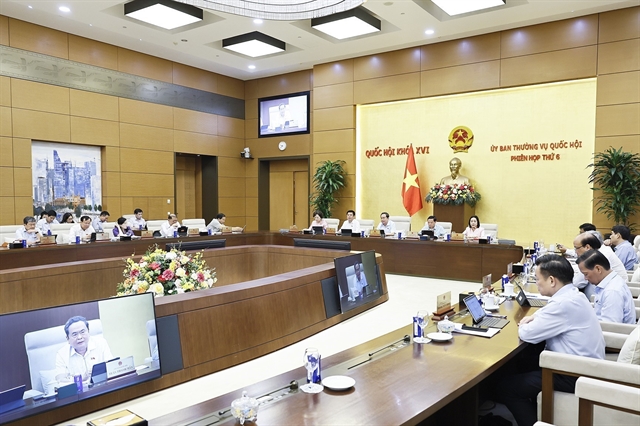 |
| The National Assembly Standing Committee on Tuesday discussed the revised Law on Environmental Protection. VNA/VNS Photo |
HÀ NỘI — The National Assembly Standing Committee on Tuesday discussed the revised Law on Environmental Protection, focusing on proposed changes to strategic environmental assessment, environmental impact assessment (EIA) and environmental permits.
The draft law reduces the number of preliminary environmental impact assessment criteria from three to two, with the Government tasked with providing detailed regulations.
It also simplifies the classification of investment projects from four groups to three, significantly narrows the scope of projects subject to EIA, expands exemptions and moves certain projects to the environmental registration system.
The draft further streamlines EIA reports and appraisal procedures, clarifies appraisal authority and authorises the Government to regulate the scope and validity of decisions approving EIA appraisal results, aiming to avoid overlaps with other environmental management tools.
It also simplifies environmental licensing requirements and application dossiers, extends the validity of environmental permits for certain entities, and delegates greater licensing authority to local administrations.
According to Nguyễn Thanh Hải, Chairman of the NA's Committee on Science, Technology and Environment, the draft makes significant reforms to simplify the classification of investment projects based on environmental criteria, reducing the number of groups from four to three and substantially narrowing the scope of projects subject to EIA.
However, the committee's standing body called for further review, saying that all directly relevant sensitive factors should be specifically listed and clearly quantified in the law. This would enable people and businesses to determine applicable requirements themselves and help prevent arbitrary implementation.
It also proposed assigning the Government to issue detailed lists of projects subject to EIA, projects requiring environmental permits and projects subject only to environmental registration.
Regarding EIA requirements, the committee's standing body described the proposed reform as important in addressing the existing emphasis on pre-inspection, which it said had not been matched by effective post-inspection.
It asked the drafting agency to carefully review proposed EIA exemptions for secondary projects in industrial parks and industrial clusters.
Projects generating large emissions, in particular, should be classified separately to ensure that those producing significant air emissions remain subject to EIA requirements and are subject to strict management, it said.
NA Vice Chairwoman Nguyễn Thị Thanh basically supported simplifying the classification of investment projects from four groups to three while narrowing the scope of projects subject to EIA.
She described the change as a major reform that could reduce administrative procedures for projects posing low environmental risks.
However, she said regulations should clearly determine, for each project group, which projects are required to conduct an EIA, which must obtain an environmental permit and which only need environmental registration, in order to avoid regulatory gaps and overlaps.
She also asked the drafting agency to clarify the conditions for applying EIA exemptions, particularly requirements concerning environmental protection infrastructure in industrial parks and industrial clusters, as well as controls on projects generating large volumes of waste and those involving the treatment of imported hazardous waste and scrap. — VNS
Politics & Law
 Politics & Law
 Politics & Law
 Politics & Law
 Politics & Law
 Politics & Law
 Politics & Law
 Politics & Law
 Politics & Law
 Politics & Law
 Politics & Law
 Politics & Law
 Politics & Law
 Politics & Law
 Politics & Law