 Politics & Law
Việt Nam, Russia step up cooperation in criminal sentence enforcement
1.
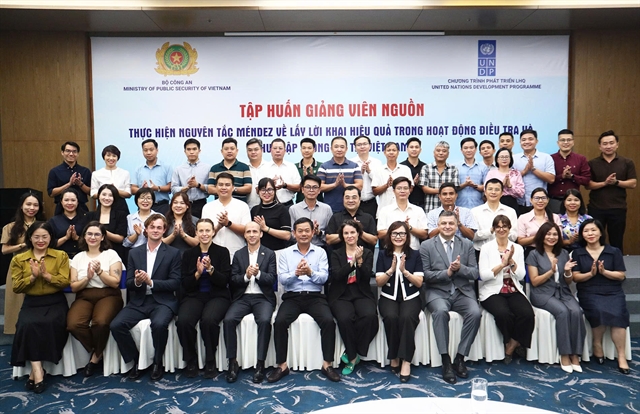 |
| A training course for trainers on the Mendez Principles for Effective Interviewing for Investigation and Information Gathering is held in Nha Trang. — VNS Photo Thành Long |
KHÁNH HÒA — The Ministry of Public Security and the United Nations Development Programme (UNDP) organised a course for trainers on the Mendez Principles for Effective Interviewing for Investigation and Information Gathering in Nha Trang, Khánh Hòa Province.
The course on Tuesday aims to strengthen the capacity of law enforcement officers to apply scientific, lawful and human rights-based approaches to investigative interviewing, contributing to Việt Nam's implementation of the UN Convention against Torture (CAT).
Since becoming a party to the convention in 2015, Việt Nam has been actively implementing its commitments, said Nguyễn Thị Thanh Hương, Head of the Human Rights Division within the Department of Foreign Relations under the Ministry of Public Security.
“The Mendez Principles focus on obtaining accurate information through scientifically based interviewing methods, while ensuring legality and respect for human rights and reducing the use of coercion and inappropriate treatment,” she said.
Francesca Nardini, UNDP Deputy Resident Representative in Việt Nam, emphasised the training came at an important time as Việt Nam prepares for the review of its Second National Report by the UN Committee against Torture.
“The skills developed here represent concrete, demonstrable progress, as Việt Nam's commitment translates into professional standards in practice,” she said.
Nardini added that the initiative was also in line with Việt Nam's priorities, particularly Resolution No. 27 and its goal of ensuring the supremacy of the Constitution and the law and protecting human and citizens' rights towards 2030.
The training followed a workshop introducing the Mendez Principles in Quảng Ninh in December 2025.
While the earlier workshop provided an opportunity to introduce and discuss the principles, the latest training focused on developing a pool of trainers capable of passing the knowledge and skills on to other law enforcement officers.
“The training of trainers will be followed by a phased roll-out of training events, led by you, that translates these standards into practice," Nardini said.
"This is how awareness and understanding become institutional capacity, and ultimately lasting reform. The real measure of our success will be the moment when good practice becomes routine practice.”
Practical needs
Phạm Anh Tuấn, Deputy Director of the Khánh Hòa Provincial Police, said the province's rapid economic development, urbanisation and tourism growth had brought a large number of domestic and international visitors to the locality.
In the first nine months, the province recorded more than 18 million tourist arrivals, including more than 6.3 million international visitors. Tourism revenue was estimated at VNĐ60.9 trillion (US$2.3 billion).
At the same time, the province has faced increasingly diverse and complex crime and law violations, including property crimes, high-tech crimes, drug-related offences and crimes against public order, as well as cases involving multiple provinces and foreign elements.
These developments place greater demands on investigative interviewing, with questioning required to comply with the law and respect the legitimate rights and interests of people involved in legal proceedings.
“A confession must not be considered the sole basis for concluding that an offence has been committed," Tuấn said.
“Therefore, the approach to information gathering based on building rapport, fostering cooperation, asking appropriate questions and verifying information, offers several practices that could be studied and applied to investigative work,” he said. — VNS
Politics & Law
 Politics & Law
 Politics & Law
 Politics & Law
 Politics & Law
 Politics & Law
 Politics & Law
 Politics & Law
 Politics & Law
 Politics & Law
.jpg) Politics & Law
Politics & Law
 Politics & Law
 Politics & Law
 Politics & Law
 Politics & Law