 Politics & Law
Việt Nam seeks major overhaul of measurement law
1.

|
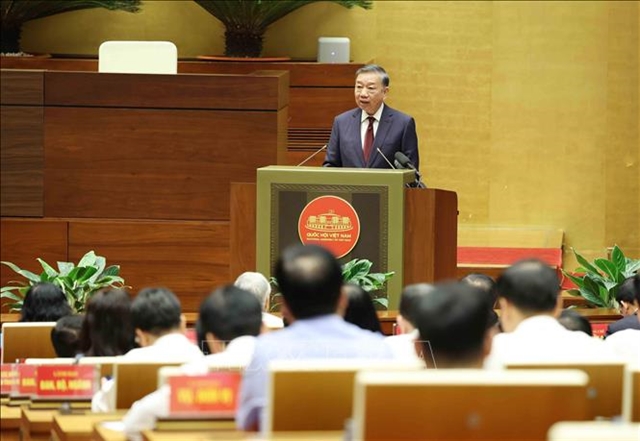
| Party General Secretary and State President Tô Lâm delivers his speech at a national conference on implementing a number of Politburo resolutions and directives in Hà Nội on Thursday morning. — VNA/VNS Photo Phương Hoa |
HÀ NỘI — General Secretary of the Communist Party of Vietnam Central Committee and President To Lam has stressed that the value of the Party's resolutions and directives must be measured by their ability to address practical problems and bring about changes that people can see and feel.
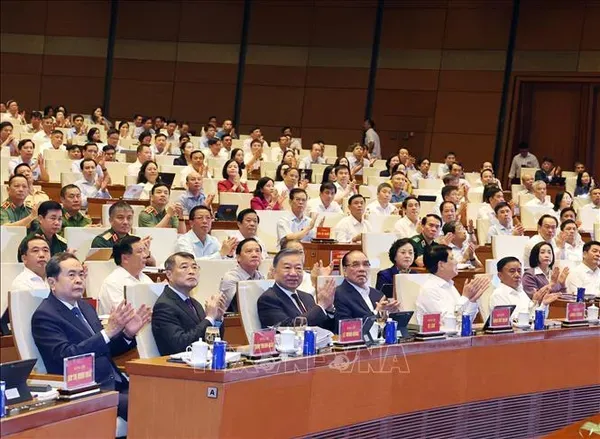
Speaking at a nationwide conference in Hà Nội on September 3 to study, disseminate and implement a number of resolutions and directives of the Political Bureau, the top leader said the conference marked not only a period of studying and understanding the documents but also the beginning of a decisive stage: putting them into practice.
He asked every Party committee, agency, locality and Party member to have a clear understanding of what needs to be done, who is responsible, what authority and resources are available, what the deadline is, what product is expected and who will be accountable. The goal is to turn awareness into action and determination into results.
The national interest and the legitimate interests of the people must remain the highest standards for evaluating the effectiveness of implementation, he said, calling for further improvements to institutions, clearer division of authority, adequate resources and better risk management.
Institutions must move ahead, maintaining discipline while also opening the way for development. The Party Committees of the National Assembly and the Government, together with relevant agencies, should promptly address overlapping regulations and fill legal gaps that hinder innovation, regional connectivity, tourism development and efforts to attract talents and mobilise resources, the General Secretary and President noted.
He also stressed that decentralisation and delegation of authority must go together with sufficient human resources, finance, data, technology and power control. The central authorities should focus on strategy, institutions, shared platforms and major resources, while provincial authorities should ensure necessary conditions, while commune-level administrations must have sufficient capacity to serve the people.
According to the leader, power control should ensure that innovation moves in the right direction rather than paralysing creativity. At the same time, those who act for personal gain, avoid responsibility or deliberately delay work must be dealt with strictly.
He described time as a non-renewable development resource, warning that delays in institutional reform, decision-making and removing bottlenecks increase costs and result in lost opportunities. “Things that are clear must be done immediately,” he said, calling for obstacles to be addressed at an early stage.
Tasks that are clear must be carried out immediately, while matters falling within an organisation’s authority must be decided upon and those beyond its authority must be reported along with specific proposed solutions, he said.
The decisive factor is implementation and the responsibility of the department head. Each document must be translated into specific tasks, with a person accountable for them and implementation verified through results.
“Ultimately, the country must become stronger, people’s lives must improve and public confidence must be strengthened,” Lâm added.
In response to the top leader's guidance, Trịnh Văn Quyết, head of the Party Central Committee’s Commission for Communications and Education, called on Party organisations at all levels to urgently translate his instructions into concrete actions and ensure the resolutions are carried out as effectively as possible.
Earlier at the conference, Quyết had presented a report on the key content of the Politburo’s Directive 07 on promoting the study and practice of Hồ Chí Minh’s thought, morality and methods in the new development period.
Quyết said two new requirements have been set for cadres and Party members.
First, setting an example is no longer simply an encouraged personal quality, but has become a mandatory leadership method, with criteria differentiated according to position and responsibility.
Second, the practice of following President Hồ Chí Minh must be closely linked to encouraging and protecting officials who dare to think, act and take responsibility for the common good, while replacing those who avoid responsibility, shift blame or fail to act out of fear of accountability.
Party Central Committee Secretary Nguyễn Duy Ngọc then summarised a report on the Politburo’s resolution promoting the pioneering and exemplary role, innovative spirit and willingness to think, act and take responsibility among cadres and Party members in the new era.
Ngọc said that the issue must be viewed from both sides. Those who dare to act must be protected, while those who refuse to act must be dealt with firmly.
Promoting regional links and overseas Vietnamese resources
Also at the conference, Minister of Foreign Affairs Lê Hoài Trung also presented a report on the Politburo's Resolution 23, which concerns Vietnamese people working abroad.
The resolution sets out four guiding viewpoints and three major objectives, and raises awareness of the position and role of the Vietnamese community abroad, reaffirming that overseas Vietnamese are an inseparable part of the nation.
It also identifies the community as an important strategic resource and a bridge between Việt Nam and the world, accompanying and directly contributing to the cause of national construction, development and defence.
This represents a shift away from an approach that views the overseas Vietnamese community primarily as a target for policies towards regarding them instead as active participants in the country’s development and a resource for national growth.
Regarding more than 6.5 million Vietnamese people living abroad, General Secretary and President Lâm affirmed that they are an inseparable part of the Vietnamese nation and a strategic resource.
He demanded policies to be improved, administrative procedures simplified, and a database and global network of Vietnamese people established, while prejudice should be removed and the past left behind in order to look toward the future.
Overseas Vietnamese should be encouraged to serve as “cultural ambassadors” and “friendship ambassadors” and as participants in external communications, helping strengthen Việt Nam’s soft power and contribute to protecting the country from an early stage and from afar.
Head of the Party Central Committee’s Commission for Policies and Strategy Nguyễn Thanh Nghị reported on the Politburo’s resolution on regional growth and the organisation of national development space in the new era.
Meanwhile, Deputy Prime Minister Phạm Thị Thanh Trà presented a report on the Politburo’s resolution to develop Việt Nam’s tourism industry into a spearhead economic sector. — VNS
Politics & Law
 Politics & Law
.jpg) Politics & Law
Politics & Law
 Politics & Law
 Politics & Law
 Politics & Law
 Politics & Law
 Politics & Law
 Politics & Law
 Politics & Law
 Politics & Law
 Politics & Law
 Politics & Law
 Politics & Law
 Politics & Law