 Politics & Law
Market falls due to loss on energy, large-cap stocks
1.
|
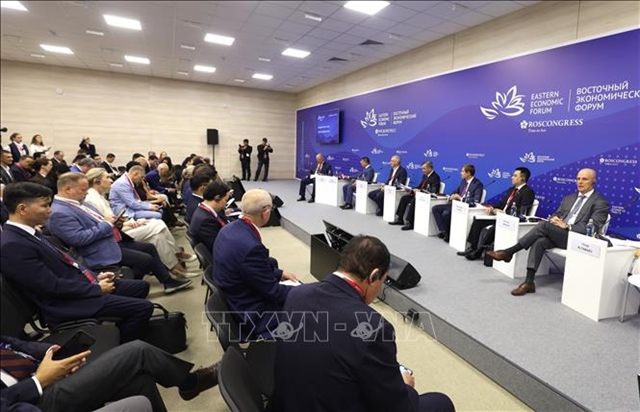
| Minister of Finance Ngô Văn Tuấn (centre) attends the Russia-ASEAN Business Dialogue in Vladivostok, Russia on Wednesday, part of the 11th Eastern Economic Forum. — VNA/VNS Photo Văn Hiếu |
VLADIVOSTOK — Việt Nam has proposed five key areas for ASEAN-Russia cooperation, focusing on supply chains, logistics, technology, green growth, and finance and people-to-people ties, at the Russia-ASEAN Business Dialogue held on Wednesday as part of the 11th Eastern Economic Forum in Vladivostok, Russia.
Minister of Finance Ngô Văn Tuấn attended and addressed the dialogue, which brought together Sergey Katyrin, President of the Russian Chamber of Commerce and Industry, officials and business representatives from Russia and ASEAN countries.
Tuấn highlighted Vladivostok's important role as a gateway connecting Russia with the Asia-Pacific region, including Việt Nam, noting that 2026 marks the 35th anniversary of ASEAN-Russia relations.
The recent ASEAN-Russia Summit in Kazan, Russia, adopted the ASEAN-Russia Comprehensive Plan of Action for 2026-2030, providing an important basis for deepening the strategic partnership, he said.
Trade between Russia and ASEAN has increased by nearly 58 per cent over the past decade, reaching about US$21 billion in 2025. Tuấn said the figure was positive but there remained significant room for growth, stressing the need to turn cooperation orientations into concrete projects, stronger trade and investment flows, and measurable results.
Việt Nam is entering a new development period, targeting annual economic growth of at least 10 per cent during 2026-2030 and aiming to become a developed, high-income country by 2045, he said.
Việt Nam is promoting science and technology, innovation, digital transformation, artificial intelligence (AI), high-quality human resources and the private sector, while investing heavily in strategic infrastructure and improving the investment and business environment.
With an economy worth about $514 billion and total goods trade exceeding $930 billion in 2025, Việt Nam is becoming increasingly integrated into regional production and supply chains, he said.
Tuấn underlined Việt Nam's special role in ASEAN-Russia relations. Bilateral trade reached about $4.77 billion in 2025, accounting for roughly one-quarter of Russia-ASEAN trade. Việt Nam was also the first ASEAN member to sign a free trade agreement with the Eurasian Economic Union (EAEU).
With its extensive network of free trade agreements, Việt Nam can serve as a bridge for Russian businesses to access ASEAN and other international markets, while Russia's Far East can help Vietnamese and ASEAN businesses access the Russian and wider Eurasian markets.
On this basis, Tuấn proposed five key cooperation orientations.
First, developing new supply chains and strengthening trade and investment connectivity. Russia's strengths in energy, raw materials, agriculture, industry and science and technology can complement ASEAN's large market, young workforce and dynamic production networks. Việt Nam is ready to serve as a bridge and encourage Russian investment in processing and manufacturing, high technology, energy, logistics and high-tech agriculture.
Second, making a breakthrough in transport and logistics. The two sides should strengthen maritime links between Vladivostok and the Far East and Việt Nam and Southeast Asia, while connecting them with Eurasian railways and transport corridors. Tuấn proposed studying a Far East-Vietnam-ASEAN logistics corridor linking seaports, cold storage, distribution centres and production chains.
Third, making science and technology, digital transformation, and artificial intelligence (AI) new drivers of cooperation. The sides should promote joint programmes in AI, cybersecurity, fintech, digital healthcare and education, data centres and smart manufacturing, with a focus on joint research, technology transfer, human-resource training and commercialisation.
Fourth, strengthening cooperation in energy, green growth, and sustainable development. With ASEAN's energy demand rising and pressure to cut emissions increasing, Việt Nam sees opportunities in clean and renewable energy, offshore wind power, modern power infrastructure, the green economy and the circular economy, drawing on Russia's energy and technological strengths.
Fifth, expanding cooperation in finance, investment, tourism, and people-to-people exchanges. Việt Nam is developing free-trade zones linked to seaports, logistics, industry and services, as well as international financial centres in HCM City and Đà Nẵng, offering new opportunities for Russian financial institutions and investors.
The two sides should also strengthen air connectivity and cooperation in tourism, education, culture and people-to-people exchanges. Việt Nam welcomed nearly 21.2 million international visitors in 2025, providing a strong basis for greater tourism links among Russia, Việt Nam and ASEAN.
Looking towards 2030, Tuấn expressed his hope that ASEAN-Russia relations would become more substantive and balanced, with stronger and more diverse trade, new supply chains, investment projects and logistics corridors, and wider cooperation in the digital economy, finance and clean energy.
He stressed that the most important task is to turn the ASEAN-Russia Plan of Action for 2026-2030 into concrete projects with clearly identified partners and measurable outcomes.
Việt Nam regards Russia as an important partner and ASEAN as a strategic space for cooperation, Tuấn said, affirming Việt Nam's readiness to further promote its role as an economic bridge between Russia and ASEAN and between the EAEU and Southeast Asia. — VNA/VNS
Politics & Law
 Politics & Law
 Politics & Law
 Politics & Law
 Politics & Law
 Politics & Law
 Politics & Law
 Politics & Law
 Politics & Law
 Politics & Law
 Politics & Law
 Politics & Law
 Politics & Law
 Politics & Law
 Politics & Law