 Politics & Law

Cổ Thạch Hill and its ancient seaside stone path
1.
|
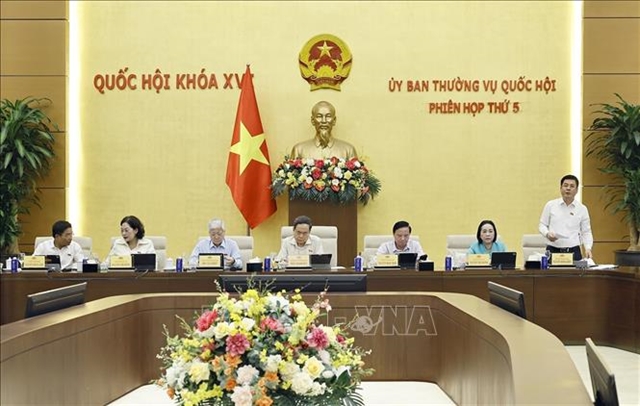
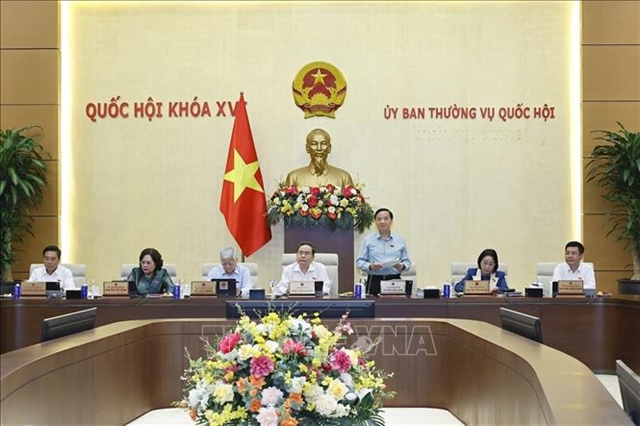
| The NA Standing Committee discussed a proposal to integrate four national target programmes into a single one. — VNA/VNS Photo |
HÀ NỘI — The fifth session of the National Assembly (NA) Standing Committee on Friday discussed a proposal to integrate four national target programmes into one to address overlapping and fragmented implementation.
Minister of Finance Ngô Văn Tuấn said the integration aims to restructure the programmes to eliminate duplication and fragmentation, streamline management agencies, reduce coordination procedures, facilitate the pooling of resources and improve the efficiency of State budget use, while ensuring the full implementation of objectives and tasks approved by the NA.
The proposed approach is to establish a national target programme by integrating four programmes covering cultural development, education and training, new-style rural development, poverty reduction and development in ethnic minority and mountainous areas as well as healthcare, population and development, he said.
The National Target Programme on Drug Prevention and Control through 2030, which has its own specific characteristics, would not be incorporated into the general programme, which focuses on economic development and social welfare.
The integrated programme would be named the national target programme for socio-cultural, rural, ethnic and mountainous development for 2026-2035.
The integration is expected to be submitted to the NA for consideration and approval during the second phase of the first extraordinary session of the 16th NA next week.
NA Chairman Trần Thanh Mẫn said the policy of integrating the four national target programmes had been clearly discussed by the Politburo, with the aim of thoroughly addressing fragmentation, overlapping responsibilities and multiple management bodies, while minimising administrative compliance costs and strengthening decentralisation in state budget management.
He suggested studying the establishment of a central coordinating office for the integrated programme.
The Ministry of Finance would oversee the overall budget, while a centralised inter-agency coordinating body could serve as an one-stop focal point for localities in reporting, explanation and monitoring.
He also called for a standardised set of integrated output indicators to prevent overlaps or conflicts between new-style rural development criteria and sector-specific criteria in healthcare, education and culture.
During the morning session, the NA Standing Committee also discussed explanations, revisions and amendments to two draft documents - a law amending Article 6 and Appendix IV on the list of conditional business investment sectors under the Law on Investment and a draft NA resolution providing special mechanisms and policies to resolve difficulties and obstacles in projects and works serving the 2027 APEC Economic Leaders' Meeting in Phú Quốc Special Administrative Zone, An Giang Province. — VNS
Politics & Law
 Politics & Law
 Politics & Law
 Politics & Law
 Politics & Law
 Politics & Law
 Politics & Law
 Politics & Law
 Politics & Law
 Politics & Law
 Politics & Law
 Politics & Law
 Politics & Law
 Politics & Law
 Politics & Law