 Politics & Law

AITO Looks Ahead to Europe, Building a Thriving Automotive Ecosystem
1.
|
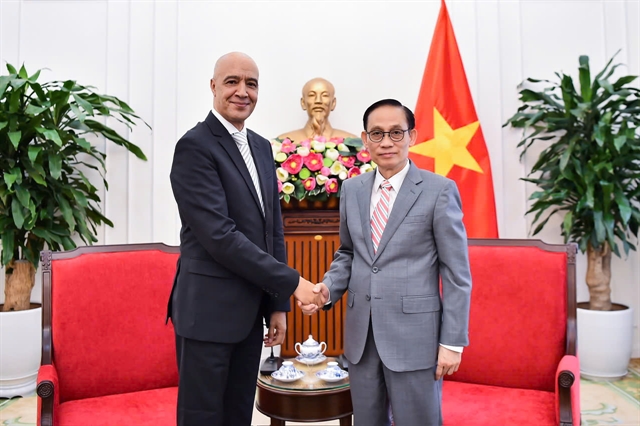
| Minister of Foreign Affairs Lê Hoài Trung (right) meets Moroccan Ambassador to Việt Nam Jamale Chouaibi during a reception in Hà Nội on May 21. — Photos courtesy of the embassy |
HÀ NỘI — As Morocco celebrates on July 30 the 27th anniversary of the enthronement of His Majesty King Mohammed VI, the occasion offers an opportunity to reflect on the Kingdom’s remarkable transformation under His Majesty’s wise leadership.
This year is also significant for Morocco’s international partnerships, especially with Việt Nam, with which it marks the 65th anniversary of the establishment of diplomatic relations.
Together, these two milestones highlight Morocco’s development journey at home and its commitment to building bridges of cooperation abroad.
Over the past two decades, Morocco has emerged as one of Africa’s most dynamic economies, combining political reform, economic diversification and an active diplomatic presence.
The Kingdom’s emphasis on stability, sustainable development and international partnership has strengthened its standing across Africa and the Mediterranean, while opening new opportunities for cooperation with emerging economies such as Việt Nam.
Morocco’s economy continues to gain momentum, driven by industrial expansion, strategic infrastructure and deeper integration into global supply chains. The Kingdom has consolidated its position as Africa’s leading automotive producer, with production capacity approaching one million vehicles annually and generating US$15 billion in exports last year.
At the heart of this success is Tanger Med, Africa’s largest port complex and one of the world’s most efficient logistics hubs, which handled more than 11 million TEUs in 2025, reinforcing Morocco’s role as a gateway linking Europe, Africa and global markets.
Alongside the automotive industry, high-value sectors such as aerospace, pharmaceuticals and phosphate-based industries continue to expand, attracting foreign investment and strengthening export capacity. This transformation is supported by major investments in infrastructure, from Africa’s first high-speed rail network and an expanding motorway system to modern airports and nationwide digital connectivity, creating a competitive environment for manufacturing, innovation and international trade.
Morocco has also accelerated its transition toward a low-carbon economy, reinforcing its position as one of Africa’s renewable energy leaders. The Kingdom is on track to raise renewables to more than 52 per cent of installed electricity capacity by 2030, possibly ahead of schedule.
Supported by major investments in solar, wind, hydroelectric power and battery storage, landmark projects such as the Noor solar complex, Noor Midelt and emerging green hydrogen initiatives reflect Morocco’s ambition to strengthen energy security and become a regional clean energy hub.
Morocco is also using the momentum from hosting the 2025 Africa Cup of Nations and preparing to co-host the 2030 FIFA World Cup with Spain and Portugal to accelerate its development agenda. These events have become catalysts for investments in transport, stadiums, airports, urban mobility, water infrastructure and hospitality, designed to create lasting benefits, enhance competitiveness, attract investment, generate employment and reinforce Morocco’s role as a regional hub linking Africa and Europe.
At the international level, Morocco has expanded its diplomatic engagement, promoting multilateral cooperation, South-South partnerships, peacekeeping, climate action, food security and sustainable development. This outward-looking vision is clearly reflected in the Kingdom’s growing ties with Việt Nam.
|
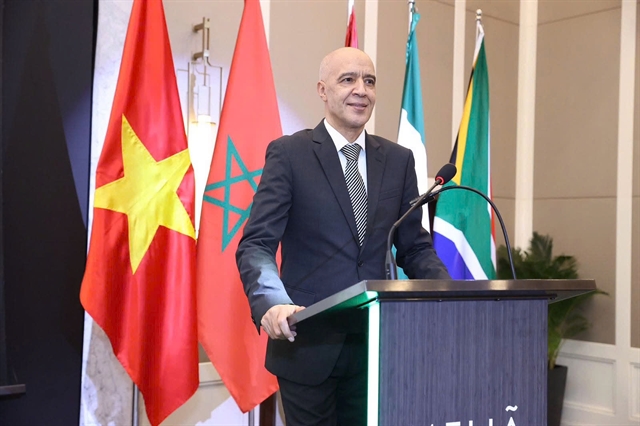
| Moroccan Ambassador to Việt Nam Jamale Chouaibi makes a speech during the celebration of Africa Day in Hà Nội on May 22. |
Morocco-Việt Nam relations are rooted in a shared history of solidarity that predates the formal establishment of diplomatic ties.
During the Indochina War, Moroccan soldiers, moved by the same aspiration for independence, chose to stand alongside the Vietnamese people.
Over the decades, this historical bond has grown into a genuine partnership based on mutual respect, friendship and South-South cooperation. Symbols such as the Morocco Gate in Ba Vì, Hà Nội and the Việt Nam Gate near Kenitra continue to embody this enduring friendship.
The bilateral relationship has continued to gain momentum, marked by high-level diplomatic and parliamentary exchanges. These exchanges have reaffirmed a shared political commitment to bringing economic cooperation closer to the strength of the diplomatic partnership, and to translating recent political agreements into tangible trade growth and cross-sectoral investment.
Economic ties have continued to strengthen, with bilateral trade reaching approximately $380 million in 2025, up 25 per cent year-on-year, while both countries aim to raise this figure to $500 million in the coming years.
Morocco is now among Việt Nam's 10 largest export markets in Africa, reflecting the growing complementarity of the two economies.
Beyond trade, cooperation is expanding into high-potential sectors, including the halal industry, where Morocco’s recognised certification expertise can support Việt Nam's access to the global halal market, as well as renewable energy, green hydrogen, textiles, agriculture, logistics and digital transformation.
Education and people-to-people ties remain a cornerstone of the relationship, with Morocco having offered annual scholarships to Vietnamese students since 2011, alongside cultural and tourism exchanges that bring the two peoples closer together.
United by a shared commitment to sustainable growth, historical memory and cultural exchange, Morocco and Việt Nam are building a partnership that serves as a model for South-South cooperation.
As Morocco deepens its engagement with ASEAN and Việt Nam seeks greater access to African markets, their collaboration continues to create a bridge of opportunity, resilience and shared prosperity for both nations and their respective regions. — VNS
Politics & Law
 Politics & Law
 Politics & Law
 Politics & Law
 Politics & Law
 Politics & Law
 Politics & Law
 Politics & Law
 Politics & Law
 Politics & Law
 Politics & Law
 Politics & Law
 Politics & Law
 Politics & Law
 Politics & Law




