 Sci-Tech

The spice ship
1.
HÀ NỘI — Deputy Prime Minister Hồ Quốc Dũng on Tuesday called on the Vietnam Atomic Energy Institute (VINATOM) to play a leading role in supporting the country's revived nuclear power programme, accelerate the development of a national nuclear science and technology centre and expand the application of nuclear tech for socio-economic development.
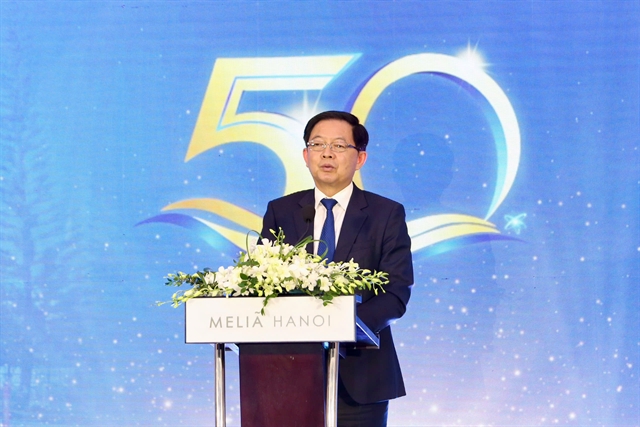 |
| Deputy Prime Minister Hồ Quốc Dũng delivers remarks at the ceremony marking the 50th anniversary of the Vietnam Atomic Energy Institute (VINATOM) in Hà Nội on Tuesday. — VNS Photo |
He was speaking during a ceremony marking the institute's 50th anniversary, also attended by Minister of Science and Technology Vũ Hải Quân, IAEA Deputy Director General Najat Mokhtar and representatives of international partners.
The Deputy Prime Minister outlined six priorities for VINATOM, including restructuring the institute to meet future development needs, accelerating the Nuclear Science and Technology Research Centre project, supporting the national nuclear power programme, strengthening nuclear workforce development, and expanding nuclear applications in healthcare, agriculture, industry, environmental protection and climate change response.
"The entire sector must regard these directions as both a guiding principle and a call to action to make nuclear science a key driver of the country's development," he said.
He also urged the institute to intensify research into advanced reactor technologies, including small modular reactors (SMRs), Generation IV reactors and modern light-water reactors, as Việt Nam prepares to restart its nuclear power programme.
Representing the International Atomic Energy Agency (IAEA), Deputy Director General Najat Mokhtar reaffirmed the agency's commitment to supporting Việt Nam's peaceful nuclear development, highlighting five decades of cooperation between the IAEA and VINATOM.
She said VINATOM had demonstrated how nuclear science could improve everyday life through applications ranging from environmental protection and food security to healthcare and industrial quality assurance.
Mokhtar highlighted cooperation in marine pollution monitoring, climate change research, food irradiation, industrial non-destructive testing, radiation metrology and medical applications, saying these efforts had strengthened food security, environmental protection, healthcare and scientific capacity in Việt Nam. She noted that Việt Nam currently has 19 active technical cooperation projects with the IAEA and said the agency looked forward to continuing its partnership with the country as it expands both the peaceful applications of nuclear technology and its nuclear power programme.
Established in 1976, VINATOM has grown into the country's leading research organisation for the peaceful application of nuclear science and technology. Over the past five decades, the institute has made significant contributions to healthcare, agriculture, industry, environmental protection and nuclear safety.
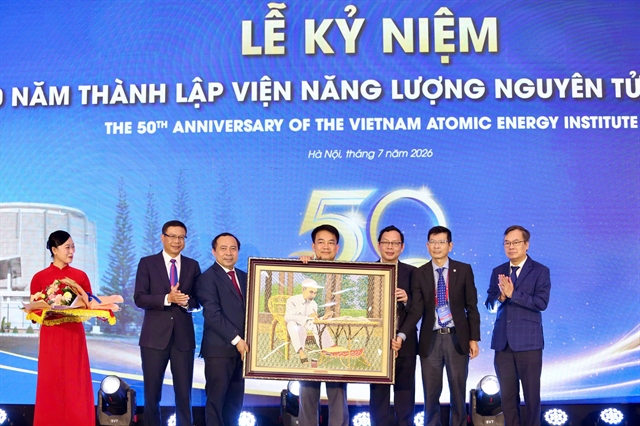 |
| Minister of Science and Technology Vũ Hải Quân presents a commemorative gift to the leadership of the Vietnam Atomic Energy Institute (VINATOM) during the institute's 50th anniversary celebration in Hà Nội. — Photo courtesy of VINATOM |
VINATOM President Trần Chí Thành said the anniversary marked far more than the passage of time.
"These 50 years are not merely a measure of time. They represent five decades of conviction, choice, intellect, resilience and dedication by generations of Vietnamese scientists," he said.
"It has been the journey of people who chose to devote themselves to one of the most demanding scientific fields, carrying one of the nation's greatest hopes for the future."
He added that VINATOM aims to become the nation's strategic nuclear science and technology organisation, capable of mastering advanced technologies, training high-quality human resources and supporting Việt Nam's long-term nuclear development.
Among the institute's major achievements are the restoration and safe operation of the Đà Lạt Nuclear Research Reactor in 1984, the production of more than 30 radioisotopes and radiopharmaceuticals for cancer diagnosis and treatment, the development of nuclear techniques for crop breeding, industrial irradiation technologies, and the operation of the national environmental radiation monitoring and early warning network.
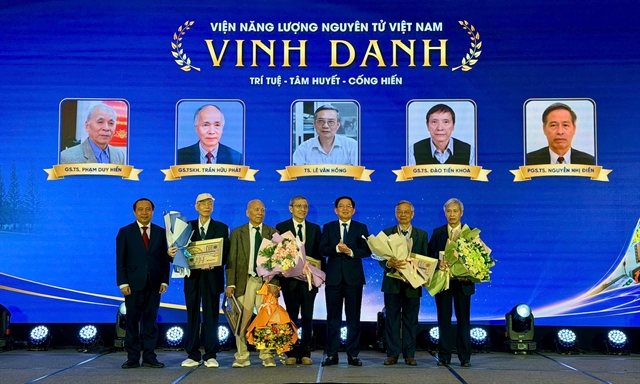 |
| Outstanding individuals are recognised for their contributions during the Vietnam Atomic Energy Institute's (VINATOM) 50th anniversary celebration in Hà Nội. — VNS Photo |
The celebration concluded with a tribute to distinguished scientists and former leaders whose dedication helped build VINATOM over the past 50 years. The recognition underscored that the institute's achievements today are the result of generations of scientists, researchers and staff who devoted their expertise and commitment to advancing the peaceful use of nuclear science in Việt Nam, laying a foundation for future innovation and international cooperation. — VNS
Sci-Tech
 Sci-Tech
 Sci-Tech
 Sci-Tech
 Sci-Tech
 Sci-Tech
 Sci-Tech
 Sci-Tech
 Sci-Tech
 Sci-Tech
 Sci-Tech
 Sci-Tech
 Sci-Tech
 Sci-Tech
 Sci-Tech