 Politics & Law

Exotic Food Showcases Its Position as a Leading Global Sriracha Producer and Exporter at SIAL Paris 2026
1.
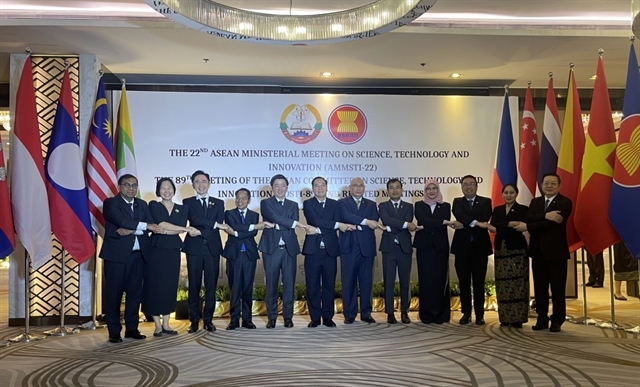 |
| Representatives from ASEAN member countries pose for a group photo. — VNA/VNS Photo Văn Phiên |
VIENTIANE — Việt Nam reaffirmed its commitment to advancing regional cooperation at the 22nd ASEAN Ministerial Meeting on Science, Technology and Innovation (AMMSTI-22) held in Vientiane, Laos, on Friday.
The meeting, themed "Advancing ASEAN Plan of Action on Science, Technology and Innovation (APASTI) for a Resilient, Sustainable and Competitive ASEAN," brought together ministers and officials from ASEAN member states and ASEAN Secretary-General Kao Kim Hourn to discuss how science, technology and innovation can strengthen the bloc's resilience, competitiveness and sustainable development.
The Vietnamese delegation, led by Deputy Minister of Science and Technology Bùi Hoàng Phương, put forward a number of proposals aimed at deepening regional cooperation.
Addressing the meeting, Phương expressed Việt Nam's support for the ASEAN plan, describing science, technology, innovation and digital transformation as strategic drivers for sustainable development across the region.
Drawing on Việt Nam's development experience, he proposed expanding joint research programmes in priority areas of common concern, including water security, climate-resilient hi-tech agriculture and the green energy transition.
The Deputy Minister also stressed the need to develop a highly-skilled workforce by strengthening networks among leading ASEAN universities and research institutes and promoting expert exchanges to narrow technology gaps within the region.
Việt Nam called for enhanced cooperation and the establishment of common regional frameworks for emerging strategic technologies such as artificial intelligence (AI), big data, space technology and cybersecurity to create a secure digital business environment and improve ASEAN's overall competitiveness.
A major outcome of the meeting was the endorsement of a significant restructuring of the ASEAN Committee on Science, Technology and Innovation (COSTI), reducing its sub-committee framework from nine to five specialised bodies to improve governance, enhance alignment with APASTI and accelerate the delivery of regional priorities.
The meeting also welcomed progress on two Priority Economic Deliverables for 2026: an ASEAN declaration on the advancement of cooperation in space science, technology and innovation, and a regional programme for AI applications in the health sector.
Delegates launched the ASEAN Science, Technology and Innovation Fund (ASTIF) Call for Proposals under the theme "ASEAN Grand Challenge: AI-Enabled Competitive and Resilient Region," aimed at harnessing AI to address regional challenges, foster innovation, and improve people's wellbeing.
They also welcomed the operationalisation of the ASEAN–Republic of Korea High-Performance Computing Facility in Indonesia, the region's first shared supercomputing infrastructure, which is expected to support advanced research in AI, climate modelling, disaster forecasting, biotechnology and industrial innovation.
The meeting concluded with the adoption of a joint media statement reaffirming ASEAN's commitment to strengthening regional STI cooperation and partnerships with dialogue partners to build a more resilient, sustainable and competitive ASEAN. Malaysia will host the 23rd ASEAN Ministerial Meeting on Science, Technology and Innovation in June next year. — VNA/VNS
Politics & Law
 Politics & Law
 Politics & Law
 Politics & Law
 Politics & Law
 Politics & Law
 Politics & Law
 Politics & Law
 Politics & Law
 Politics & Law
 Politics & Law
 Politics & Law
 Politics & Law
 Politics & Law
 Politics & Law