 Politics & Law

Lacquer painting exhibition brings 62 works to HCM City
1.
|
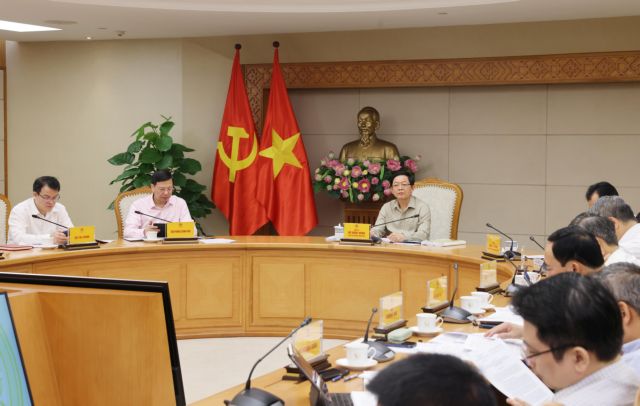
| Deputy Prime Minister Hồ Quốc Dũng chairs the meeting on adjusting the National Land Use Planning for the period 2021-2030, with a vision to 2050 on May 22 in Hà Nội. — VNA/VNS Photo |
HÀ NỘI — The adjustment of the National Land Use Planning for the period 2021–2030 with a vision to 2050 must ensure long-term thinking, remain consistent with national and local plans and create new development space for industry and infrastructure while maintaining food and environmental security and national defence.
Deputy Prime Minister Hồ Quốc Dũng requested a meeting on Friday on revising the National Land Use Planning for the period 2021–2030 with a vision to 2050, implementing the preliminary review of Resolution 18-NQ/TW of the Central Committee of the 13th Party Congress on land and amending the Land Law.
According to the Ministry of Agriculture and Environment, after nearly five years of implementing the National Land Use Plan under Resolution No. 39/2021/QH15 of the National Assembly, many socio-economic development goals have changed significantly, especially the requirement for double-digit economic growth in the coming period, leading to increased land use demand in many sectors.
Along with this, the adjustment of provincial plans and national sectoral plans approved after the national land use plan by localities has also given rise to many new requirements for land allocation.
Minister of Agriculture and Environment Trịnh Việt Hùng said this revised plan was developed based on aggregated land use needs of 34 provinces and cities, national sectoral plans involving land use, regional plans and socio-economic development orientations in line with the spirit of the 14th National Congress of the Communist Party of Việt Nam.
At the meeting, many opinions focused on reviewing agricultural land indicators, especially rice paddy land, protective forests, special-use forests and national defence and security land.
Ministries and agencies argued that the adjustment of planning must both meet new development requirements and avoid suspended planning, which wastes land resources.
Deputy Minister of Finance Trần Quốc Phương said rice paddy land planning needs to be reviewed on a scientific and objective basis to ensure absolute national food security and serve exports, especially protecting rice paddy land in the Mekong Delta.
However, for areas with low-efficiency cultivation, flexible conversion mechanisms are needed to enhance land use value.
Concluding the meeting, the Deputy PM said the Party Central Committee’s guiding principles on land use planning must be followed, stressing that it must create breakthroughs for rapid and sustainable development while maintaining independence, self-reliance, food security, water security, environmental security and social stability.
“Planning must have a long-term vision, not only serving immediate needs but also laying the foundation for subsequent stages of national development,” he said.
“The planning adjustments must be based on a comprehensive, accurate and substantive assessment of the current land use situation as well as future development needs.
“The goal is to ensure food security, protect the ecological environment and forest land area while creating room for the development of industry, urban areas, infrastructure and services in the new phase.
“Planning must be comprehensive and long-term, encompassing the development of industry, urban areas, agriculture, infrastructure, culture, education, national defence, security and environmental protection.” — VNS
Politics & Law
 Politics & Law
 Politics & Law
 Politics & Law
 Politics & Law
 Politics & Law
 Politics & Law
 Politics & Law
 Politics & Law
 Politics & Law
 Politics & Law
 Politics & Law
 Politics & Law
 Politics & Law
 Politics & Law