 Politics & Law
Vietnamese Prime Minister meets Cambodian National Assembly President
1.
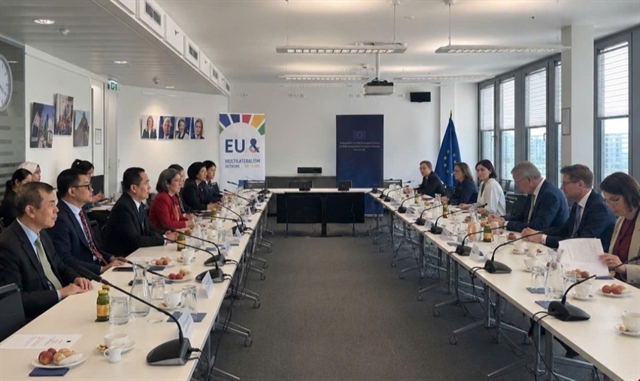 |
| Ambassador Vũ Lê Thái Hoàng, Permanent Representative of Việt Nam to the United Nations and other international organisations in Vienna, Austria. had talks with EU Ambassador Carl Hallergard in Vienna, Austria, on May 20. — VNA/VNS Photo |
VIENNA — Ambassadors from the Association of Southeast Asian Nations (ASEAN) have reaffirmed their commitment to close coordination with the European Union (EU) in safeguarding the multilateral system and strengthening cooperation in digital transformation, sustainable development, cybersecurity, science-technology, and innovation, thereby contributing to peace, stability and development in the region and beyond.
They made the remarks at a meeting with EU Ambassador Carl Hallergard in Vienna, Austria, on May 20, to discuss ASEAN–EU cooperation, the United Nations (UN) reform process and cooperation at the International Atomic Energy Agency (IAEA).
Ambassador Vũ Lê Thái Hoàng, Permanent Representative of Việt Nam to the United Nations and other international organisations in Vienna, Austria, said amid intensifying strategic competition among major powers, ASEAN and the EU share many common values and interests in promoting multilateralism, international law and the central role of the UN. He stressed the need to strengthen “collective strategic autonomy” in order to safeguard the interests of member states and enhance the voice of the two regions in global governance.
The Vietnamese diplomat noted that the UN is at a critical juncture, requiring comprehensive reforms ranging from reviewing functions, operational priorities and working methods to restructuring international institutions in order to adapt to the evolving global context. He also highlighted Vietnam’s active and constructive contributions to multilateral processes, including hosting the signing ceremony for the UN Convention against Cybercrime (Hanoi Convention) and presiding over the inaugural session of the 11th Review Conference of the Parties to the Treaty on the Non-Proliferation of Nuclear Weapons (NPT) in New York.
He underscored the important role of the IAEA in promoting the peaceful use of nuclear energy for sustainable development, noting that Việt Nam is working closely with IAEA on the construction of its first two nuclear power plants. He highly appreciated IAEA’s practical support, particularly through the Technical Cooperation Fund (TCF), in capacity building, human resources training, strengthening legal and technical infrastructure, and advancing nuclear applications for socio-economic development.
In the field of cybercrime prevention, the Ambassador thanked the EU Ambassador for sharing information on the EU’s upcoming ratification of the UN Convention against Cybercrime, describing it as an important step towards strengthening international cooperation in addressing non-traditional security challenges. He added that Việt Nam plans to establish a regional cybercrime training centre for developing countries to support capacity building, experience sharing and international cooperation in implementing the convention.
At the meeting, the EU Ambassador recalled the positive outcomes of the 25th ASEAN-EU Foreign Ministers’ Meeting held on April 28, praising ASEAN’s increasingly proactive role in multilateral mechanisms, particularly at international organisations and the UN in Vienna. He reaffirmed that the EU continues to regard ASEAN as an important partner in promoting multilateralism and maintaining peace, stability and sustainable development.
The two sides held in-depth discussions on UN Secretary-General Antonio Guterres’ “UN80” initiative aimed at improving the effectiveness of the UN, addressing current financial challenges and ensuring the effective functioning of multilateral mechanisms. They stressed the need for comprehensive UN reforms towards a leaner and more efficient system that safeguards inclusiveness and the interests of developing countries. — VNA/VNS
Politics & Law
 Politics & Law
 Politics & Law
 Politics & Law
 Politics & Law
 Politics & Law
 Politics & Law
 Politics & Law
 Politics & Law
 Politics & Law
 Politics & Law
 Politics & Law
 Politics & Law
 Politics & Law
 Politics & Law