 Politics & Law
Cambodian PM Hun Manet chairs welcome ceremony for Vietnamese counterpart Lê Minh Hưng in Phnom Penh
1.
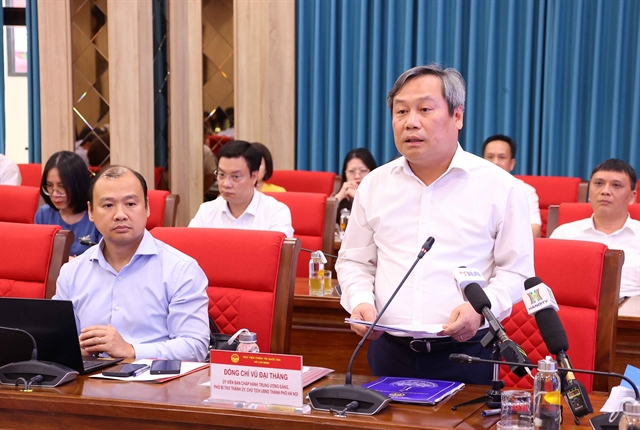 |
| Chairman of Hà Nội People’s Committee Vũ Đại Thắng. — VNA/VNS Photo |
HÀ NỘI — Authorities in Hà Nội plan to select two neighbouring communes or wards with a combined population of about 700,000 to pilot a new “socialist commune-ward” model, Chairman of the municipal People’s Committee Vũ Đại Thắng said on Thursday.
Speaking at a scientific workshop by the Hồ Chí Minh National Academy of Politics in Hà Nội on the theme of “Building socialist communes and wards in a new development era – theoretical and practical issues”, Thắng said the city had begun preparations for the initiative in the first quarter of 2026 following directions from Party General Secretary and State President Tô Lâm.
According to Thắng, Hà Nội established a steering committee earlier this year to develop a pilot project on building socialist communes and wards across the capital.
The city has consulted experts, scientists and relevant agencies to study the theoretical, legal and practical foundations for the initiative.
He said the model aims to “materialise the good nature of the socialist system” at the administrative level closest to residents, with all policies and activities directed towards improving people’s well-being, ensuring fairness and progress, and leaving no one behind.
The implementation roadmap is expected to be divided into three phases.
In 2026, the city plans to complete the overall project and related sub-projects, select pilot locations and allocate resources for implementation. The pilot sites and implementation plans are expected to be finalised by September.
From 2027 to 2030, the city will simultaneously deploy all key tasks in the selected pilot areas.
After 2030, authorities will review and refine the evaluation criteria before expanding the model between 2031 and 2035.
The Hà Nội's mayor said the pilot project had undergone multiple rounds of consultation and careful review and is expected to be completed this month before being submitted to competent authorities for consideration and approval.
The proposed framework is based on eight core areas and 54 evaluation criteria, including 52 primary indicators and two composite measures covering residents’ happiness and overall public satisfaction.
The criteria cover economic development, income, urban planning, healthcare, education, environmental standards, national defence and security, and digital transformation.
Chairman Thắng said the framework could eventually be applied across all communes and wards in the capital, not only the pilot localities.
Regarding the selection of pilot areas, Chairman Thắng said the city would prioritise locations that are representative and feasible for implementation, rather than areas facing exceptional difficulties or possessing overly unique characteristics.
The chosen localities must be capable of implementing the eight core components in a coordinated manner, reorganising development space effectively, and demonstrating strong political commitment from local Party committees and authorities.
The areas should also have favourable transport connectivity and functional planning conditions to support future replication of the model.
“Initially, the city is expected to select two neighbouring communes to implement the model simultaneously, ensuring a combined population scale of around 700,000 people,” Thắng said.
He added that the city would clearly define funding sources, including the state budget, socialised funding mechanisms and special investment attraction policies, alongside close coordination between municipal authorities and local administrations to ensure consistency. — VNS
Politics & Law
 Politics & Law
 Politics & Law
 Politics & Law
 Politics & Law
 Politics & Law
 Politics & Law
 Politics & Law
 Politics & Law
 Politics & Law
 Politics & Law
 Politics & Law
 Politics & Law
 Politics & Law
 Politics & Law