 Politics & Law
Vietnamese Prime Minister meets Cambodian National Assembly President
1.
|
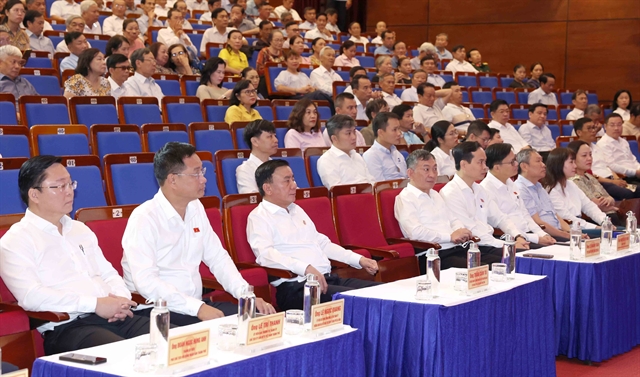
| Permanent member of Party Central Committee's Secretariat Trần Cẩm Tú (third from left) at the meeting with Đà Nẵng's voters from six wards on Tuesday. VNA/VNS Photo |
ĐÀ NẴNG — Permanent member of Party Central Committee's Secretariat Trần Cẩm Tú said the Party Central Committee places strong emphasis on developing Đà Nẵng into a major hub for tourism services, logistics, innovation and high technology in the central and Central Highlands regions.
He made the remarks while meeting with the city’s voters from six wards on Tuesday.
At the meeting, voters from Hải Châu, An Khê, Thanh Khê, Sơn Trà, An Hải and Hoà Cường wards raised concerns over electricity prices, fuel price stabilisation, and called on the National Assembly to pay greater attention to social welfare as living costs continue to rise.
They also highlighted issues related to the implementation of the Land Law; tackling school violence; managing public assets following administrative mergers; resolving bottlenecks at commune and ward levels under the two-tier local government model; and addressing long-delayed projects.
Speaking at the meeting, Tú acknowledged and highly valued voters’ opinions, noting that for key growth centres like Đà Nẵng, the central authorities would continue refining special mechanisms and policies to support the city’s development towards 2030, with a vision to 2045.
Responding to voters in Sơn Trà Ward on measures to better control power, particularly in land management, public investment, state assets and personnel work, he said the Party would strictly enforce its regulations on power control in cadre affairs, while ensuring effective implementation of laws on anti-corruption, land, public investment and public asset management.
“These areas will be at the core of inspection, supervision and auditing in the coming period. The Secretariat will direct Party committees at all levels to develop detailed implementation plans, clearly defining responsibilities, timelines and expected outcomes,” he said.
On socio-economic development goals, Tú stressed that the central government would continue efforts to maintain macroeconomic stability, improve the business environment, support enterprises in recovering production, accelerate public investment disbursement, create jobs, raise incomes and strengthen social welfare.
Voters in Hải Châu Ward pointed to unclear delineation of responsibilities between city and ward-level authorities, leading to delays in administrative handling and affecting the investment climate as well as business activities.
In response, Tú said the Party would continue streamlining the organisational apparatus. The central authorities were preparing a one-year review of the two-tier local government model to assess, adjust and further improve service quality for citizens.
He added that the State would prioritise investment in digital infrastructure, synchronising national databases on population, land, and public officials, while enhancing data connectivity to reduce paperwork, processing time and costs for citizens and businesses.
Tú also noted that the reorganisation of villages and residential groups to align with the two-tier governance model was an objective requirement aimed at streamlining administrative units and improving management efficiency.
He urged Party committees and authorities in Đà Nẵng to continue reporting difficulties and proposing innovative, effective models for the central government to study and replicate nationwide.
At the meeting, he also addressed voters’ concerns regarding the recent rotation and reassignment of key leaders across cities and provinces. For major growth centres such as Hà Nội, HCM City and Đà Nẵng, he said the central authorities were placing strong emphasis on selecting officials with political integrity, innovative thinking and modern governance capacity, with work performance and public trust serving as the primary benchmarks.
He further outlined solutions related to science and technology development, digital transformation, private sector growth, healthcare, education and energy.
He reaffirmed the central government’s determination to ensure periodic health check-ups for citizens and to implement a major policy to build inter-level boarding schools in 248 land-border communes, ensuring that children from ethnic communities can study in safe and well-equipped facilities. — VNS
Politics & Law
 Politics & Law
 Politics & Law
 Politics & Law
 Politics & Law
 Politics & Law
 Politics & Law
 Politics & Law
 Politics & Law
 Politics & Law
 Politics & Law
 Politics & Law
 Politics & Law
 Politics & Law
 Politics & Law