 Politics & Law

Đắk Lắk coffee targets global living heritage status
1.
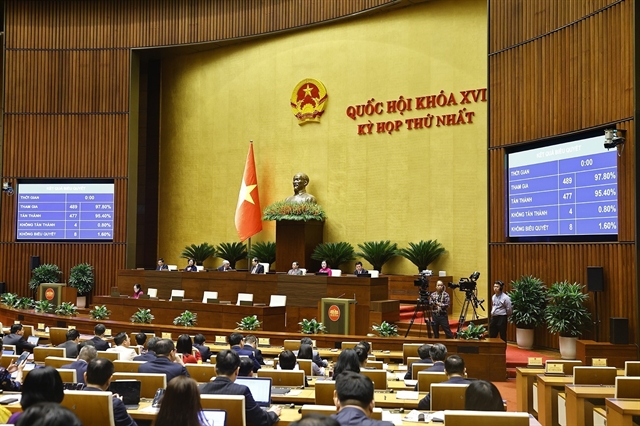 |
| The National Assembly deputies vote to approve the National Assembly Resolution on the Development of Vietnamese Culture. — VNA/VNS Photo Doãn Tấn |
HÀ NỘI — The National Assembly on Friday morning approved a resolution designating November 24 as Việt Nam Culture Day, granting workers a day off with full pay.
The measure passed with 477 of 489 deputies present voting in favour.
The date commemorates the first National Cultural Conference in 1946, chaired by President Hồ Chí Minh.
The resolution will take effect from July 1, 2026.
Under the resolution, entry fees to public cultural and sports facilities will be waived or reduced on Việt Nam Culture Day, subject to decisions by competent authorities.
The public, particularly young people and children, is encouraged to take part in cultural activities during major national holidays.
The Government said relevant agencies are studying the inclusion of a draft law amending and supplementing several provisions of four laws in the home affairs sector in the 2026 legislative programme of the 16th National Assembly.
This includes proposed amendments to the Labour Code to formally recognise November 24 as a paid public holiday.
The draft law is expected to be adopted at the second session of the 16th National Assembly.
Under the resolution, the State will ensure that annual spending on culture accounts for at least 2 per cent of total State budget expenditure, with gradual increases in line with development needs, while encouraging the mobilisation of social resources for cultural development.
On investment incentives in the cultural sector, the resolution stipulates that activities such as film production, distribution and exhibition; exhibitions; and training and competition services in sports for persons with disabilities or professional sports will be eligible for a 5 per cent value-added tax rate.
High-value artworks and Vietnamese cultural heritage items meeting the criteria for national treasures or rare antiquities currently held overseas, if acquired or auctioned and brought back to Việt Nam on a non-profit basis for display or donation or transfer of ownership to the State, will be exempt from import duties and customs fees, and not subject to VAT.
Local authorities that pilot a “heritage urban area” model in line with Government criteria will be empowered to introduce preferential policies on land and fees to support activities aimed at preserving and promoting cultural heritage and developing cultural industries. The pilot period will run until the end of 2035.
Regarding policies for the preservation of ethnic groups' cultures, folk and traditional arts, as well as national treasures and rare antiquities, the resolution affirms that the State will ensure financial resources to safeguard and promote the traditional cultural values of all ethnic groups in Việt Nam, particularly those at risk of fading.
Tailored mechanisms and policies will be developed for ethnic minority cultures, alongside efforts to expand cultural preservation spaces, including traditional villages and communities linked with tourism, thereby enhancing the role of cultural custodians and creating sustainable livelihoods.
Funding will be promptly allocated for the repatriation of Vietnamese-origin national treasures and rare antiquities from abroad once the Prime Minister approves their acquisition or auction.
The State will invest in and upgrade infrastructure and ensure the operation of public service units providing essential cultural and traditional arts services.
Priority will be given to incorporating traditional art forms into national and international cultural events serving political tasks, and adequate airtime will be ensured for programmes featuring folk culture and traditional arts on radio and television systems.
Public lawyers to be piloted from October
Also on Friday morning, the National Assembly also approved a resolution on a pilot scheme for a public lawyer system, to run from October 1, 2026, to September 30, 2028, with 467 of 484 deputies present voting in favour.
The resolution sets out principles of operation, standards, scope of work, rights and obligations, procedures and policy regimes for public lawyers.
Eligible candidates include officials, civil servants, public employees, military officers, police officers, and employees of State-owned enterprises who meet lawyer qualification standards and have at least five years’ professional experience.
The pilot will be implemented at the Ministries of National Defence, Public Security, Foreign Affairs, Justice, Finance, Industry and Trade, Agriculture and Environment, and Construction as well as in the municipal authorities of Hà Nội, HCM City, Đà Nẵng, Hải Phòng, Cần Thơ, and the provinces of Đồng Nai, Bắc Ninh, Quảng Ninh, Khánh Hòa, and Lâm Đồng.
Public lawyers must comply with the Constitution and the law, adhere to the code of ethics and professional conduct for Vietnamese lawyers, and uphold the ethical standards applicable to public officials and members of the armed forces.
They are required to act independently, honestly, and objectively, and bear legal responsibility, as well as accountability to the employing agency, for their professional activities.
The resolution strictly prohibits public lawyers from providing legal services to non-State clients; disclosing information related to assigned cases without authorisation; colluding with others to violate legal provisions in handling cases; abusing their position for personal gain; and committing other acts prohibited under relevant laws. Any obstruction of public lawyers’ activities is also banned. — VNS
Politics & Law
 Politics & Law
 Politics & Law
 Politics & Law
 Politics & Law
 Politics & Law
 Politics & Law
 Politics & Law
 Politics & Law
 Politics & Law
 Politics & Law
 Politics & Law
 Politics & Law
 Politics & Law
 Politics & Law