 Politics & Law
Vietnamese Prime Minister meets Cambodian National Assembly President
1.
|
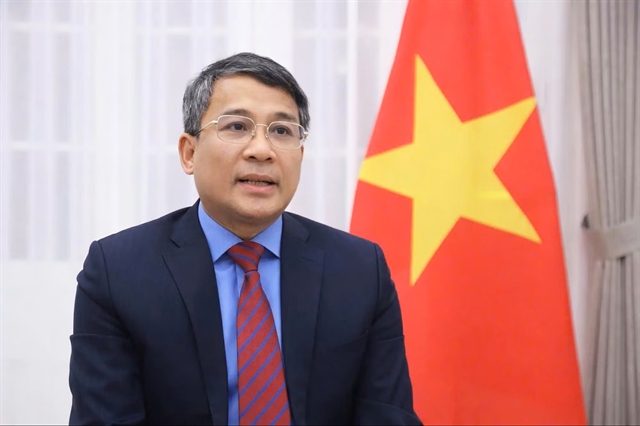
| Permanent Deputy Minister of Foreign Affairs Nguyễn Minh Vũ. Photo courtesy of the Ministry of Foreign Affairs |
HÀ NỘI – The state visit to China by General Secretary of the Communist Party of Việt Nam (CPV) Central Committee and State President Tô Lâm and his spouse from April 14 to 17 will create an important foundation for breakthroughs that will elevate bilateral relations to a new stage of development, with renewed momentum and expanded scope for cooperation, according to an official.
Talking to the press, Permanent Deputy Minister of Foreign Affairs Nguyễn Minh Vũ said that the trip, made at the invitation of General Secretary of the Communist Party of China (CPC) Central Committee and President of China Xi Jinping and his spouse, will mark the first state visit by Tô Lâm in his capacity as the top leader of the Party and the State of Việt Nam. It comes exactly one year after the Chinese leader’s state visit to Việt Nam, on April 14–15, 2025, and represents the third trip between the two top leaders within less than two years.
According to Vũ, the visit carries three particularly significant implications. First, it is expected to usher in a new phase in bilateral relations as both countries enter a new stage of development. Việt Nam has embarked on a new development era following the highly successful 14th National Party Congress, while China is initiating the implementation of its 15th five-year Socio-Economic Development Plan.
The early arrangement of the visit, he noted, reflects the top priority and strong determination both sides attach to further strengthening a relationship often described as 'both comrades and brothers', making it more stable, substantive, and sustainable in the time ahead.
Second, the trip is seen as an important opportunity to elevate strategic connectivity and define a new level for bilateral cooperation. The two top leaders will identify new directions and breakthroughs in areas such as trade, investment, tourism, supply chains, production networks, education – training, and science – technology, helping realise each country’s development goals and aspirations.
Third, the visit is expected to further consolidate political trust, promote solutions to outstanding differences, and enhance people-to-people exchanges and local-level cooperation, contributing to the stability and sustainability of bilateral ties as well as to peace, stability, and cooperation in the region and the world, he said.
Assessing recent developments in Việt Nam – China relations, the deputy minister observed that the ties have maintained a positive growth trajectory, with clear and relatively comprehensive progress made in line with the 'six major orientations'.
He noted that political trust has been steadily strengthened, with high-level exchanges conducted regularly through flexible formats. Notably, the state visits by Party General Secretary and State President Tô Lâm in August 2024 and his Chinese counterpart in April 2025 took place within less than a year.
Cooperation in diplomacy, defence, and security has also recorded substantive strides. The two sides successfully convened the first ministerial-level '3+3' strategic dialogue on diplomacy, national defence, and public security within the framework of the 17th meeting of the Việt Nam – China Steering Committee for Bilateral Cooperation. Regular activities such as joint naval patrols in the Gulf of Tonkin, joint army training and collaboration in combating transnational crime and managing border areas have further strengthened mutual trust and practical cooperation.
Economic, trade, and investment ties have remained a bright spot. Việt Nam has retained its position as China’s largest trading partner in ASEAN for 10 consecutive years and ranked as China’s fourth-largest globally in 2024 and 2025. China has also been the largest trading partner of Việt Nam for many years. Bilateral trade reached US$256.4 billion in 2025, marking a 24.8 per cent increase year-on-year. Meanwhile, investment cooperation has shifted toward higher quality, with China ranking second in total registered capital in Việt Nam with $5.96 billion.
Progress has also been made in strategic connectivity, especially in transport infrastructure and logistics. Both sides have promoted railway connections, upgraded economic corridors and piloted smart border gate models to facilitate trade and enhance supply chain integration, Vũ added.
People-to-people exchanges have flourished, with 5.28 million Chinese tourist arrivals in Việt Nam last year, representing a significant year-on-year increase of 41.3 per cent and making this the biggest source of foreign visitors to the Southeast Asian nation. Educational and cultural exchanges have also expanded, alongside vibrant local-level cooperation, helping to strengthen the social foundation of bilateral ties.
The official emphasised that both sides have maintained close coordination at multilateral mechanisms, supporting multilateralism with the United Nations as the core and international law as the foundation. They have also supported each other's important development initiatives and roles at multilateral forums, especially the UN, ASEAN, and Mekong – Lancang cooperation, contributing to regional and global peace and stability.
Regarding border and territorial issues, he affirmed that the overall situation along the land boundary remains stable while bilateral mechanisms for dialogue, negotiation and cooperation on maritime issues have been regularly maintained. Both sides have underscored the importance of properly managing and addressing differences to help with the preservation of peace, stability and development in the region.
Vu also asserted that the comprehensive and substantive achievements in recent years have been underpinned by strong mutual trust and understanding between the two Parties and countries' high-ranking leaders, along with joint efforts and strong support across sectors, localities, businesses, and communities in both countries. These results, he added, provide a solid foundation for further advancing bilateral relations in a stable, healthy and sustainable direction. VNA/VNS
Politics & Law
 Politics & Law
 Politics & Law
 Politics & Law
 Politics & Law
 Politics & Law
 Politics & Law
 Politics & Law
 Politics & Law
 Politics & Law
 Politics & Law
 Politics & Law
 Politics & Law
 Politics & Law
 Politics & Law