 Politics & Law
Viettel’s Unitel in Laos a symbol of Việt Nam-Laos friendship: Prime Minister
1.

|
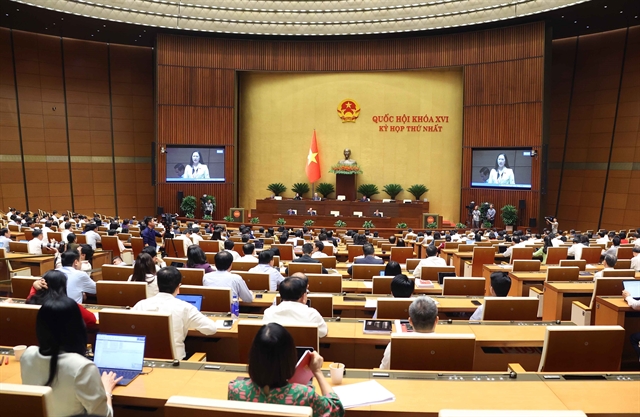
| National Assembly (NA) deputies participate in the 16th NA’s first session on Saturday morning. VNA/VNS Photo |
HÀ NỘI — National Assembly (NA) deputies have called for sweeping efforts to remove unnecessary administrative barriers, eliminate redundant licensing requirements and accelerate digital transformation, all with the aim of better serving citizens.
During discussions on the revised Law on Civil Status at the 16th NA’s first session on Saturday morning, lawmakers stressed that the amendments are urgent to institutionalise the national digital transformation agenda, reduce compliance costs and improve the efficiency of population management.

|
| Deputy Tô Ái Vang from Cần Thơ City speaks at the working session on Saturday morning during discussions on the revised Law on Civil Status. VNA/VNS Photo |
Analysing the relationship between the Law on Civil Status and the Law on Identity, Deputy Tô Ái Vang from Cần Thơ City described civil status as the root dataset recording an individual’s legal identity, while identity data serves as the operational layer for utilisation. To avoid overlap, she proposed full data interoperability, using the personal identification number as a unified key on the VNeID platform.
She also suggested integrating civil status public services into VNeID to replace paper extracts, alongside implementing a “three-in-one” procedure of birth registration, permanent residence registration and issuance of ID cards for children under 14, potentially reducing citizens’ administrative travel time by up to two-thirds.
While acknowledging the draft law’s forward-looking approach, Deputy Cil Bri from Lâm Đồng Province pointed to a persistent gap between policy ambition and implementation capacity. He cautioned that current databases remain incomplete and technical infrastructure in remote areas is still weak. Rigid requirements for fully online registration and borderless administrative processing could therefore create new bottlenecks. He recommended that infrastructure, data systems and human resources be developed in advance, with a phased roadmap tailored by region and backed by clear state investment commitments.
Deputy Trần Nhật Minh from Nghệ An Province proposed removing the issuance of marital status certificates as a civil status registration procedure. He argued that information on marriage, divorce and single status is already integrated into the national civil status database. Continuing to require citizens to obtain certificates, which are valid for only six months, creates unnecessary administrative burdens and costs in transactions such as property transfers or loan applications.
Minh also noted that under the Law on Marriage and Family, cohabitation without registration is not legally recognised as marriage, making the current legal terminology used in such certificates inaccurate. Regarding death registration procedures, he suggested easing requirements for submitting proof of death by adding the phrase “if available” in cases where individuals pass away at home due to age or illness without medical or forensic confirmation.
The recording of personal information in civil status documents also drew attention. Deputy Trần Văn Tuấn from Bắc Ninh Province highlighted inconsistencies surrounding the concept of “place of origin,” which can vary within the same family. He recommended considering international practices, where most countries record only place of birth and nationality for greater clarity and consistency.
Meanwhile, Deputy Dương Minh Ánh from Hà Nội proposed that parental information on birth certificates be defined based on legal parent-child relationships rather than gender. She suggested recognising both same-sex parents on birth certificates where a lawful parent-child relationship has been established, and introducing mechanisms to legally recognise co-caregivers, thereby safeguarding children’s rights in a substantive and non-discriminatory manner.
Turning to the draft revised Law on Notarisation on Saturday morning, many NA deputies called for prioritising the removal of administrative hurdles. Deputy Nguyễn Minh Tuấn from Phú Thọ Province urged clearer definitions of notaries’ roles and responsibilities in transactions showing signs of irregularities, including real estate tax evasion.
He argued that not all real estate contracts should be subject to mandatory notarisation, suggesting that standardised contracts combined with tax compliance could suffice.

|
| Deputy Lê Thanh Hoàn from Thanh Hóa Province voices his opinion about the draft revised Law on Notarisation on Saturday morning. VNA/VNS Photo |
Several deputies opposed including real estate deposit agreements in the category of contracts requiring compulsory notarisation. Deputy Lê Thanh Hoàn from Thanh Hóa Province explained that under the Civil Code, if a buyer breaches a deposit agreement, the seller has the right to sell the property to another party. However, if a notarised deposit contract is under dispute and has not been invalidated by a court, notary offices may refuse subsequent transactions, effectively restricting the seller’s rights.
On provisions limiting notarisation jurisdiction to the locality where the property is located, Hoàn argued that such rules create location-based advantages for notary offices and hinder competition based on service quality.
Deputy Phạm Văn Hòa from Đồng Tháp Province also called for the removal of so-called “sub-licences” in personnel management, citing as an example the requirement to submit notarised copies of diplomas and certificates for reappointment procedures. — VNS
Politics & Law
 Politics & Law
 Politics & Law
 Politics & Law
 Politics & Law
 Politics & Law
 Politics & Law
 Politics & Law
 Politics & Law
 Politics & Law
 Politics & Law
 Politics & Law
 Politics & Law
 Politics & Law
 Politics & Law