 Politics & Law
Deputy PM urges removal of legal bottlenecks hindering development
1.
|
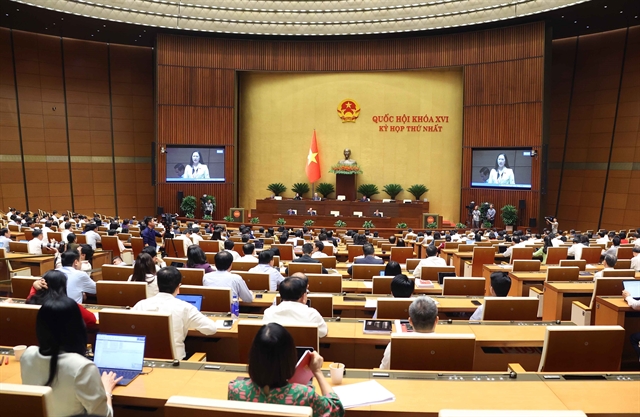
| Lawmakers debate the revised Law on Civil Status, as well as draft amendments to the Law on Notarisation and the Law on Legal Aid on Saturday morning. VNA/VNS Photo |
HÀ NỘI — Continuing the agenda of the first session of the 16th National Assembly (NA), lawmakers on Saturday morning debated the revised Law on Civil Status, as well as draft amendments to the Law on Notarisation and the Law on Legal Aid.
In the afternoon, the legislature discussed a draft NA resolution on coordination mechanisms and special policies to improve the prevention and settlement of international investment disputes, alongside proposed amendments to the Law on Việt Nam’s overseas representative missions.
According to the verification report on the revised Law on Civil Status, the NA’s Committee for Legal and Judicial Affairs broadly agreed with the draft’s direction, which affirms birth registration information as the original and primary civil status record of an individual.
Where discrepancies arise between birth registration data and other documents or databases, relevant agencies and organisations would be required to coordinate with civil status authorities to review and make adjustments.
The draft also proposes decentralising all civil status registration authority to commune-level People’s Committees, while provincial and central authorities would focus on state management. It calls for the development and upgrading of the civil status database into a national database, ensuring connectivity and data-sharing with the national population database and other sectoral databases.
The committee recommended further research and refinement of provisions on proactive birth and death registration, a new feature of the draft law. To facilitate implementation, the Government would be tasked with setting out a roadmap for rolling out these mechanisms.
Regarding amendments to the Law on Notarisation, the committee supported clarifying and expanding the scope of real estate transactions eligible for notarisation regardless of administrative boundaries. The Government would be assigned to develop a roadmap for implementing this cross-boundary notarisation under Article 44.
On the revised Law on Legal Aid, the committee largely endorsed proposals to remove the requirement of “financial difficulty” for certain beneficiary groups currently defined in the law, while adding new eligible groups. Some opinions, however, called for further review to ensure no eligible beneficiaries who may be recognised under other legal documents but not yet reflected in the draft are left out.
As for the draft resolution on coordination mechanisms and special policies to enhance the effectiveness of preventing and resolving international investment disputes, the NA’s Committee for Economic and Financial Affairs agreed in principle with assigning the state agency responsible for foreign investment as the lead body in cases where the directly involved or proposed defendant agency is a judicial body.
This approach is intended to safeguard the independence of judicial proceedings and minimise conflicts of interest. However, the committee stressed the need for binding mechanisms to ensure the timely provision of information and documents from judicial bodies, preventing the lead agency from becoming nominal or overly dependent on others.
Concerning amendments to the Law on Việt Nam’s overseas representative missions, some deputies suggested clarifying the phrase “in line with the requirements of international integration” in Clauses 1 and 4. They noted that the term remains qualitative and lacks precise legal definition, which could lead to inconsistent interpretation and application in practice. — VNS
Politics & Law
 Politics & Law
 Politics & Law
 Politics & Law
 Politics & Law
 Politics & Law
 Politics & Law
 Politics & Law
 Politics & Law
 Politics & Law
 Politics & Law
 Politics & Law
 Politics & Law
 Politics & Law
 Politics & Law