 Politics & Law
Vietnamese Prime Minister meets Cambodian National Assembly President
1.
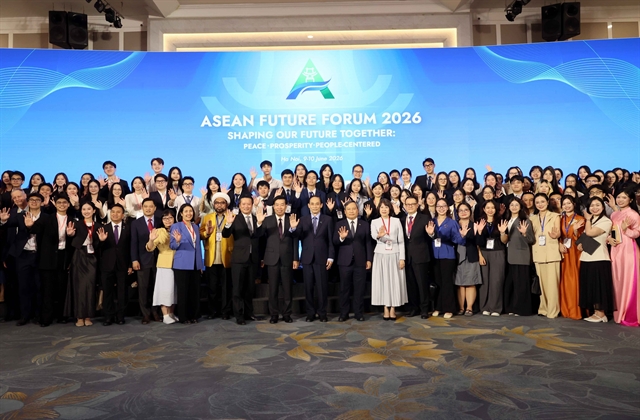 |
| Minister of Foreign Affairs Lê Hoài Trung, Deputy Foreign Minister Nguyễn Mạnh Cường, and Chairman of the Hà Nội People's Committee Vũ Đại Thắng pose for a group photo with delegates at the closing session of the ASEAN Future Forum (AFF) 2026. VNA/VNS Photo |
HÀ NỘI — The ASEAN Future Forum (AFF) 2026 concluded on Wednesday afternoon after two days of intensive discussions under the theme “Shaping Our Shared Future: Peace, Prosperity and People-centred Development”.
The forum attracted a record turnout, bringing together more than 1,200 delegates from across the region and beyond, including senior leaders, policymakers, experts, scholars, representatives of international organisations, businesses and youth groups.
Addressing the closing session, Minister of Foreign Affairs Lê Hoài Trung said the issues discussed at the forum were of critical importance to both ASEAN member states and their partners.
He noted that the third edition of the forum provided a platform for exchanges on both emerging and long-term challenges, while remaining closely aligned with the theme of the Philippines’ ASEAN Chairmanship this year.
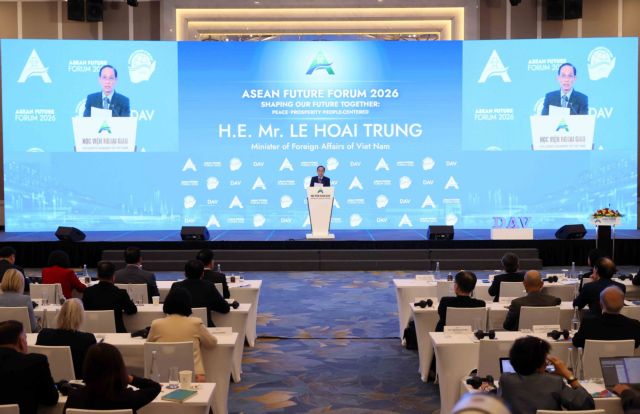 |
| Minister of Foreign Affairs Lê Hoài Trung delivers a keynote speech at the event. VNA/VNS Photo |
According to Trung, AFF 2026 introduced several new initiatives, including the first ASEAN Cities Leadership Conference, an inaugural dialogue among political party representatives from ASEAN member states, and dedicated discussions involving youth delegates and representatives from the Mekong sub-region.
“We hope these activities will help strengthen people-to-people ties and foster a sustainable, inclusive and people-centred community,” he said.
The Foreign Minister added that the substantive and innovative ideas put forward by delegates would be conveyed to ASEAN leaders for consideration.
Trung said the discussions reflected a stronger sense of ASEAN community than ever before. Contributions from leaders, scholars and youth representatives underscored shared concerns over regional security and the importance of upholding international law, which he described as essential foundations for sustainable development.
Delegates also reaffirmed their commitment to ASEAN’s future, its core values and its strategic role in an increasingly complex global landscape.
One of the forum’s key messages, he noted, was the growing convergence of views among ASEAN countries on how to address current challenges. Strengthening regional resilience and adaptability has emerged as a top priority, with speakers stressing the need to build a favourable long-term strategic environment rather than simply respond to immediate crises.
“After three years, the ASEAN Future Forum has become an increasingly important platform for advancing collective efforts to build the ASEAN Community and strengthen ASEAN’s relations with key partners beyond the region,” Trung said.
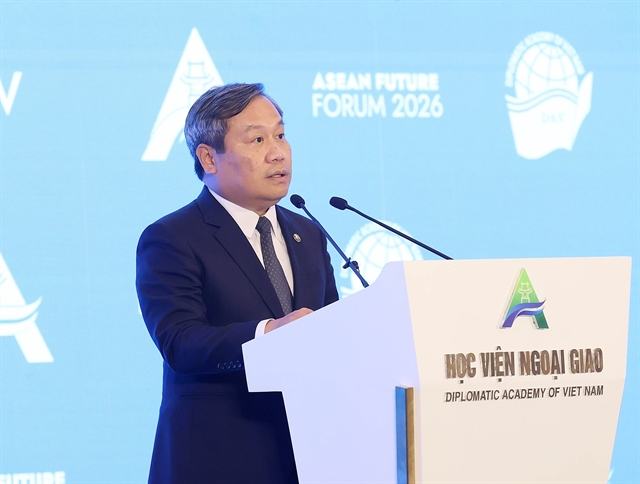 |
| Chairman of the Hà Nội People's Committee Vũ Đại Thắng speaks at the event. VNA/VNS Photo |
Reporting on the outcomes of the forum, Chairman of the Hà Nội People's Committee Vũ Đại Thắng said the ASEAN Cities Leadership Conference attracted more than 250 delegates representing 25 localities across the region.
Participants welcomed Hà Nội’s initiative to organise the event, describing it as a practical platform for dialogue, connectivity and experience sharing among ASEAN cities and urban centres at a time when the region faces both new opportunities and growing challenges.
Delegates agreed that cities are playing an increasingly important role in driving economic growth, fostering innovation, accelerating digital transformation, promoting green development and improving people's quality of life.
At the same time, they acknowledged a range of common challenges facing ASEAN cities, including climate change, development gaps, shortages of skilled workers needed for the green and digital transitions, as well as emerging issues such as artificial intelligence and data security.
Participants also noted that these shared challenges present opportunities for deeper cooperation, greater knowledge exchange and joint efforts to develop innovative solutions for sustainable development across the region.
The discussions highlighted two key priorities. First, technology and digital infrastructure can only achieve their full potential when supported by modern governance systems and designed to better serve people's needs. Delegates also underscored the important role of artificial intelligence, data and private-sector participation in driving innovation and digital transformation in ASEAN cities.
Second, cities should prioritise the development of green infrastructure, strengthen climate resilience and advance sustainable development, while ensuring that people remain at the centre of all adaptation and development strategies.
Reporting on the Dialogue among Southeast Asian Political Parties, Deputy Foreign Minister Nguyễn Mạnh Cường stressed the importance of strengthening political trust and dialogue across the region.
The event brought together representatives of 11 political parties from 11 countries for open, candid and constructive discussions.
According to Cường, the dialogue provided a valuable platform for political parties to exchange perspectives, share practical experiences and contribute to efforts to build the ASEAN Community.
Participants agreed to propose transforming the dialogue into an annual mechanism aimed at enhancing mutual understanding and strengthening ASEAN’s resilience in the years ahead. — VNS
Politics & Law
 Politics & Law
 Politics & Law
 Politics & Law
 Politics & Law
 Politics & Law
 Politics & Law
 Politics & Law
 Politics & Law
 Politics & Law
 Politics & Law
 Politics & Law
 Politics & Law
 Politics & Law
 Politics & Law