 Politics & Law
Deputy PM urges removal of legal bottlenecks hindering development
1.
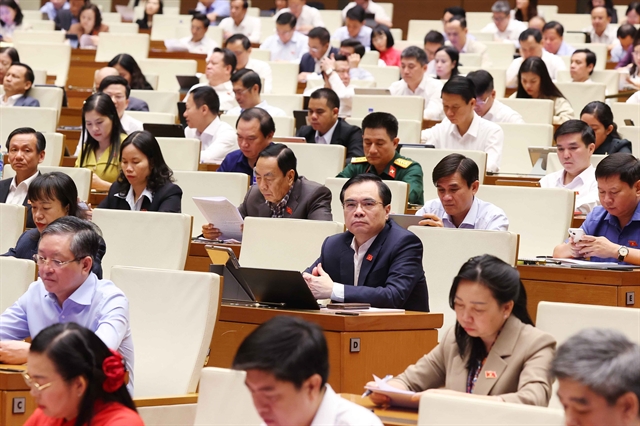 |
| The16th NA’s first session deputies discuss proposed amendments to the Law on Legal Aid on Saturday morning. VNA/VNS Photo |
HÀ NỘI — A majority of National Assembly (NA) deputies have voiced support for expanding the scope of beneficiaries eligible for legal aid, aiming to better safeguard access to legal services for vulnerable groups in society.
At the 16th NA’s first session on Saturday morning, lawmakers debated proposed amendments to the Law on Legal Aid, broadly agreeing with key contents of the Government’s submission, the verification report and the draft revisions.
NA deputies underscored that legal aid is a deeply humanitarian policy area, contributing to the building of a rule-of-law socialist state and upholding the principle that all citizens are equal before the law.
Deputy Dương Khắc Mai from Lâm Đồng Province supported the need to amend and supplement the law to further institutionalise the Party and State’s policies on protecting human and civil rights, particularly the right of vulnerable groups to access legal services.
Commenting on the categories of legal aid beneficiaries under Clause 2, Article 1 of the draft, he called for broader and more substantive coverage. Specifically, he proposed revising provisions on ethnic groups so that eligibility does not depend on residence status, given their heightened vulnerability and barriers to accessing legal services.
He also suggested adding new groups, including victims or individuals in the process of being identified as victims of human trafficking, and those subject to compulsory drug rehabilitation measures. These groups require timely legal support to protect their lawful rights and interests.
Regarding the elderly, Mai recommended a more targeted approach, focusing on specific criteria such as those living alone, without support, or receiving monthly social assistance, rather than applying broad, generalised provisions.
Sharing the view on expanding eligible beneficiaries under Article 7, Deputy Nguyễn Thanh Phong from Vĩnh Long Province proposed including additional groups such as low-income earners as their income falls below the average but are not classified as poor, and therefore cannot afford legal services, as well as other vulnerable individuals. These include victims of domestic violence, those affected by Agent Orange, and people who are unemployed or have lost jobs due to objective factors such as natural disasters, pandemics or economic crises.
Beyond traditional, demand-based forms of legal aid such as legal counselling or participation in legal proceedings, he also recommended more proactive and diversified approaches. These include outreach and on-site support in prisons, hospitals, industrial zones and areas with large numbers of low-income workers, as well as digital transformation through online legal aid platforms to improve accessibility, particularly in remote and disadvantaged areas.
Addressing policy approach, Deputy Cao Thị Xuân from Thanh Hóa Province noted that although the scope of legal aid beneficiaries has been relatively broad on paper, in practice many people facing difficulties in accessing legal services still fall outside eligible categories. This suggests that the current approach remains administrative and target-based, rather than rights-based, and does not fully ensure proactive access to justice.
She pointed out that in ethnic groups in remote and mountainous regions, demand for legal aid is high, yet many people remain hesitant or unable to access services due to lack of awareness or failure to meet existing criteria. At the same time, some legally vulnerable groups are still not covered.
“I therefore propose that the drafting body consider adding criteria to identify beneficiaries based on their level of legal vulnerability,” Xuân said, suggesting that the Government be tasked with detailing implementation to ensure flexibility across different development stages, in line with current legislative orientations.
She also stressed that improving the quality of legal aid services should be treated as a breakthrough priority. While implementation has yielded positive results, disparities in service quality remain across localities. Ultimately, she noted, the goal of the policy is not merely the number of cases handled, but the effectiveness in protecting the lawful rights and interests of beneficiaries.
Xuân called for the draft law to place greater emphasis on codifying service quality standards and to explore independent evaluation mechanisms, alongside clearer accountability for legal aid providers. — VNS
Politics & Law
 Politics & Law
 Politics & Law
 Politics & Law
 Politics & Law
 Politics & Law
 Politics & Law
 Politics & Law
 Politics & Law
 Politics & Law
 Politics & Law
 Politics & Law
 Politics & Law
 Politics & Law
 Politics & Law