 Politics & Law
Việt Nam fosters comprehensive cooperation with Uruguay
1.
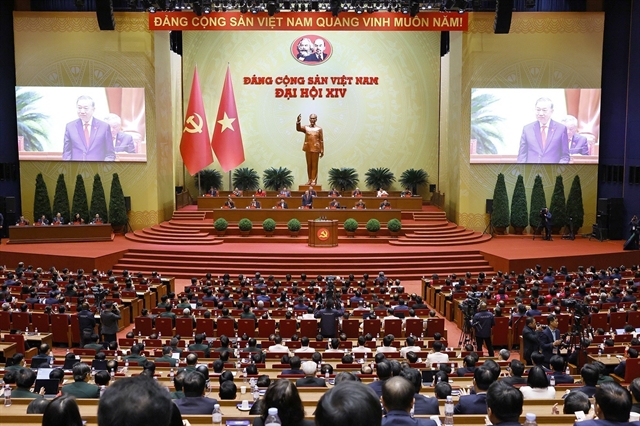 |
| The Communist Party of Việt Nam held its 14th National Congress in Hà Nội from January 19 to 23. — VNA/VNS Photo |
HÀ NỘI — Against the backdrop of four decades of Đổi Mới reforms and mounting global uncertainty, the 14th National Congress of the Communist Party of Việt Nam (CPV) gathered 1,586 delegates in Hà Nội in January to define the country’s political, economic and institutional priorities for the years ahead.
Held once every five years, the Party Congress is Việt Nam’s most important political event. Under the Constitution, the Party is defined as the leading force of the State and society, meaning decisions taken at the Congress shape government policy, legislation and national planning.
The 14th Party Congress took place as Việt Nam marked four decades since the launch of its market-oriented Đổi Mới (Renewal) reforms and looked ahead to two major milestones: the centenary of the Party in 2030 and the 100th anniversary of the founding of modern Việt Nam in 2045.
Against this backdrop, the Congress was described as a historic moment opening a new stage in the country’s development trajectory.
Leadership and targets
The Congress elected a new 200-strong Central Committee, comprising 180 full members and 20 alternates, from a shortlist of 222 candidates.
The delegate profile underscored the Party’s emphasis on education and technocratic capacity. About 23 per cent of delegates (366) held doctoral degrees, more than 59 per cent (939) held master’s degrees and 4.41 per cent (70) were professors or associate professors.
The average age of delegates was 51.8, reflecting a balance between senior leadership experience and younger cadres.
At its first meeting on January 23, the new Central Committee elected a 19-member Politburo, one more than in the previous term, and re-elected incumbent General Secretary Tô Lâm with unanimous support.
The Congress reaffirmed its goal of turning Việt Nam into an upper-middle-income economy with a modern industrial base by 2030 and a high-income developed country by 2045, targets that echo those set in 2021.
For the 2026–2030 period, the Party endorsed an average annual GDP growth rate of at least 10 per cent, compared with about 7 per cent targeted in the 2021–2025 plan. GDP per capita is projected to reach about US$8,500 by 2030.
Other targets for 2030 include raising the share of the digital economy to around 30 per cent of GDP, increasing the contribution of total factor productivity to more than 55 per cent of growth and lifting average labour productivity by about 8.5 per cent a year.
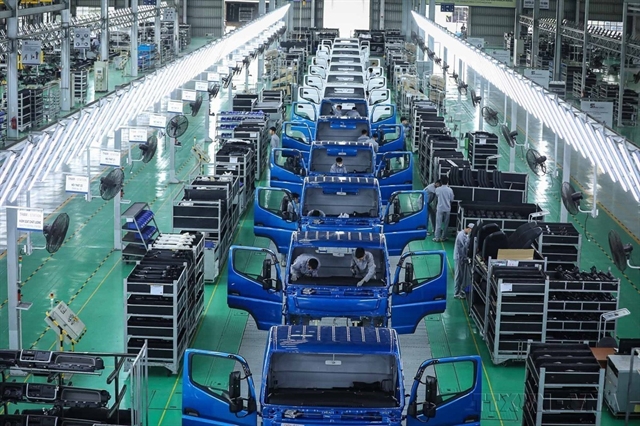 |
| Vehicles on an assembly line at Trường Hải Group. Việt Nam aims for double-digit GDP growth, with manufacturing accounting for 28 per cent of GDP. VNA/VNS Photo |
Manufacturing and processing industries are expected to account for roughly 28 per cent of GDP, while total social investment is projected at around 40 per cent of GDP over the five-year period.
Party documents describe these figures as necessary to keep Việt Nam on track towards its longer-term goals, particularly as global growth slows and competition for investment intensifies.
Who is Tô Lâm?
Tô Lâm, born in 1957 in the northern province of Hưng Yên, was first elected General Secretary in August 2024 by the Party Central Committee, 13th tenure, following the death of his predecessor Nguyễn Phú Trọng.
Before that, he served as Secretary of the Central Public Security Party Committee and Minister of Public Security from 2016 to 2024. In January 2019, he was promoted to the rank of General of the People’s Public Security.
From May 2024 to October 2024, General Lâm served as President of the Socialist Republic of Việt Nam.
Although his initial tenure as the CPV’s General Secretary covered only the final 18 months of the previous Congress term (2021–2026), that period was marked by several major policy and institutional developments.
Under his leadership, the Party sustained its anti-corruption campaign with a stronger emphasis on enforcement and institutional discipline. The period also saw Việt Nam navigate post-pandemic recovery amid supply chain disruptions, extreme weather disasters and external trade pressures, while maintaining macroeconomic stability and growth momentum.
The most far-reaching changes during this period were institutional. Việt Nam moved to a two-tier local government system, merged administrative units to reduce the total number of provinces and centrally run cities to 34 from 64 and reorganised internal structures across Party organisations, ministries and local authorities.
The overhaul marked one of the most substantial administrative restructurings in decades and was carried out under Lâm’s leadership.
At the 14th Party Congress, Lâm was re-elected as General Secretary, with all 180 full members of the new Central Committee voting in favour.
Speaking after the Congress, he affirmed that Việt Nam would need faster and more effective growth in the coming period, arguing that changes to the growth model were required to sustain double-digit expansion.
“Only with double-digit growth can we achieve the targets that have been set,” he said.
He also reiterated Việt Nam’s intention to play a more active role in international cooperation, including peacekeeping, disaster response and mediation efforts.
He said Việt Nam faced many of the same development challenges as other countries and was willing to exchange experience, adding that greater international cooperation through forums such as ASEAN and the UN was increasingly important amid global uncertainty.
Beyond growth
Alongside the growth targets, the 14th Party Congress placed renewed emphasis on social development. Improving living standards and overall quality of life were presented as central policy objectives.
By 2030, Việt Nam aims to raise its Human Development Index to 0.8, increase average life expectancy to 75.5 years and extend healthy life expectancy to at least 68 years.
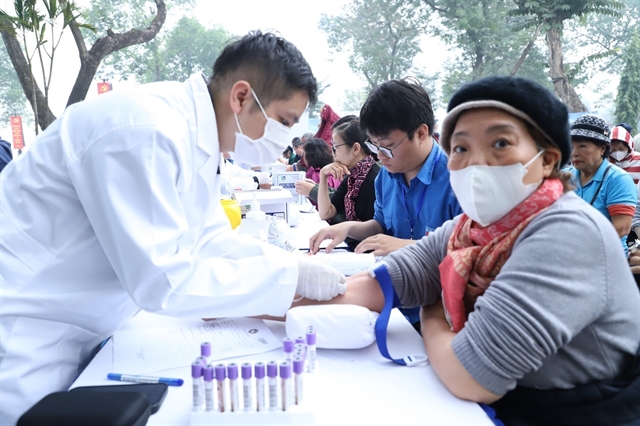 |
| Elderly residents in Hà Nội receive free health check-ups in a community programme. Việt Nam targets an average life expectancy of 75.5 years by 2030. — VNA/VNS Photo |
The poverty rate is targeted to fall by between 1 and 1.5 percentage points a year, continuing a long-standing trend of gradual reduction.
For the first time, the CPV included a national happiness indicator in its congress resolution, aiming to place Việt Nam among the world’s top 40 countries in global happiness rankings.
Official documents frame this move as part of a broader effort to assess development outcomes beyond income alone.
Environmental targets are more clearly specified, including maintaining forest coverage at around 43 per cent, treating and reusing up to 70 per cent of wastewater discharged into major river basins and reducing greenhouse gas emissions by roughly 9 per cent during the next development phase.
Digital transformation features more prominently than in earlier congresses. Technology, innovation and the digital economy are identified as central drivers of growth, alongside green development and circular economy models.
On foreign affairs, the Party Congress reaffirmed Việt Nam’s consistent foreign policy of independence, self-reliance, multilateralisation and diversification of external relations.
A recurring theme in the documents is strategic autonomy, referring to Việt Nam’s capacity to set its own direction amid global uncertainty.
This reflects the country’s effort to balance economic openness with national policy space as global dynamics continue to shift.
From goals to delivery
To translate these goals into outcomes, Việt Nam will concentrate on three closely linked areas during the 2026–2030 period.
The first is institutional reform, aimed at improving regulatory effectiveness and enforcement. The second is human capital, with a target of raising the proportion of workers with formal qualifications or certificates to between 35 and 40 per cent of the workforce.
The third is infrastructure, including transport, energy and digital networks, intended to support industrial upgrading and regional development.
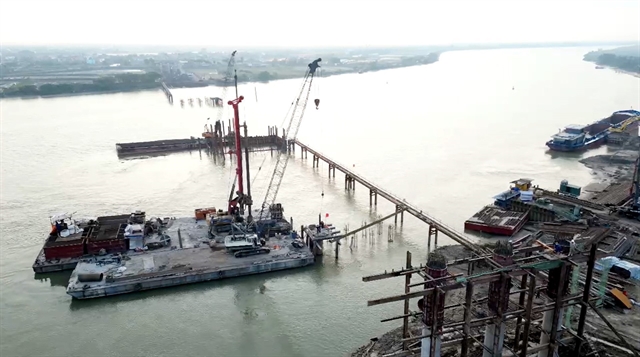 |
| A bridge over the Red River linking Hưng Yên and Ninh Bình under construction. Infrastructure is seen as a key catalyst for meeting growth targets set at the Congress. VNA/VNS — Photo |
Party documents describe these areas as mutually reinforcing: institutional reforms are intended to reduce bottlenecks, skilled labour to raise productivity and modern infrastructure to create space for expansion.
Another notable feature of the 14th Party Congress was its strong focus on execution.
Rather than limiting itself to broad policy statements, the Party integrated a detailed action programme into its main political report, setting out priorities alongside responsibilities, timelines and intended outcomes.
The aim is to narrow the gap between policy decisions and implementation, an issue that has attracted growing attention in national policy debates.
Senior leaders also stressed the importance of measurable results and follow-through, signalling a sharper emphasis on delivery over rhetoric.
What distinguishes the 14th Party Congress from its predecessor is the combination of higher short-term economic targets, more detailed performance indicators and stronger language on implementation.
Together, these elements signal an expectation of faster, more measurable progress over the next five years, as Việt Nam moves decisively towards its 2030 and 2045 milestones in an increasingly complex global landscape. — VNS
Politics & Law
 Politics & Law
 Politics & Law
 Politics & Law
 Politics & Law
 Politics & Law
 Politics & Law
 Politics & Law
 Politics & Law
 Politics & Law
 Politics & Law
 Politics & Law
 Politics & Law
 Politics & Law
 Politics & Law